
Bile Duct Cancer Treatment in Delhi NCR
Bile duct cancer, medically known as cholangiocarcinoma, is a malignant tumour that develops in the bile ducts, thin tubes that carry bile from the liver and gallbladder to the small intestine, and is one of the most complex gastrointestinal cancers to treat.
The bile ducts play a critical role in digestion by transporting bile, which helps break down fats. When bile duct cancer (cholangiocarcinoma) develops, it can block the flow of bile, causing jaundice and other serious symptoms. It is often detected late, but early evaluation by an experienced specialist can significantly improve outcomes.
Types of Bile Duct Cancer
Bile Duct Cancer can be divided into three types based on the location:
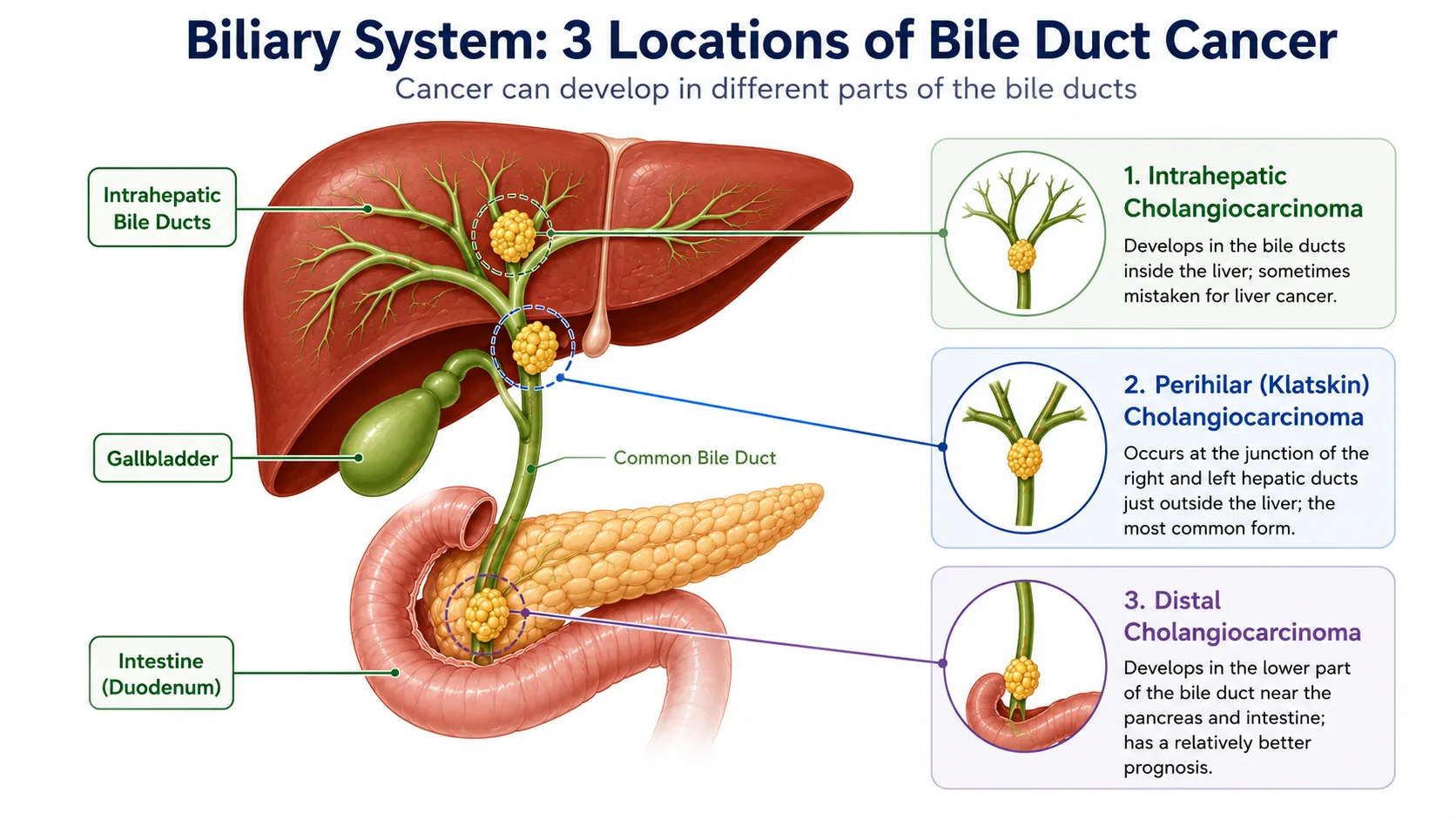
What Causes Bile Duct Cancer?
Bile duct cancer is most commonly linked to chronic inflammation of the bile ducts, liver disease, and certain infections, in India, gallstones and biliary tract infections are among the most frequently identified risk factors.
Common bile duct cancer risk factors and causes include:
- Primary sclerosing cholangitis (PSC), a condition that causes scarring and hardening of the bile ducts, significantly increasing cancer risk
- Bile duct cysts (choledochal cysts), congenital abnormalities present from birth that predispose to cholangiocarcinoma
- Chronic liver disease, cirrhosis, hepatitis B, and hepatitis C infections raise the risk of bile duct cancer
- Gallstones, long-standing stones in the bile ducts cause chronic inflammation and irritation
- Liver fluke infection, parasitic infections (Opisthorchis viverrini) are a known bile duct cancer cause in certain parts of Asia
- Inflammatory bowel disease, particularly ulcerative colitis, often associated with PSC
- Obesity and metabolic syndrome, increasing evidence links these to biliary tract cancers
- Age, most cases occur in people above 65 years, though younger patients can also be affected
Reach Out for Expert Care
Symptoms of Bile Duct Cancer
Bile duct cancer symptoms often appear only after the tumour has blocked the bile duct, jaundice, dark urine, and pale stools are the most recognisable warning signs that should not be ignored.
Because cholangiocarcinoma symptoms develop gradually and resemble other conditions, many patients are diagnosed late. Watch for:
- Jaundice, yellowing of the skin and eyes caused by bile duct blockage
- Dark urine, tea or cola-coloured urine due to excess bilirubin
- Pale or clay-coloured stools
- Intense itching of the skin (pruritus) without a rash
- Upper abdominal pain, particularly in the right side or centre
- Unexplained weight loss
- Loss of appetite and persistent fatigue
- Fever with chills, may indicate infection from bile duct obstruction (cholangitis)
- Nausea and vomiting
If you or a family member is experiencing jaundice along with any of the above bile duct cancer symptoms, seek evaluation from a specialist immediately.
How Is Bile Duct Cancer Diagnosed?
Bile duct cancer is diagnosed using a combination of blood tests, advanced imaging scans, and endoscopic procedures, early and accurate diagnosis is critical to determine whether curative surgery is possible.
Dr. Surender Kumar Dabas, one of the best robotic cancer surgeon in India, follows a structured bile duct cancer diagnosis pathway for every patient:
- Liver function tests (LFTs), elevated bilirubin, ALP, and GGT are common markers
- Tumour markers, CA 19-9 and CEA are elevated in many cholangiocarcinoma cases
- Ultrasound, first-line imaging to detect bile duct dilation or masses
- CT scan with contrast, evaluates tumour size, location, vascular involvement, and lymph node spread
- MRI and MRCP (Magnetic Resonance Cholangiopancreatography), the most detailed imaging for bile duct anatomy and tumour extent
- PET scan, detects distant spread to other organs
- ERCP (Endoscopic Retrograde Cholangiopancreatography), allows direct visualisation, bile duct brushings for biopsy, and stenting to relieve jaundice
- EUS (Endoscopic Ultrasound), evaluates lymph nodes and vascular involvement in detail
- Biopsy, confirms bile duct cancer diagnosis and determines tumour type for treatment planning
Stages of Bile Duct Cancer
Bile duct cancer is staged from Stage I to Stage IV, early stages are localised and potentially curable with surgery, while advanced stages involve spread to nearby organs or distant sites.
| Stage | Description |
| Stage I | Tumour confined to the bile duct wall |
| Stage II | Cancer has grown through the bile duct into surrounding fat or liver tissue |
| Stage III | Cancer has spread to nearby blood vessels, lymph nodes, or adjacent organs |
| Stage IV | Cancer has spread to distant organs such as the lungs, bones, or peritoneum |
Localised bile duct cancer (Stage I and II) can often be treated with curative surgery. Even locally advanced bile duct cancer in Stage III is sometimes resectable with careful surgical planning at a high-volume hepatobiliary centre.
Bile Duct Cancer Treatment Options in Delhi NCR
Surgery is the only potentially curative treatment for bile duct cancer, the type of operation depends on the location of the tumour, and complete tumour removal (R0 resection) is the most critical factor in determining outcome.
Dr. Surender Kumar Dabas, one of the best doctors for bile duct cancer in Delhi NCR, offers a comprehensive range of cholangiocarcinoma treatments tailored to each patient’s tumour location, stage, and health.
- Surgical Resection: The Primary Curative Treatment
- Bile duct excision with hepaticojejunostomy, for perihilar and extrahepatic bile duct cancer; the bile duct is removed and reconstruction is done connecting the liver to the intestine
- Partial hepatectomy (liver resection), for intrahepatic cholangiocarcinoma or perihilar tumours involving the liver; removal of the affected liver segment along with the bile duct
- Whipple procedure (pancreaticoduodenectomy), for distal bile duct cancer near the pancreas; removes the lower bile duct, head of pancreas, duodenum, and gallbladder
- Extended hepatectomy with caudate lobe resection, for complex perihilar tumours; requires advanced hepatobiliary surgical expertise
- The goal in all cases is a margin-negative R0 resection, complete tumour removal is the single most important factor in long-term survival
- Biliary Drainage and Stenting (Relief of Jaundice)
- Many patients with bile duct cancer present with severe jaundice before surgery is planned
- ERCP with biliary stenting or PTBD (Percutaneous Transhepatic Biliary Drainage) is used to relieve jaundice and restore bile flow
- Relieves itching, improves liver function, and prepares patients for surgery or chemotherapy
- Chemotherapy for Bile Duct Cancer
- Adjuvant chemotherapy, given after surgery to reduce recurrence risk; capecitabine is the current standard
- Palliative chemotherapy, for unresectable or metastatic cholangiocarcinoma; gemcitabine with cisplatin is the standard first-line regimen
- Chemotherapy combined with immunotherapy (durvalumab) is now used in advanced cases based on recent global evidence
- Targeted Therapy for Bile Duct Cancer
- Many cholangiocarcinomas carry targetable genetic mutations (FGFR2 fusions, IDH1 mutations, BRAF, HER2)
- Targeted drugs such as pemigatinib (FGFR2), ivosidenib (IDH1), and others offer additional options for patients who progress on chemotherapy
- Molecular profiling (next-generation sequencing) is now recommended for all advanced bile duct cancer patients
- Radiation Therapy
- Used selectively in patients with residual disease after surgery or as part of palliative care
- Stereotactic body radiation therapy (SBRT) is used for localised, inoperable tumours in selected cases
- Palliative and Supportive Care
- For advanced or inoperable bile duct cancer, palliative treatment focuses on relieving jaundice (stenting), pain management, and nutritional support
- Palliative chemotherapy can extend survival and maintain quality of life in suitable patients
Why Choose Dr. Surender Kumar Dabas for Bile Duct Cancer Treatment in Delhi NCR?
Dr. Surender Kumar Dabas is one of the best GI and hepatobiliary cancer surgeons in Delhi NCR with 22+ years of experience, 30,000+ complex cancer surgeries, and specialist expertise in bile duct cancer surgery and hepatobiliary oncology.
- 22+ years of experience in complex GI and hepatobiliary cancer surgery including bile duct cancer, gallbladder cancer, and liver tumours
- 30,000+ complex cancer surgeries performed across gastrointestinal, urological, thoracic, and head and neck cancers
- High-volume hepatobiliary surgeon, performs major bile duct resections, hepatectomy, and Whipple procedures with expertise
- Multidisciplinary treatment planning, works alongside medical oncologists, interventional radiologists, and gastroenterologists to build a personalised cholangiocarcinoma treatment plan for every patient
- Second opinion welcome, patients told their bile duct cancer is inoperable elsewhere are encouraged to seek Dr. Dabas’s evaluation, as resectability assessment requires specialist HPB expertise
- Clear, compassionate communication, explains bile duct cancer diagnosis, surgical options, and what to expect in plain language so patients and families feel informed and supported
- Patients from across India travel to consult Dr. Dabas for complex and locally advanced cholangiocarcinoma cases
- Best robotic cancer surgeon in Delhi NCR, uses advanced minimally invasive techniques wherever applicable in HPB cancer surgery
Cost of Bile Duct Cancer Treatment in Delhi NCR
The cost of bile duct cancer treatment in Delhi NCR varies depending on:
- Tumour location and stage: intrahepatic, perihilar, or distal cholangiocarcinoma require different surgical approaches
- Type of surgery: bile duct excision, hepatectomy, or Whipple procedure
- Need for biliary drainage or stenting before surgery
- Chemotherapy, targeted therapy, or immunotherapy requirements
- Duration of hospital stay and post-operative recovery
For a personalised cost estimate based on your imaging and reports, book a consultation with Dr. Surender Kumar Dabas, one of the best bile duct cancer doctor in Delhi.
If you or a family member has been diagnosed with bile duct cancer (cholangiocarcinoma) or is experiencing jaundice and related bile duct cancer symptoms, early specialist evaluation from one of the best surgical oncologist is the most important step.

Dr. Surender Dabas' Medical Content Team
Dr. Surender Dabas' Medical Content Team is committed to providing accurate, reliable, and easy-to-understand information on cancer care. Working closely with oncology experts, the team ensures that every article is medically reviewed, up-to-date, and designed to help patients and their families better understand cancer, treatment options, and recovery.


 WhatsApp