
Lung Cancer Treatment in Delhi NCR
Lung cancer begins when cells in the lungs start dividing abnormally and grow out of control. Most lung cancers originate in the cells lining the airways, the bronchi and bronchioles, that carry air in and out of the lungs.
It is one of the most commonly diagnosed cancers in the world and remains the leading cause of cancer-related deaths globally. In India, lung cancer rates have been climbing steadily, with a significant proportion of cases coming from urban regions including Delhi, Gurgaon, Faridabad, and the wider NCR area, where air pollution adds to the already substantial risk from tobacco use.
What makes lung cancer particularly challenging is that it frequently produces no symptoms in its early stages. By the time most patients notice something is wrong, the disease has already progressed. This makes awareness of risk factors and early diagnostic testing especially important.
The other side of that picture is that treatment has improved significantly over the past decade. Robotic surgery, targeted therapies, and immunotherapy have expanded what is possible, even for patients diagnosed at an advanced stage.
Types of Lung Cancer
Lung cancer is broadly divided into two categories, and the distinction matters, they behave differently, spread differently, and are treated differently.
Non-Small Cell Lung Cancer (NSCLC)
NSCLC is the most common type, accounting for approximately 85% of all lung cancer cases. It tends to grow more slowly than small cell lung cancer, which gives more time for surgical intervention in early and locally advanced stages.
NSCLC has three main subtypes:
- Adenocarcinoma is the most prevalent subtype of NSCLC and the most common lung cancer overall. It typically develops in the outer regions of the lungs and is the type most often seen in non-smokers, younger patients, and women. It is also the subtype most likely to harbour targetable genetic mutations like EGFR, ALK, and ROS1.
- Squamous Cell Carcinoma usually arises in the cells lining the central airways, close to the bronchi. It is strongly linked to smoking and tends to stay localised longer before spreading, which can sometimes make it more amenable to surgery.
- Large Cell Carcinoma is a less common subtype that can develop in any part of the lung. It tends to grow and spread quickly and does not fit the specific patterns of adenocarcinoma or squamous cell carcinoma under the microscope.
Small Cell Lung Cancer (SCLC)
SCLC accounts for roughly 15% of lung cancer cases but behaves very differently from NSCLC. It grows rapidly and spreads to other parts of the body early, often before symptoms appear. It is almost exclusively associated with heavy smoking. Because of how quickly it spreads, SCLC is less often treated with surgery and is primarily managed with chemotherapy and radiation.
Risk Factors for Lung Cancer
Risk factors for lung cancer includes:
- Smoking is the single largest risk factor for lung cancer. Cigarettes, cigars, and pipes all carry significant risk. The longer a person has smoked and the more they smoke each day, the higher the risk. Even after quitting, risk remains elevated for years, though it does decrease over time.
- Secondhand smoke is a well-established risk factor. People who live or work around regular smokers have a meaningfully higher risk of developing lung cancer than those who are not exposed.
- Air pollution is a growing concern, particularly in cities like Delhi, Gurgaon, and Faridabad, where particulate matter levels regularly exceed safe limits. Long-term exposure to polluted air is now recognised as a significant contributor to lung cancer in non-smokers.
- Radon gas is a naturally occurring radioactive gas that seeps from soil and rock into buildings. It is the second leading cause of lung cancer globally after smoking and often goes undetected in homes.
- Occupational exposures including asbestos, arsenic, chromium, and diesel exhaust increase lung cancer risk, particularly in people who also smoke.
- Family history of lung cancer raises individual risk, suggesting a genetic component in some cases.
- Previous lung disease such as chronic obstructive pulmonary disease (COPD) or pulmonary fibrosis also increases susceptibility.
Reach Out for Expert Care
Symptoms of Lung Cancer
Lung cancer often has no symptoms at all in its early stages. When symptoms do appear, they are easy to attribute to other causes, a persistent cough dismissed as a smoker’s cough, or breathlessness blamed on age or fitness. This is part of why so many cases are diagnosed late.
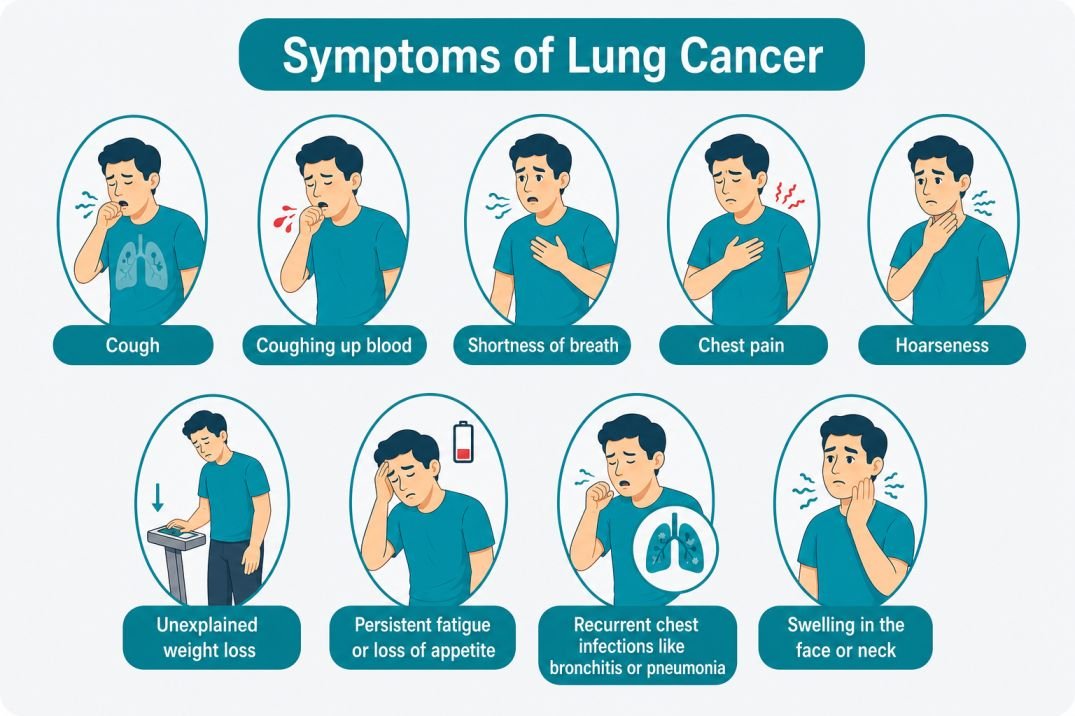
Symptoms to take seriously include:
- A cough that is new, persistent, or has changed in character
- Coughing up blood or rust-coloured mucus
- Shortness of breath during activities that were previously manageable
- Chest pain that is constant or worsens with deep breathing or coughing
- Hoarseness or a significant change in voice
- Unexplained weight loss
- Persistent fatigue or loss of appetite
- Recurrent chest infections like bronchitis or pneumonia
- Swelling in the face or neck (which can indicate that the tumour is pressing on a major vein)
If you are a smoker or a former smoker over the age of 45, and you develop any of the above symptoms, do not wait. See a specialist. For high-risk individuals, annual low-dose CT screening is now recommended even without symptoms.
How Is Lung Cancer Diagnosed?
Diagnosing lung cancer involves a combination of imaging, tissue sampling, and molecular testing. Getting all of this right before treatment begins is critical, the type, stage, and molecular profile of the cancer all directly shape the treatment plan.
- Chest X-ray is often the first investigation when a patient presents with respiratory symptoms. It can reveal a mass or abnormal shadow but is not sufficient on its own to confirm or characterise lung cancer.
- CT Scan of the Chest provides a detailed cross-sectional view of the lungs, mediastinum, and nearby lymph nodes. It is the standard investigation for evaluating a suspected lung tumour, its size, location, and relationship to surrounding structures.
- PET-CT Scan combines metabolic imaging with anatomical detail. Cancer cells consume glucose at a higher rate than normal cells, which makes them visible on a PET scan. A PET-CT is used for staging, to determine whether the cancer has spread to lymph nodes or distant organs.
- Bronchoscopy involves passing a thin, flexible camera into the airways. It can directly visualise tumours in the central airways and allows tissue samples to be taken from accessible lesions.
- CT-guided Biopsy is used for tumours in the outer parts of the lung that cannot be reached by bronchoscopy. A needle is inserted through the chest wall under CT guidance to obtain a tissue sample.
- Endobronchial Ultrasound (EBUS) is a minimally invasive technique used to biopsy lymph nodes in the mediastinum, the space between the lungs, without surgery. It is particularly useful for staging NSCLC.
- Molecular and Genetic Testing of the tumour tissue is now standard for all non-small cell lung cancers. Tests look for specific mutations, EGFR, ALK, ROS1, KRAS, BRAF, MET, and others, that determine whether targeted therapies are likely to work. PD-L1 testing is also done to assess suitability for immunotherapy.
Stages of Lung Cancer
Staging determines how far the cancer has spread and guides treatment decisions.
Stage I – The cancer is confined to the lung and has not spread to lymph nodes or other organs. Surgery is the primary treatment and outcomes are good, with 5-year survival rates of 70–90% for Stage IA.
Stage II – The cancer has spread to nearby lymph nodes within the chest or has grown into the chest wall or major bronchus. Surgery remains the preferred treatment, often followed by chemotherapy.
Stage III – The cancer has spread to lymph nodes in the mediastinum or to nearby structures. Stage IIIA may still be operable in some patients. Stage IIIB and IIIC are usually treated with a combination of chemotherapy and radiation, sometimes followed by immunotherapy.
Stage IV – The cancer has spread to the other lung, the fluid around the lungs or heart, or to distant organs such as the brain, bones, liver, or adrenal glands. Stage IV is treated with systemic therapy, targeted drugs, immunotherapy, or chemotherapy, depending on the molecular profile of the tumour. Palliative surgery or radiation may also be used to control symptoms.
Small cell lung cancer uses a simpler two-stage system: Limited stage (confined to one side of the chest) and Extensive stage (spread beyond the chest). Most SCLC patients are diagnosed at the extensive stage.
Treatment Options for Lung Cancer
Surgery
Surgery offers the best chance of cure for early-stage non-small cell lung cancer. The goal is to remove the tumour with a clear margin of healthy tissue while preserving as much lung function as possible.
- Lobectomy removes one lobe of the lung and is the standard operation for most early-stage NSCLC. The lung has five lobes in total, three on the right, two on the left, and most people function well with one lobe removed.
- Segmentectomy or Wedge Resection removes a smaller section of the lung rather than an entire lobe. This is considered for patients with small tumours, those with limited lung function, or older patients who may not tolerate a full lobectomy.
- Pneumonectomy removes an entire lung. This is reserved for tumours that cannot be removed by lobectomy alone. It carries a higher risk and requires thorough preoperative assessment of lung function.
- Mediastinal Lymph Node Dissection is performed alongside lung resection to remove lymph nodes in the chest that may harbour cancer cells, ensuring accurate staging and reducing the risk of recurrence.
Robotic Thoracic Surgery for Lung Cancer
Robotic surgery has transformed how lung cancer operations are performed. Where traditional open surgery required a large incision between the ribs, often painful and requiring weeks of recovery, robotic thoracic surgery is performed through small keyhole incisions using a robotic surgical system that the surgeon controls from a console.
The robotic platform provides a magnified, high-definition three-dimensional view inside the chest and allows for precise, finely controlled movements that are difficult to replicate in open surgery. For the patient, this translates into significantly less pain after surgery, a shorter hospital stay, lower risk of complications, and faster return to normal activity.
Dr. Surender Kumar Dabas, one of the best robotic cancer surgeons in India and a recognised cancer doctor in Delhi NCR, performs robotic thoracic surgery for lung cancer at Manipal Comprehensive Cancer Centre. With over 5,000 robotic procedures to his name, Dr. Dabas brings a depth of experience in robotic cancer surgery that very few surgeons in India can match. Patients from Faridabad, Gurgaon, Delhi, and across North India seek him out specifically for robotic cancer surgery in Delhi NCR.
Radiation Therapy
Radiation therapy uses high-energy beams to damage and destroy cancer cells. In lung cancer, it is used in several different contexts.
- Stereotactic Body Radiotherapy (SBRT), also called SABR, delivers very high, precisely targeted doses of radiation to small, early-stage lung tumours over a small number of sessions. It is an option for patients who have early-stage lung cancer but are not fit for surgery due to other health conditions.
- Concurrent Chemoradiation is the standard treatment for Stage III NSCLC that cannot be surgically removed. Chemotherapy and radiation are given together to improve tumour control.
- Palliative Radiation is used in advanced disease to relieve symptoms, controlling bleeding, reducing pain from bone metastases, or treating brain metastases.
Chemotherapy
Chemotherapy uses drugs that kill rapidly dividing cells, including cancer cells. In lung cancer, it is used as the primary treatment for SCLC, as adjuvant therapy after surgery in NSCLC to reduce recurrence risk, in combination with radiation for Stage III disease, and as systemic treatment in Stage IV NSCLC when targeted therapy or immunotherapy are not suitable.
The most commonly used regimens for NSCLC are platinum-based combinations, carboplatin or cisplatin paired with drugs like paclitaxel, pemetrexed, or gemcitabine.
Targeted Therapy
Targeted therapy has changed the treatment landscape for NSCLC significantly over the past decade. These drugs block specific molecular pathways that drive cancer cell growth and survival.
- EGFR inhibitors (osimertinib, gefitinib, erlotinib) for tumours with EGFR mutations
- ALK inhibitors (alectinib, crizotinib, lorlatinib) for ALK-rearranged tumours
- ROS1 inhibitors for ROS1-rearranged tumours
- KRAS G12C inhibitors (sotorasib) for KRAS-mutated tumours
- MET inhibitors for MET exon 14-skipping mutations
- BRAF/MEK inhibitors for BRAF V600E mutations
Targeted therapy is taken as a daily oral tablet in most cases and is generally better tolerated than chemotherapy. It works best in patients whose tumour carries the specific mutation the drug targets, which is why molecular testing at diagnosis is so important.
Immunotherapy
Immunotherapy works by releasing the brakes on the immune system, allowing it to recognise and attack cancer cells more effectively. In lung cancer, the main class of immunotherapy drugs is checkpoint inhibitors, specifically PD-1 and PD-L1 inhibitors like pembrolizumab, nivolumab, and atezolizumab.
Immunotherapy is now used across multiple stages and settings of lung cancer, as a single agent for high PD-L1 expressing Stage IV NSCLC, in combination with chemotherapy, and as maintenance therapy after chemoradiation in Stage III disease. It has significantly improved survival in a subset of lung cancer patients who respond to it.
Cost of Lung Cancer Treatment in Delhi NCR
The cost of lung cancer treatment in Delhi NCR is between ₹4,00,000 to ₹15,00,000, depending on the stage of the disease, type of treatment, and whether robotic or open surgical techniques are used. For a personalised cost estimate based on your specific diagnosis and treatment plan, it is best to contact Dr Surender Dabas’s team directly.
Life After Lung Cancer Treatment
Recovery after lung cancer surgery depends on the type of operation, the patient’s lung function before surgery, and overall health. Most patients who undergo lobectomy through a robotic approach are discharged within 3–5 days and return to their normal routine within 4–6 weeks.
Long-term follow-up after treatment typically includes:
- CT scans of the chest every 6–12 months for the first few years
- Regular clinical review to assess symptoms and lung function
- Monitoring for recurrence or new primary tumours
- Continued smoking cessation support if applicable
- Management of any treatment-related side effects
For patients on targeted therapy or immunotherapy, follow-up also involves monitoring for drug-related side effects and periodic imaging to assess treatment response.
Why Surgeon and Centre Selection Matters?
Lung cancer surgery is technically demanding. Operating inside the chest, near the heart, major blood vessels, and both lungs, requires not just surgical skill but specialised training in thoracic oncology and, for robotic cases, substantial robotic surgery experience.
Outcomes for lung cancer surgery are directly linked to the volume of cases a surgeon and centre handle. Higher-volume centres consistently show lower complication rates, shorter hospital stays, and better long-term survival figures.
Dr. Surender Kumar Dabas is among the best surgical oncologists in India with a specific focus on thoracic cancers including lung cancer. Operating at Manipal Comprehensive Cancer Centre, he brings over 30,000 cancer surgeries and 5,000+ robotic procedures to each case. Patients consult him as a lung cancer doctor in Delhi for both surgical opinions and robotic surgery. If you are looking for the best robotic surgeon in Gurgaon for lung cancer, his practice is one of the most experienced in North India.
Conclusion
A lung cancer diagnosis is serious, but it is not the end of the conversation. Treatment options have expanded significantly, surgery is less invasive than it has ever been, and targeted therapies have transformed outcomes for patients with specific tumour profiles. What has not changed is the importance of getting to the right specialist quickly. Whether you are looking for a lung cancer doctor in Delhi, a surgical oncologist in Delhi, or a second opinion before deciding on treatment, early expert evaluation is the most important step you can take. Dr. Surender Kumar Dabas at Manipal Comprehensive Cancer Centre brings decades of experience in thoracic oncology and robotic cancer surgery in Delhi NCR to every patient he sees, from straightforward early-stage resections to complex, multi-modality cases. If you or someone in your family has been diagnosed with lung cancer, do not delay getting a specialist opinion.
Frequently Asked Questions
Can non-smokers get lung cancer? expand_more
Yes. While smoking remains the biggest risk factor, a significant and growing proportion of lung cancer cases, particularly adenocarcinoma, occur in people who have never smoked. Air pollution, radon exposure, and genetic factors all contribute.
What is robotic surgery for lung cancer? expand_more
Robotic thoracic surgery uses a robot-assisted platform to perform lung operations through small keyhole incisions rather than a large open chest cut. It offers the same cancer control as open surgery with less pain, shorter recovery, and fewer complications.
Where can I get robotic lung cancer surgery in Delhi NCR? expand_more
Patients from Delhi NCR can consult Dr. Surender Kumar Dabas, a leading robotic cancer surgeon in Delhi. For Consultations - Call 8796173403.
Where can I get robotic lung cancer surgery in Gurgaon? expand_more
Patients from Gurgaon can consult Dr. Surender Kumar Dabas, a leading robotic cancer surgeon in Gurgaon. For Consultations - Call 8796173403.

Dr. Surender Dabas' Medical Content Team
Dr. Surender Dabas' Medical Content Team is committed to providing accurate, reliable, and easy-to-understand information on cancer care. Working closely with oncology experts, the team ensures that every article is medically reviewed, up-to-date, and designed to help patients and their families better understand cancer, treatment options, and recovery.

 WhatsApp