
Cervical Cancer Treatment in Delhi NCR
Cervical cancer is one of the most common cancers among women in India and a leading cause of cancer-related deaths. However, it is also one of the most preventable and treatable cancers when detected early through regular screening and HPV testing.
Advances in diagnosis, robotic surgery, radiation therapy, chemotherapy, and targeted treatments have significantly improved outcomes for women seeking cervical cancer treatment in Delhi NCR.
Patients from Delhi, Gurgaon, Faridabad, Karnal, and across North India consult Dr. Surender Kumar Dabas, one of the best robotic cancer surgeons in India, for advanced cervical cancer treatment, robotic gynaecologic cancer surgery, and comprehensive cancer care at Manipal Comprehensive Cancer Centre.
What Is Cervical Cancer?
Cervical cancer develops in the cervix, the lower part of the uterus that connects the womb to the vagina. Most cases are caused by persistent infection with high-risk types of the Human Papillomavirus (HPV).
The disease usually develops slowly over several years, often progressing from precancerous changes that can be detected through Pap smears and HPV screening. Early detection plays a crucial role in successful cervical cancer treatment and long-term survival.
What Causes Cervical Cancer?
Nearly 99% of cervical cancer cases are caused by persistent infection with high-risk strains of the Human Papillomavirus (HPV), a common virus transmitted through sexual contact. HPV infection itself is very common. Most sexually active women acquire HPV at some point in their lives. In about 80% of cases, the body clears the virus on its own within two years, with no lasting effect.
In the remaining 20%, the virus persists in the cervical cells. Over time, this persistent infection causes changes in the cells, first precancerous abnormalities, and eventually invasive cancer. The progression from initial HPV infection to detectable precancerous changes to cancer typically takes between 10 and 30 years. This is precisely why screening works so well; there is a very long period during which the disease can be caught and stopped before it becomes cancer at all.
Reach Out for Expert Care
Symptoms of Cervical Cancer
Early cervical cancer often causes no symptoms at all, which reinforces why screening matters so much. By the time symptoms appear, the cancer has usually progressed beyond the earliest, most treatable stages.
Symptoms to watch for include:
- Vaginal bleeding that is irregular, between periods, after sexual intercourse, or after menopause
- Heavier or longer periods than usual
- Foul-smelling vaginal discharge
- Pelvic pain or pain during sexual intercourse
- Back pain or lower limb swelling in more advanced disease
- Bladder or rectal symptoms, difficulty urinating, blood in urine, or rectal bleeding, in advanced cases
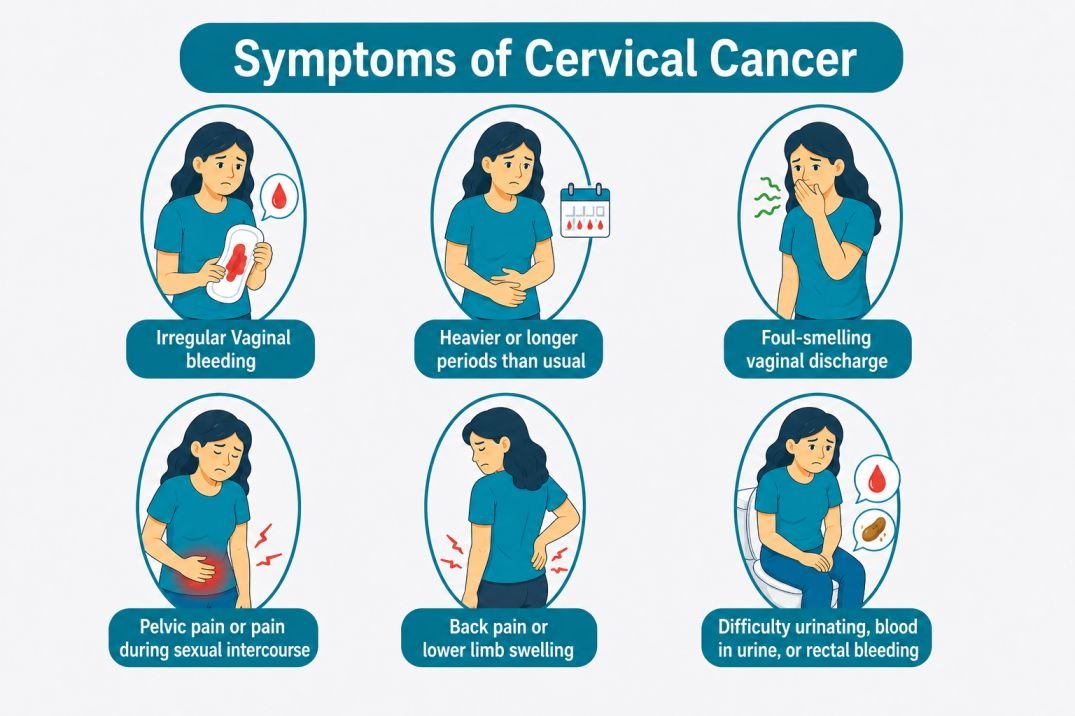
Any of these symptoms in a woman of reproductive age or postmenopause should prompt a medical evaluation. Most of these symptoms have common, benign causes, but cervical cancer needs to be excluded, particularly in women who are not up to date with screening.
Risk Factors for Cervical Cancer
HPV infection is the underlying cause in almost all cases, but several factors increase the likelihood of acquiring HPV, developing a persistent infection, or progressing from infection to cancer:
- Early age at first sexual intercourse
- Multiple sexual partners
- Multiple pregnancies
- Low socioeconomic status and poor genital hygiene
- Malnutrition
- History of smoking, smoking impairs the immune system’s ability to clear HPV
- Immunocompromised state, including HIV/AIDS infection
- History of other sexually transmitted diseases (STDs)
- Lack of regular screening
Women with several of these risk factors should be particularly vigilant about regular cervical screening, even if they feel well.
Screening for Cervical Cancer
Screening is one of the most effective tools in cancer medicine because cervical cancer develops slowly and predictably from a viral infection through precancerous stages. Identifying and treating precancerous changes before they become cancer means that cervical cancer is, in a real sense, a preventable disease for women who are regularly screened.
Pap Smear (Pap Test)
The Pap smear is the most widely used screening test for cervical cancer. During the test, a gynaecologist uses a small spatula and brush to collect cells from the cervix. These cells are smeared onto a glass slide and examined under a microscope by a pathologist for HPV-related abnormalities.
Every married woman should have a Pap smear every three years, starting from the age of 21 and continuing until the age of 65. The test is painless, non-invasive, and can be done during a routine gynaecological check-up.
HPV DNA Test
The HPV DNA test uses a small brush to collect cervical cells, which are then tested for the genetic material of high-risk HPV strains. When the HPV DNA test is done alongside a Pap smear, called a co-test, a normal result on both tests means the next screening can be safely delayed to five years rather than three.
HPV DNA testing is not recommended for women under 30. In younger women, HPV infections are common and usually clear on their own; testing for HPV at this age leads to unnecessary anxiety and follow-up investigations without meaningfully changing outcomes.
HPV Vaccination
HPV vaccines protect against the high-risk strains most responsible for cervical cancer, particularly HPV 16 and 18, which together account for more than 70% of cervical cancer cases. The vaccine is most effective when given before the onset of sexual activity, ideally to girls between the ages of 9 and 15. It can also be given up to the age of 45, though its effectiveness is lower in older women.
One important point: HPV vaccination does not replace the need for cervical screening. Vaccinated women should follow the same screening schedule as unvaccinated women. The vaccine protects against the most common strains but not all high-risk HPV types.
How Is Cervical Cancer Diagnosed?
Cervical cancer diagnosis involves a combination of clinical examination, biopsy, and advanced imaging tests. These investigations help confirm the presence of cancer, determine its stage, and guide the most effective cervical cancer treatment plan.
- Clinical Examination and Cervical Biopsy: A gynaecologist examining the cervix can often see suspicious changes directly. A biopsy, removing a small piece of cervical tissue, confirms whether cancer is present and what type it is.
- Colposcopy: If a Pap smear shows abnormal cells but no obvious lesion is visible, a colposcopy is performed. This involves examining the cervix under magnification using a special instrument called a colposcope. Targeted biopsies can be taken from abnormal-looking areas.
- MRI of the Pelvis: Once cervical cancer is confirmed, MRI provides detailed information about the size of the tumour, how far it has grown into surrounding tissues, and whether it has spread to nearby structures like the bladder or rectum. MRI is the most important imaging test for local staging of cervical cancer.
- CT Scan of the Chest, Abdomen, and Pelvis: Used to assess lymph node involvement and detect spread to distant organs.
- PET-CT Scan: Provides a whole-body view of cancer activity and is particularly useful for detecting spread to lymph nodes and distant sites that may not be visible on CT or MRI alone.
Stages of Cervical Cancer
Cervical cancer is staged from Stage I to Stage IV based on the size of the tumour and how far it has spread. Staging plays a crucial role in determining the most appropriate cervical cancer treatment and prognosis.
- Stage I: Cancer is confined to the cervix. Treatment is usually surgery, and cure rates are high.
- Stage II: Cancer has spread beyond the cervix but not to the pelvic wall or distant organs. Treatment may involve surgery or chemoradiation.
- Stage III: Cancer has spread to nearby pelvic structures and/or lymph nodes. Chemoradiation is the standard treatment.
- Stage IV: Cancer has spread to the bladder, rectum, or distant organs. Treatment may include chemotherapy, radiation therapy, targeted therapy, and immunotherapy.
Treatment Options for Cervical Cancer in Delhi NCR
Cervical cancer treatment depends on the stage of the cancer, the patient’s age, overall health, and whether preserving fertility is a consideration.
Surgery
Surgery is the primary treatment for early-stage cervical cancer. The goal is complete removal of the tumour with clear margins.
- Cone Biopsy (Conisation) removes a cone-shaped piece of the cervix containing the abnormal tissue. It is used for very early cancers (Stage IA1) and for women who wish to preserve their fertility.
- Simple Hysterectomy removes the uterus and cervix and is used for Stage IA1 disease in women who do not need to preserve fertility.
- Radical Hysterectomy removes the uterus, cervix, upper vagina, and the tissue surrounding the cervix (parametrium), along with pelvic lymph nodes. This is the standard surgical treatment for Stage IB and early Stage II cervical cancer. It is a more extensive operation than a simple hysterectomy and requires a skilled gynaecological oncologist.
- Pelvic Lymph Node Dissection is performed alongside radical hysterectomy to remove and examine lymph nodes in the pelvis for cancer involvement.
- Trachelectomy is an option for young women with early-stage cervical cancer who wish to maintain the possibility of future pregnancy.
Robotic Surgery for Cervical Cancer
Robotic surgery has changed the way radical hysterectomy is performed for cervical cancer. Where traditional open surgery requires a large abdominal incision and a hospital stay of several days, robotic radical hysterectomy is performed through small keyhole incisions using a robotic surgical system controlled by the surgeon.
The robotic platform provides a magnified, high-definition, three-dimensional view of the pelvis, which is particularly important in this region, where the ureters, bladder, and major blood vessels run in close proximity to the cervix. The precision and control offered by the robotic system reduce the risk of injury to these structures and enable more complete removal of the parametrium and lymph nodes.
For patients, the benefits are real, less blood loss, significantly less postoperative pain, shorter hospital stay, and a faster return to normal activity compared to open surgery.
Dr. Surender Kumar Dabas is one of the best robotic cancer surgeons in Gurgaon and a highly experienced gynaecological oncologist in Delhi NCR. He has developed a novel technique for robotic surgery of the neck and applies the same level of robotic surgical expertise to gynaecological cancer operations. He performs robotic radical hysterectomy and robotic pelvic lymph node dissection at Manipal Comprehensive Cancer Centre. Patients from Faridabad, Kanpur, Muzaffarnagar, and across Delhi NCR consult him as one of the best cervical cancer surgeons in Delhi for both primary surgical treatment and second opinions.
Other Therapies
- Radiation Therapy and Chemoradiation: For locally advanced cervical cancer, Stage IIB and above, the standard treatment is concurrent chemoradiation: radiation therapy combined with chemotherapy given at the same time. The chemotherapy (typically weekly cisplatin) acts as a radiosensitiser, making the cancer cells more vulnerable to radiation.
- External Beam Radiation Therapy (EBRT) delivers radiation to the pelvis from outside the body over a course of 25-28 sessions.
- Brachytherapy is a form of internal radiation where a radioactive source is placed directly inside or near the cervix. It delivers a high dose of radiation precisely to the tumour while sparing surrounding tissues. Brachytherapy is an essential component of curative-intent radiotherapy for cervical cancer and is given after the external beam course.
- Chemotherapy: Chemotherapy is used alongside radiation for locally advanced cervical cancer, and as the primary treatment for Stage IVB disease or recurrent cancer. Commonly used regimens include cisplatin-based combinations, carboplatin-paclitaxel, and, more recently, bevacizumab, a targeted therapy that inhibits tumour blood vessel growth, added to chemotherapy for metastatic disease.
- Targeted Therapy and Immunotherapy: Bevacizumab is currently approved for use in recurrent or metastatic cervical cancer in combination with chemotherapy. It works by blocking the growth of new blood vessels that tumours need to grow. Pembrolizumab, an immunotherapy checkpoint inhibitor, is approved for PD-L1 positive recurrent or metastatic cervical cancer and has shown meaningful improvements in survival in this group. Immunotherapy in combination with chemotherapy is increasingly becoming a standard option for advanced cervical cancer.
Cervical Cancer Treatment Cost in Delhi NCR
The cost of cervical cancer treatment in Delhi NCR starts from ₹1,20,000, depending on the stage, the type of surgery, robotic or open, and whether radiation, chemotherapy, or immunotherapy are part of the treatment plan. For a personalised estimate based on your specific diagnosis, contact us directly for a consultation.
Recovery After Cervical Cancer Treatment
Most women treated for early-stage cervical cancer recover well and return to their normal lives. Follow-up care after treatment includes:
- Pelvic examination every 3-6 months for the first two years, then annually
- Vault smear (if the uterus has been removed) at regular intervals
- CT or PET-CT imaging if recurrence is suspected
- Monitoring for treatment-related effects, urinary symptoms, bowel changes, or lymphoedema in the lower limbs
- Psychological support, particularly for younger women dealing with changes to fertility or sexual health
Women who have been treated with radiation may experience long-term effects on bladder and bowel function. These are manageable in most cases and should be discussed openly with the treating team.
Why Choosing the Right Surgeon Matters?
Radical hysterectomy for cervical cancer is a complex pelvic operation. The proximity of the ureters, bladder, and major blood vessels to the surgical field means that experience and precision directly affect outcomes, both in terms of cancer control and in avoiding complications.
Robotic radical hysterectomy specifically requires a surgeon with substantial experience in robotic gynaecological surgery. Not all centres offer this, and not all surgeons performing robotic surgery do it in sufficient volume to achieve the best outcomes.
Dr. Surender Kumar Dabas is one of the best surgical oncologists in India with specific expertise in robotic gynaecological cancer surgery. Operating at Manipal Comprehensive Cancer Centre, he brings over 30,000 cancer surgeries and 5,000+ robotic procedures to each case. He is actively involved in training surgeons across India in robotic techniques. Women from Faridabad, Kanpur, Muzaffarnagar, and across Delhi NCR seek him out as a gynae oncologist in Delhi for cervical cancer surgery, second opinions, and robotic surgical options.
Conclusion
Cervical cancer is one of the few cancers where a clear line runs from prevention through early detection to cure. Screening works. Vaccination works. And when cancer does develop, treatment, particularly in the hands of an experienced surgical oncologist, delivers very good outcomes in early-stage disease. The challenge in India remains awareness and access. Too many women present late, having never been screened, by which point treatment is more complex and outcomes less certain.
If you are looking for the best gynecologic oncologist in Delhi, a surgical oncologist in Delhi NCR, the best robotic cancer surgeon in Delhi NCR, or simply a second opinion before deciding on treatment, Dr. Surender Kumar Dabas at Manipal Comprehensive Cancer Centre sees patients from across North India, from Faridabad, Kanpur, and Muzaffarnagar to every corner of Delhi NCR. Do not wait for symptoms to appear. Screening is painless, takes minutes, and can change everything.

Dr. Surender Dabas' Medical Content Team
Dr. Surender Dabas' Medical Content Team is committed to providing accurate, reliable, and easy-to-understand information on cancer care. Working closely with oncology experts, the team ensures that every article is medically reviewed, up-to-date, and designed to help patients and their families better understand cancer, treatment options, and recovery.

 WhatsApp