
Ovarian Cancer Treatment in Delhi NCR
Ovarian cancer develops when cells in the ovaries start growing abnormally, it is often called a “silent cancer” because early symptoms are easy to miss, and most cases in India are caught at an advanced stage.
The ovaries are two small organs in a woman’s lower abdomen that produce eggs and hormones. When cancer grows here, it can spread quietly before causing noticeable symptoms.
The most common types are:
- Epithelial ovarian cancer – the most common type; starts on the outer surface of the ovary
- Germ cell tumours – more common in younger women; generally have better outcomes
- Stromal tumours – rare; often detected earlier because they affect hormone levels
- Fallopian tube and peritoneal cancer – closely related to ovarian cancer and treated the same way
What Causes Ovarian Cancer?
Ovarian cancer is most commonly linked to inherited gene mutations (BRCA1 and BRCA2), family history, and hormonal factors, unlike many cancers, it is not strongly tied to lifestyle habits.
Key risk factors to know:
- BRCA1 or BRCA2 gene mutation – the biggest known risk factor; women with BRCA1 have up to a 70% lifetime risk
- Family history – ovarian, breast, or colorectal cancer in close relatives raises your risk
- Age – most cases occur in women above 50, especially after menopause
- Endometriosis – a condition where uterine tissue grows outside the uterus; linked to certain ovarian cancers
- Never having been pregnant – slightly increases risk
- Obesity – linked to higher risk and poorer treatment outcomes
- Long-term hormone replacement therapy (HRT) – oestrogen-only HRT after menopause may raise risk
Symptoms of Ovarian Cancer
The most common early symptoms of ovarian cancer are persistent bloating, pelvic pain, difficulty eating, and frequent urination, these are easy to mistake for stomach or digestive problems, which is why many women are diagnosed late.
See a doctor if you regularly experience any of these, especially if they are new and occur more than 12 times a month:
- Bloating or a swollen abdomen that does not go away
- Pelvic or lower abdominal pain, different from normal period cramps
- Feeling full very quickly even after eating small amounts
- Needing to urinate frequently without a UTI
- Unexplained weight changes
- Changes in bowel habits, constipation or loose stools without reason
- Abnormal vaginal bleeding, especially after menopause
- Persistent tiredness or back pain
- A lump or heaviness felt in the lower abdomen
Do not wait. These symptoms individually are common, but together and persistently, they need evaluation.
Reach Out for Expert Care
How Is Ovarian Cancer Diagnosed?
Ovarian cancer is diagnosed through a CA-125 blood test, ultrasound, and CT or MRI scan, a definitive diagnosis is usually confirmed from tissue collected during surgery.
At his clinic, Dr. Surender Kumar Dabas uses a step-by-step ovarian cancer diagnosis process:
- CA-125 blood test – a tumour marker elevated in most cases; also used to track treatment response
- HE4 blood test – a newer, more specific marker used alongside CA-125
- Transvaginal ultrasound – the most sensitive scan for detecting ovarian masses
- CT scan of the abdomen and pelvis – shows how far the cancer has spread
- MRI pelvis – gives detailed images of complex ovarian masses
- PET-CT scan – checks for cancer spread to distant organs
- BRCA genetic testing – recommended for all patients; guides treatment and helps family members understand their own risk
- Biopsy – tissue confirmation done during surgery or via CT-guided needle in inoperable cases
Stages of Ovarian Cancer
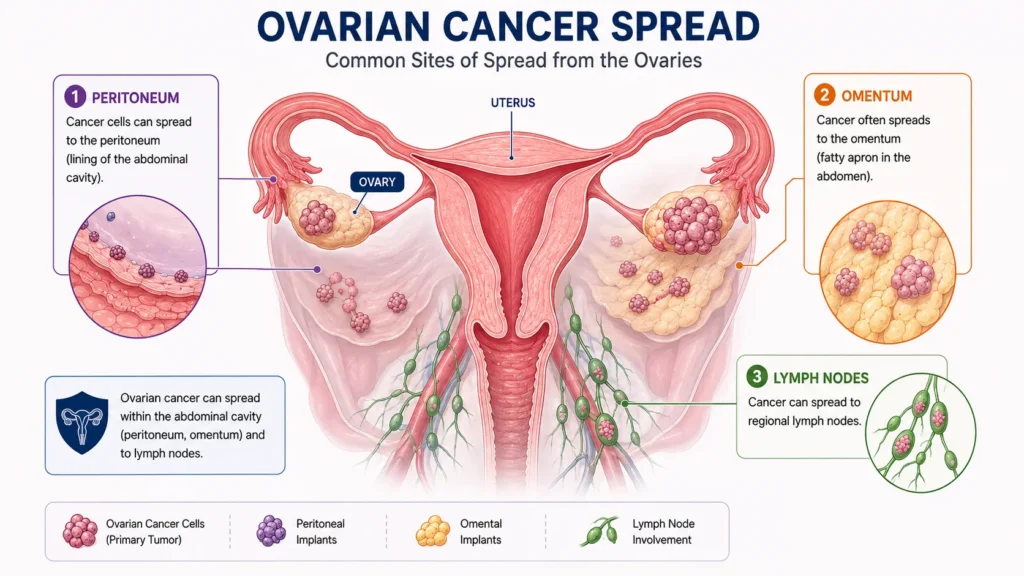
Ovarian cancer is staged from Stage I to Stage IV, most women in India are diagnosed at Stage III or IV, but even advanced ovarian cancer can be treated effectively with expert surgery and chemotherapy.
| Stage | What It Means |
| Stage I | Cancer is only in the ovaries |
| Stage II | Cancer has spread to other pelvic organs |
| Stage III | Cancer has spread to the abdominal lining or lymph nodes |
| Stage IV | Cancer has spread to distant organs like the liver or lungs |
Even at Stage III or Stage IV, complete surgical removal combined with chemotherapy and HIPEC gives meaningful long-term outcomes. Do not lose hope, specialist evaluation with the best ovarian cancer doctor is always the right first step.
Treatment Options for Ovarian Cancer in Delhi NCR
Ovarian cancer is treated with surgery and chemotherapy, surgery removes as much cancer as possible, and chemotherapy destroys remaining cancer cells to prevent it from coming back.
Dr. Surender Kumar Dabas offers every evidence-based ovarian cancer treatment option, tailored to your stage, tumour type, and overall health.
- Cytoreductive Surgery (Debulking Surgery)
- The main surgery for ovarian cancer
- Removes the ovaries, fallopian tubes, uterus, omentum (fatty tissue in the abdomen), and any other visible cancer deposits
- The more completely the cancer is removed, the better the outcome
- Performed by an experienced ovarian cancer surgeon in Delhi NCR
- HIPEC (Heated Chemotherapy Inside the Abdomen)
- Done immediately after surgery, in the same operation
- A heated chemotherapy solution is circulated inside the abdomen for 90 minutes
- Destroys microscopic cancer cells that surgery cannot see or reach
- HIPEC for ovarian cancer in Delhi NCR is used for Stage III cases with spread to the abdominal lining
- Clinical evidence shows HIPEC significantly improves survival when combined with complete debulking surgery
- Interval Cytoreductive Surgery
- Used when the cancer is too widespread for surgery upfront
- Chemotherapy is given first (3 cycles) to shrink the tumour, then surgery, then more chemotherapy
- Makes surgery safer and more effective in advanced cases
- Robotic Ovarian Cancer Surgery
- Robotic ovarian cancer surgery in Delhi using the Da Vinci Xi system
- Used for selected early-stage cases and fertility-preserving procedures
- Smaller cuts, less blood loss, faster recovery than open surgery
- Fertility-Sparing Surgery
- For younger women with early-stage ovarian cancer who want to have children
- Only the affected ovary and fallopian tube are removed, the uterus and other ovary are preserved
- Carefully selected patients with Stage I germ cell or low-grade tumours may be eligible
- Chemotherapy for Ovarian Cancer
- Carboplatin and paclitaxel – standard first-line chemotherapy given for 6 cycles after surgery
- PARP inhibitors (olaparib, niraparib) – tablet-based maintenance therapy after chemotherapy for BRCA-mutated patients; significantly reduces the chance of cancer returning
- Bevacizumab – a targeted drug added to chemotherapy for advanced cases
- Targeted Therapy and Immunotherapy
- PARP inhibitors block a specific repair mechanism that cancer cells depend on, particularly effective for BRCA-positive patients
- Bevacizumab cuts off the blood supply that feeds the tumour
- Immunotherapy checkpoint inhibitors are being studied in clinical trials for recurrent ovarian cancer
Why Choose Dr. Surender Kumar Dabas for Ovarian Cancer Treatment in Delhi NCR?
Dr. Surender Kumar Dabas is one of the best surgical oncologists for ovarian cancer in Delhi NCR, with 22+ years of experience, 30,000+ cancer surgeries, and specialist expertise in cytoreductive surgery and HIPEC.
- 22+ years of experience in complex cancer surgery including ovarian cancer, peritoneal cancers, and gynaecologic oncology
- 30,000+ cancer surgeries performed across gynaecological, GI, urological, and thoracic cancers
- HIPEC expertise, performs cytoreductive surgery with HIPEC for ovarian cancer in Delhi NCR
- Robotic surgery capability, offers minimally invasive options for eligible patients
- BRCA counselling pathway, all eligible patients are offered genetic testing and family counselling
- Team-based care, works with medical oncologists, radiation oncologists, and genetic counsellors for a complete personalised plan
- Second opinion welcome, patients told their ovarian cancer cannot be operated are encouraged to consult Dr. Dabas; resectability and HIPEC eligibility requires specialist assessment
- Speaks to you in plain language, diagnosis, staging, surgery, and chemotherapy explained simply so you and your family can make informed decisions
- Patients travel from across India – Delhi, Noida, Gurgaon, Faridabad, and internationally, for ovarian cancer treatment by Dr. Surender Kumar Dabas
Cost of Ovarian Cancer Treatment in Delhi NCR
The cost of ovarian cancer treatment in Delhi NCR depends on:
- Stage of cancer and type of surgery needed
- Whether HIPEC is part of the procedure
- Number of chemotherapy cycles and maintenance therapy required
- Duration of hospital stay
- BRCA testing and follow-up care
For a clear, personalised cost estimate based on your reports, book a consultation with one of the best doctors for ovarian cancer treatment in India, at Manipal Hospital Dwarka or Manipal Jivisha Cancer Centre, Sonipat.

Dr. Surender Dabas' Medical Content Team
Dr. Surender Dabas' Medical Content Team is committed to providing accurate, reliable, and easy-to-understand information on cancer care. Working closely with oncology experts, the team ensures that every article is medically reviewed, up-to-date, and designed to help patients and their families better understand cancer, treatment options, and recovery.

 WhatsApp