
Colon Cancer Treatment in Delhi NCR
Colon cancer is one of the most common cancers worldwide and a leading cause of cancer-related death. In India, its incidence has been rising, particularly in urban populations across Delhi, Gurgaon, Faridabad, and other cities, linked to dietary shifts, sedentary lifestyles, and an ageing population.
What makes colorectal cancer particularly important to understand is that it is one of the most preventable and detectable cancers when identified early. Advances in screening, diagnosis, and colon cancer treatment in Delhi NCR have significantly improved outcomes and survival rates for many patients.
Patients from Faridabad, Gurgaon, Delhi, Karnal, and across North India seek colon cancer treatment with Dr. Surender Kumar Dabas, one of the best robotic cancer surgeons in India, for advanced colon cancer surgery, robotic colorectal procedures, and comprehensive cancer care at Manipal Comprehensive Cancer Centre.
What is Colon Cancer?
The colon, also called the large intestine or large bowel, is the final section of the digestive tract. It absorbs water and salts from digested food before waste moves into the rectum and out of the body. When cancer develops in the inner lining of the colon, it is called colon cancer. When it develops in the rectum, the last 15 centimetres of the large bowel, it is called rectal cancer. Together, they are referred to as colorectal cancer.
It almost always begins as a small, non-cancerous growth called a polyp on the inner wall of the colon. Polyps can take years, sometimes a decade or more, to become cancerous. During that time, a colonoscopy can find them and remove them entirely, stopping cancer before it starts. When colon cancer is caught early, treatment outcomes are excellent. When it is caught late, treatment becomes significantly more complex.
Not all colorectal cancers arise from polyps. A smaller proportion develop in the context of chronic inflammatory bowel disease or inherited genetic syndromes, where the pathway to cancer may be faster and less predictable.
Types of Colon Cancer
Different colon cancer types originate from different cells within the bowel and may require different diagnostic and treatment strategies. The most common types include:
- Adenocarcinoma accounts for over 95% of colon cancers. It arises from the mucus-producing glandular cells lining the inner wall of the colon. Most clinical guidelines, treatment protocols, and the information on this page refer primarily to colorectal adenocarcinoma.
- Carcinoid Tumours (Neuroendocrine Tumours) arise from hormone-producing cells in the bowel wall. They are typically slow-growing and may be found incidentally on colonoscopy or imaging.
- Gastrointestinal Stromal Tumours (GISTs) arise from the connective tissue of the bowel wall rather than the lining. They are treated differently from adenocarcinoma and require specialist evaluation.
- Lymphoma of the Colon is rare and arises from immune cells within the bowel wall. It is treated with chemotherapy rather than surgery in most cases.
Reach Out for Expert Care
Symptoms of Colon Cancer
Colon cancer, like many gastrointestinal cancers, often produces no symptoms in its early stages. By the time symptoms are noticeable, the disease has usually progressed. This is the strongest argument for screening, catching cancer or precancerous polyps before they cause any symptoms at all.
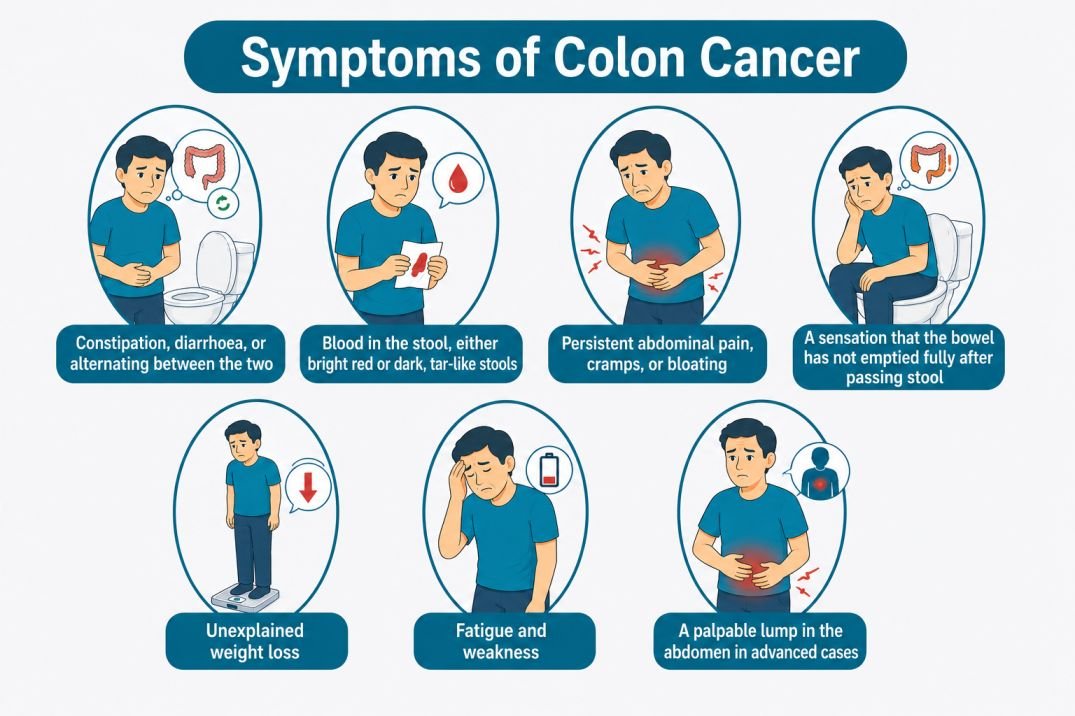
When symptoms do appear, they may include:
- A persistent change in bowel habits, constipation, diarrhoea, or alternating between the two
- Blood in the stool, either bright red or dark, tar-like stools
- Persistent abdominal pain, cramps, or bloating
- A sensation that the bowel has not emptied fully after passing stool
- Unexplained weight loss
- Fatigue and weakness, often caused by slow, chronic blood loss leading to anaemia
- A palpable lump in the abdomen in advanced cases
Rectal bleeding should never be assumed to be from haemorrhoids without proper investigation, particularly in anyone over 40 or with risk factors for colorectal cancer. A colonoscopy is the only way to rule out a more serious cause.
Risk Factors for Colon Cancer
Understanding the risk factors for colon cancer is an important step in prevention and early detection. Several genetic, medical, and lifestyle factors have been linked to an increased risk of developing colon cancer.
- Age: Most colon cancers occur after age 50, although cases in younger adults are rising. Screening is generally recommended from age 45 for average-risk individuals.
- Personal History of Polyps or Colorectal Cancer: Previous polyps or colorectal cancer increase the risk of developing new polyps or cancers, making regular surveillance essential.
- Inflammatory Bowel Disease (IBD): Long-standing Crohn’s disease or ulcerative colitis increases colon cancer risk, particularly with extensive or prolonged disease.
- Family History: Having a first-degree relative with colon cancer significantly increases risk, especially if multiple relatives are affected or diagnosed at a young age.
- Inherited Genetic Syndromes: Conditions such as Familial Adenomatous Polyposis (FAP) and Lynch Syndrome greatly increase lifetime colorectal cancer risk and require specialised screening.
- Diet: Diets high in red and processed meats and low in fibre, fruits, and vegetables are associated with a higher risk of colon cancer.
- Sedentary Lifestyle: Lack of regular physical activity is linked to an increased risk of colorectal cancer.
- Obesity and Type 2 Diabetes: Both conditions are associated with a higher risk of developing colon cancer.
- Smoking and Heavy Alcohol Use: Tobacco use and excessive alcohol consumption are established risk factors for colorectal cancer.
- Previous Abdominal Radiation: Prior radiation therapy to the abdomen or pelvis may increase the risk of colon cancer over time.
Screening of Colon Cancer
Colorectal cancer screening is one of the most impactful interventions in preventive medicine. It works because the disease has a long precancerous phase during which polyps can be detected and removed before cancer develops, and because early-stage colorectal cancer, when found on screening, is highly curable.
- Colonoscopy is the gold standard screening test. A long, flexible tube with a camera is passed through the entire colon and rectum. Any polyps found can be removed during the same procedure (polypectomy). For average-risk individuals, colonoscopy is recommended every 10 years starting at age 45. For those with a family history or previous polyps, more frequent intervals apply.
- Faecal Occult Blood Test (FOBT) / Faecal Immunochemical Test (FIT) checks stool samples for microscopic blood, which can be an early sign of polyps or cancer. A positive result requires follow-up colonoscopy. These tests are done annually or every two years and are particularly useful for population-level screening.
- CT Colonography (Virtual Colonoscopy) uses CT imaging to create a detailed picture of the colon and rectum. It is less invasive than optical colonoscopy but cannot remove polyps; a positive finding requires a follow-up optical colonoscopy.
Anyone with a family history of colorectal cancer, a known genetic syndrome, or inflammatory bowel disease should discuss early and more frequent screening with a specialist.
How Is Colon Cancer Diagnosed?
Modern colon cancer diagnosis relies on advanced endoscopic, radiological, and laboratory techniques to accurately identify the tumour and determine its stage. This assessment forms the foundation of effective colon cancer treatment and long-term management.
- Digital Rectal Examination (DRE): A simple examination that allows the surgeon to feel for any growth in the lower rectum and anal canal. A punch biopsy can be taken directly from accessible lesions.
- Proctoscopy: A short rigid instrument used to visualise the rectum and take a biopsy from any visible growth.
- Colonoscopy: The definitive diagnostic test for colon cancer. It allows direct visualisation of the entire colon and rectum, biopsy of any suspicious lesion, and removal of polyps during the same procedure. If a cancer is confirmed, its exact location in the colon is documented for surgical planning.
- Blood Tests include a full blood count (which may show anaemia from occult bleeding), liver function tests, kidney function tests, and the tumour marker CEA (Carcinoembryonic Antigen). CEA is elevated in many patients with colon cancer and is useful for monitoring treatment response and detecting recurrence, though it is not reliable as a standalone diagnostic test.
- CT Scan of the Chest, Abdomen, and Pelvis is the standard staging investigation. It assesses the local extent of the tumour, lymph node involvement, and whether the cancer has spread to distant organs, most commonly the liver and lungs.
- MRI of the Pelvis is specifically used for rectal cancers to assess the relationship of the tumour to the mesorectal fascia and nearby structures, critical information for surgical and radiation planning.
- PET-CT Scan is used selectively, particularly when CT findings are inconclusive or when metastatic disease is suspected but not confirmed.
- Molecular and Genetic Testing of the tumour tissue, including testing for microsatellite instability (MSI), mismatch repair deficiency (MMR), KRAS, NRAS, and BRAF mutations, is now standard for all patients with metastatic or recurrent colon cancer. These results directly determine eligibility for targeted therapy and immunotherapy.
Stages of Colon Cancer
Colon cancer staging describes how far the cancer has spread and is one of the most important factors in determining treatment options and prognosis. Colon cancer is staged from Stage 0 to Stage IV.
- Stage 0 (Carcinoma In Situ): Abnormal cells are confined to the inner lining of the colon and can usually be cured with removal during colonoscopy.
- Stage I: Cancer has grown into the colon wall but has not spread to lymph nodes or distant organs. Surgery alone is often curative.
- Stage II: Cancer has extended through the colon wall and may involve nearby tissues, but lymph nodes remain unaffected. Surgery is the main treatment, with chemotherapy considered in selected cases.
- Stage III: Cancer has spread to nearby lymph nodes but not to distant organs. Treatment typically involves surgery followed by chemotherapy.
- Stage IV: Cancer has spread to distant organs, most commonly the liver or lungs. Treatment may include surgery, chemotherapy, targeted therapy, immunotherapy, or a combination of these approaches.
Colon Cancer Treatment Options in Delhi NCR
Colon cancer treatment depends on the stage, location, and molecular characteristics of the tumour. Modern treatment often combines surgery, chemotherapy, targeted therapy, immunotherapy, and, in selected cases, radiation therapy. Early-stage disease is usually treated with surgery, while advanced cases may require a multidisciplinary approach.
Surgery
Surgery remains the primary and most effective treatment for colon cancer.
- Polypectomy / EMR: Early cancers confined to a polyp or the inner lining of the colon can often be removed during colonoscopy without major surgery.
- Colectomy: Removal of the cancerous section of the colon along with nearby lymph nodes; the standard treatment for most colon cancers.
- Anterior Resection / Low Anterior Resection: Used for cancers in the upper and middle rectum while preserving bowel continuity.
- Abdominoperineal Resection (APR): Required for some very low rectal cancers where sphincter preservation is not possible.
- Palliative Surgery: Performed to relieve obstruction or symptoms in advanced disease.
- Metastasectomy: Selected patients with liver or lung metastases may benefit from surgical removal with curative intent.
Robotic Colorectal Surgery
Robotic surgery is one of the most advanced approaches for colon and rectal cancer treatment, particularly for tumours located deep within the pelvis.
The robotic platform provides a high-definition, three-dimensional view and wristed instruments that allow exceptional precision in confined spaces. This is especially valuable for complex rectal cancer procedures such as low anterior resection and total mesorectal excision, where preserving surrounding nerves and structures is critical.
Benefits of robotic colorectal surgery include:
- Smaller incisions
- Less blood loss
- Reduced postoperative pain
- Lower risk of complications
- Shorter hospital stay
- Faster recovery and return to normal activities
- Excellent cancer control outcomes
Dr. Surender Kumar Dabas is among the leading robotic cancer surgeons in India and a recognised surgeon in robotic colon cancer surgery in Delhi NCR. At Manipal Comprehensive Cancer Centre, he has performed more than 5,000 robotic procedures and 30,000+ cancer surgeries, making him a sought-after specialist for complex colorectal cancers across Delhi, Gurgaon, Faridabad, Karnal, and North India.
Other therapy Options
- Chemotherapy: Chemotherapy may be used before surgery, after surgery, or for advanced-stage disease to reduce recurrence risk and control cancer spread.
- Radiation Therapy: Radiation therapy is used mainly for rectal cancer, often before surgery to shrink the tumour and improve surgical outcomes.
- Targeted Therapy: Targeted drugs attack specific molecular pathways involved in cancer growth and are commonly used in metastatic colorectal cancer based on genetic testing results.
- Immunotherapy: Immunotherapy can be highly effective in patients with MSI-H or dMMR colorectal cancers, helping the immune system recognise and destroy cancer cells. It is now a standard treatment option for eligible patients with advanced disease.
Colon Cancer Treatment Cost in Delhi NCR
The cost of colon cancer treatment in Delhi NCR varies from ₹2,00,000 to ₹13,00,000+ depending on the stage, the type of surgery, robotic or open, and whether chemotherapy, radiation, or targeted therapy are part of the treatment plan.
For a personalised estimate based on your specific diagnosis and treatment plan, contact Dr. Dabas’s clinic directly.
Life After Colon Cancer Treatment
Recovery after colon cancer treatment is generally smooth, with most patients returning to normal activities within 4-6 weeks, often sooner after robotic surgery. Temporary stomas, when required, can often be reversed once healing is complete.
Follow-up care typically includes:
- CEA blood tests every 3-6 months initially
- CT scans every 6-12 months for the first few years
- Colonoscopy at 1 year, then every 3-5 years
- Ongoing nutritional and treatment-related monitoring
The risk of recurrence is highest during the first 2-3 years, making regular follow-up essential. Early detection of recurrence can allow further treatment with curative intent in selected patients.
Why Surgeon Experience Matters in Colon Cancer?
Colorectal cancer surgery covers a wide spectrum, from straightforward right hemicolectomies to ultra-low rectal resections deep in the pelvis where the margin between complete cancer removal and a positive margin can be millimetres.
Studies show that local recurrence rates, complication rates, and long-term survival all correlate with surgeon and centre volume in colorectal cancer surgery. Choosing the best surgical oncologist in Delhi NCR who performs a high number of robotic colorectal procedures, and who operates within a multidisciplinary cancer team, makes a measurable difference in outcomes.
Dr. Surender Kumar Dabas at Manipal Comprehensive Cancer Centre has performed over 30,000 cancer surgeries, including a significant volume of robotic colorectal procedures. He is among the best robotic cancer surgeons in Delhi and the best robotic cancer surgeon in Gurgaon for complex colorectal cases and is sought by patients from Faridabad, Karnal, and across North India for colon cancer treatment in Delhi NCR, second opinions, and robotic surgical options.
Conclusion
Colon cancer is common, but it is also one of the cancers where the medical toolkit, from prevention and screening right through to surgery, chemotherapy, and immunotherapy, gives patients real options at every stage. Caught early, it is highly curable. Caught late, it is still treatable in many cases, particularly with an experienced surgical team and access to modern systemic therapies. What has not changed is the value of acting promptly, whether that means starting screening, investigating a symptom that has been put off, or getting a second opinion before agreeing to a treatment plan.
Whether you are looking for the best colon cancer treatment doctor in Gurgaon, a surgical oncologist in Delhi NCR experienced in robotic colorectal surgery, or a specialist opinion on a complex or advanced case, Dr. Surender Kumar Dabas at Manipal Comprehensive Cancer Centre sees patients from across North India. Do not delay getting the right opinion; in colon cancer, timing matters.

Dr. Surender Dabas' Medical Content Team
Dr. Surender Dabas' Medical Content Team is committed to providing accurate, reliable, and easy-to-understand information on cancer care. Working closely with oncology experts, the team ensures that every article is medically reviewed, up-to-date, and designed to help patients and their families better understand cancer, treatment options, and recovery.


 WhatsApp