
Gallbladder Cancer Treatment in Delhi NCR
People often ask what Gallbladder Cancer is. The answer is simple: Gallbladder cancer is the abnormal growth of malignant cells in the gallbladder, a small organ beneath the liver that stores bile, and is one of the most common gastrointestinal cancers in India, particularly among women.
The gallbladder sits just under the liver and helps digest fat. When cancer develops here, it often goes undetected in the early stages because symptoms are mild or absent. India has one of the highest rates of gallbladder cancer in the world, with higher incidence in northern India, including Delhi NCR.
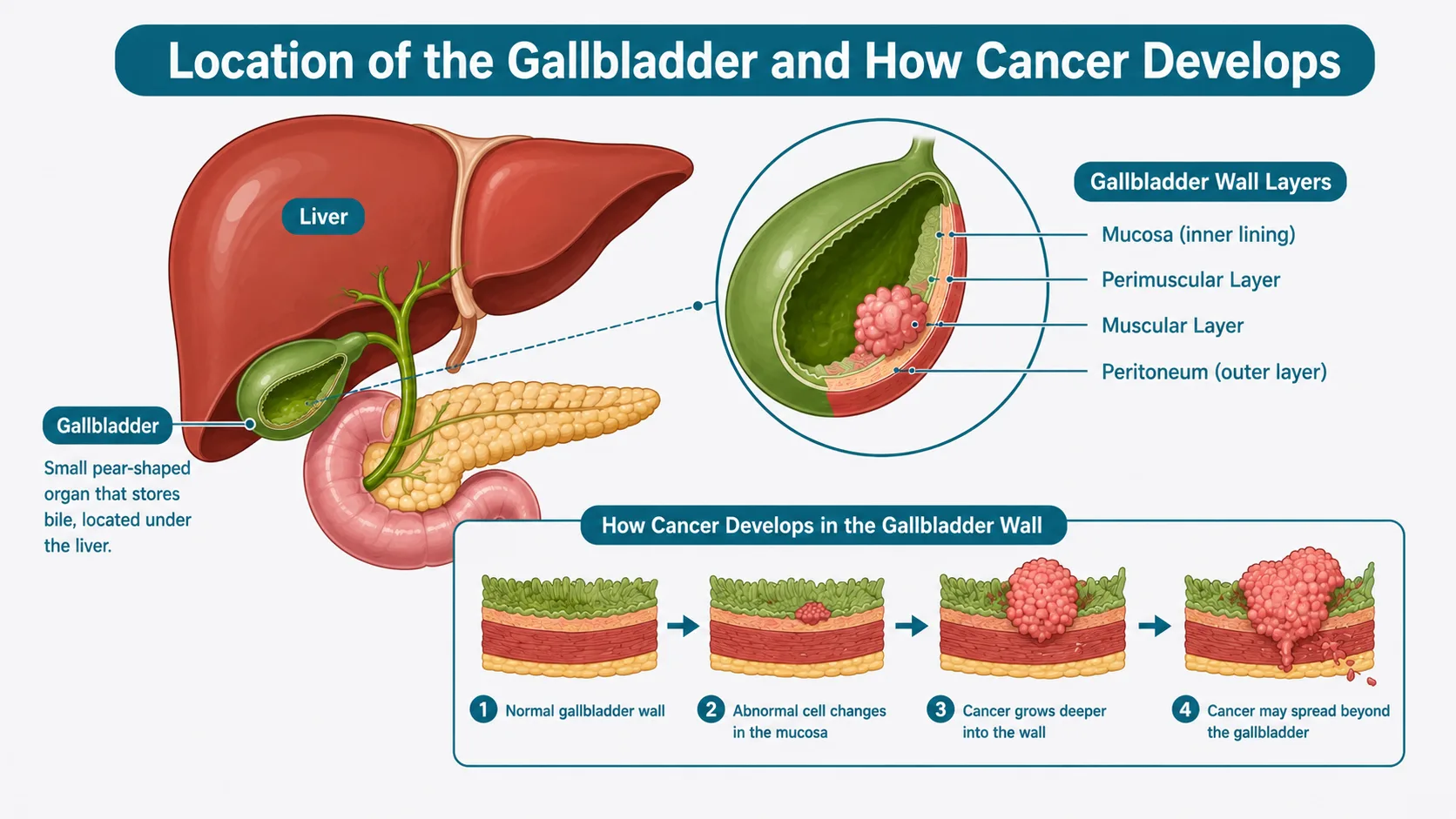
- Most gallbladder cancers are adenocarcinomas, they start in the glandular cells lining the gallbladder
- Women are more commonly affected than men
- A strong association exists between gallbladder stones and gallbladder cancer in India
- Early detection significantly improves gallbladder cancer prognosis
What Causes Gallbladder Cancer?
The exact cause of gallbladder cancer is not always known, but gallbladder stones, chronic inflammation, and certain infections are the most commonly identified risk factors in Indian patients.
Common gallbladder cancer risk factors include:
- Gallbladder stones (cholelithiasis) – the most significant gallbladder cancer reason; long-standing stones cause chronic inflammation that can lead to cancerous changes
- Porcelain gallbladder – calcium deposits in the gallbladder wall linked to cancer risk
- Chronic infection – Salmonella typhi and Helicobacter pylori infections are associated with increased risk
- Obesity – increases bile acid production and gallbladder inflammation
- Age and gender – more common in women above 50 years
- Family history – a first-degree relative with gallbladder cancer increases risk
- Bile duct abnormalities – anomalous pancreaticobiliary junction is a known risk factor
- Exposure to industrial chemicals – particularly in rubber, textile, and metalworking industries
Symptoms of Gallbladder Cancer
Gallbladder cancer in early stages often causes no symptoms, when symptoms do appear, they commonly include upper abdominal pain, jaundice, and unexplained weight loss.
Because gallbladder cancer symptoms overlap with common conditions like acidity or gallstones, many patients delay seeking medical attention. Watch for:
- Pain in the upper right abdomen or below the ribcage
- Yellowing of the skin and eyes (jaundice)
- Nausea or vomiting, especially after fatty meals
- Unexplained weight loss
- Loss of appetite
- Bloating or a feeling of fullness
- Dark-coloured urine or pale stools
- Fever without a clear cause
- A palpable lump in the upper abdomen
Gallbladder cancer symptoms in males and females are largely similar, though women tend to present at a slightly later stage on average. These are also the most common early symptoms of gallbladder cancer to watch out for.
Reach Out for Expert Care
How Is Gallbladder Cancer Diagnosed?
Gallbladder cancer is diagnosed through a combination of imaging scans, blood tests, and in some cases biopsy, a CT scan or MRI is the most commonly used tool for initial assessment.
How is gallbladder cancer diagnosed at Dr. Dabas’s? He follows a structured diagnostic process for every patient:
- Ultrasound – first-line imaging; can detect gallbladder thickening or masses
- CT scan with contrast – evaluates tumour size, local spread, and lymph node involvement
- MRI and MRCP – assesses bile duct involvement and vascular anatomy
- PET scan – detects spread to distant organs
- CA 19-9 and CEA blood markers – elevated in many gallbladder cancer diagnosis cases
- Biopsy – confirms gallbladder cancer diagnosis; may be done via endoscopy or CT-guided needle biopsy in select cases
- Endoscopic ultrasound (EUS) – used when bile duct involvement is suspected
Early and accurate gallbladder cancer diagnosis is critical to planning the right surgical or systemic treatment.
Staging of Gallbladder Cancer
Gallbladder cancer is staged from I to IV based on how deeply the tumour has grown and whether it has spread, Stage I is the most treatable, while Stage IV indicates distant spread.
| Stage | Description |
| Stage I | Cancer limited to the inner lining of the gallbladder |
| Stage II | Cancer has grown into the muscle or outer connective tissue layer |
| Stage III | Cancer has spread to nearby organs (liver, bile ducts) or lymph nodes |
| Stage IV | Cancer has spread to distant organs such as lungs, liver, or peritoneum |
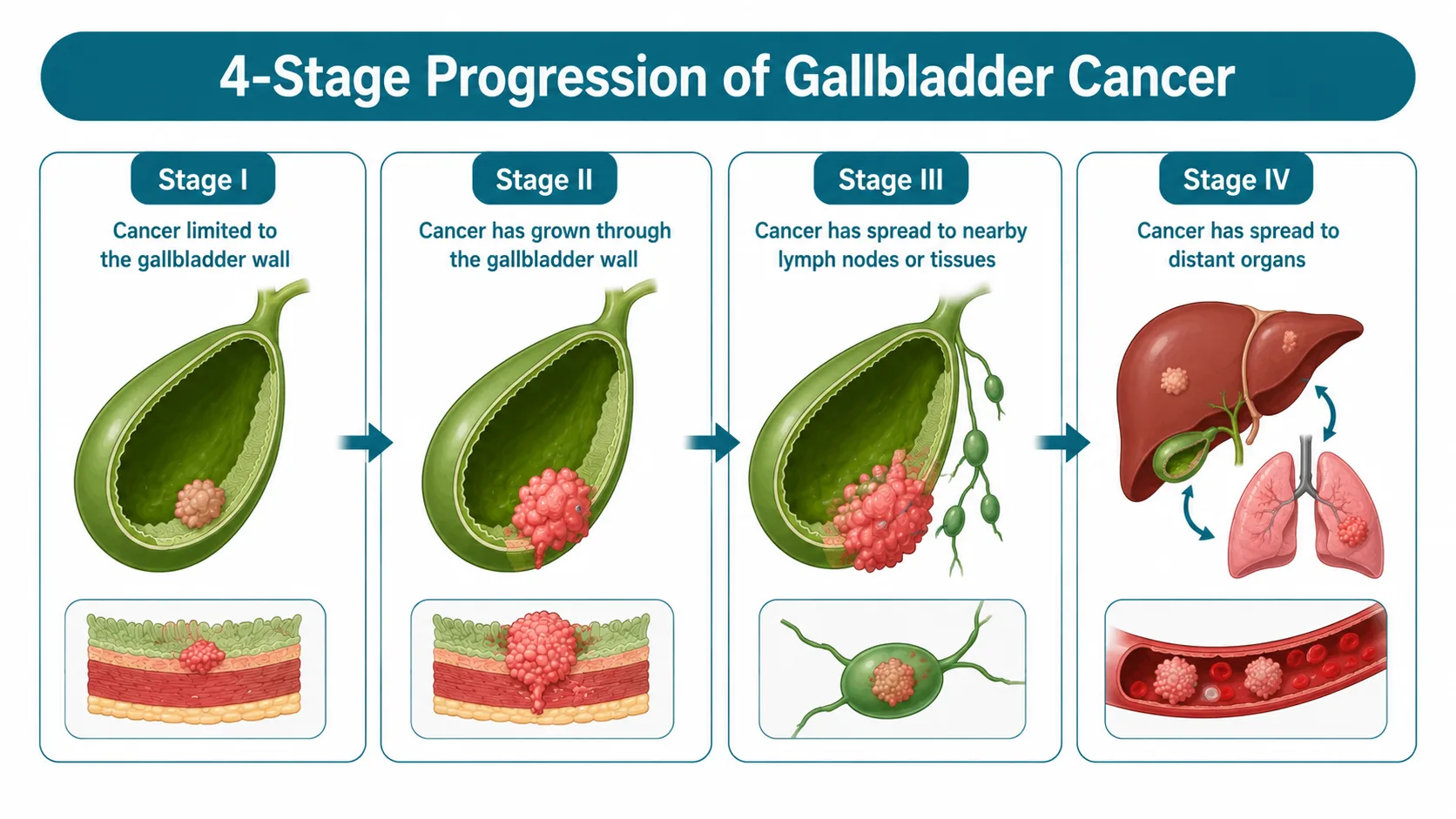
Locally advanced gallbladder cancer (Stage III) can still be treated surgically in selected patients. Even in gallbladder cancer last stage, treatment can help manage symptoms and extend quality of life.
Gallbladder Cancer Treatment Options in Delhi NCR
Surgery is the only potentially curative treatment for gallbladder cancer, when detected early, radical cholecystectomy offers the best chance of long-term remission, often combined with chemotherapy for advanced cases.
Dr. Surender Kumar Dabas, one of the best doctors for gallbladder cancer in Delhi NCR, offers a comprehensive range of gallbladder cancer treatments tailored to each patient’s stage and health status.
- Simple Cholecystectomy
- Removal of the gallbladder alone
- Suitable for very early-stage cancer (Stage I) often found incidentally after gallstone surgery
- Performed laparoscopically in eligible patients
- Radical Cholecystectomy
- Removal of the gallbladder along with a margin of liver tissue and regional lymph nodes
- The standard gallbladder cancer surgery for Stage II and selected Stage III cancers
- Offers the best chance of cure in localised disease
- Extended Resection for Locally Advanced Gallbladder Cancer
- For tumours that have grown into nearby structures such as the bile duct, liver, or duodenum
- May involve partial liver resection, bile duct removal, or removal of adjacent involved organs
- Requires a high-volume GI surgical oncologist with experience in complex hepatobiliary surgery
- Chemotherapy for Gallbladder Cancer
- Used after surgery (adjuvant) to reduce the risk of recurrence
- Used as the primary treatment for advanced or metastatic gallbladder cancer
- Common regimens include gemcitabine with cisplatin or capecitabine-based combinations
- Also used to downstage locally advanced gallbladder cancer before surgery in selected cases
- Targeted Therapy and Immunotherapy
- For patients with specific genetic mutations (FGFR2, IDH1, BRAF, HER2), targeted drugs offer additional options
- Checkpoint inhibitors are being used in advanced gallbladder cancer treatment as part of combination regimens
- Palliative Care
- For gallbladder cancer last stage where cure is not possible
- Focuses on relieving jaundice (through stenting), pain management, and maintaining quality of life
- Palliative chemotherapy for gallbladder cancer can help extend survival in suitable patients
Is Gallbladder Cancer Curable?
Gallbladder cancer is curable when detected at Stage I or II and treated with complete surgical removal, the prognosis becomes more challenging at later stages, but treatment can still meaningfully extend life and improve quality of life.
Gallbladder cancer prognosis depends on several factors:
- Gallbladder cancer staging at diagnosis, early-stage disease has significantly better outcomes
- Whether complete surgical removal (R0 resection) was achieved
- Involvement of lymph nodes and bile ducts
- Patient’s overall health and fitness for surgery
- Response to chemotherapy for gallbladder cancer in advanced cases
Patients who are diagnosed early and undergo surgery at a high-volume centre have the best chances. If you have been told your gallbladder cancer is inoperable, seeking a second opinion from an experienced surgical oncologist is always worthwhile.
Why Choose Dr. Surender Kumar Dabas for Gallbladder Cancer Treatment in Delhi NCR?
Dr. Surender Kumar Dabas is one of the best robotic cancer surgeons in Delhi NCR with 22+ years of experience, 30,000+ complex cancer surgeries, and specialist expertise in gastrointestinal and hepatobiliary cancer surgery.
- 22+ years of experience in surgical oncology including complex GI and gallbladder cancer surgery
- 30,000+ cancer surgeries performed across gastrointestinal, thoracic, urological, and head and neck cancers
- Best robotic cancer surgeon in Delhi NCR, uses the Da Vinci Xi robotic system and minimally invasive techniques for eligible gallbladder cancer cases
- Multidisciplinary care, works alongside medical oncologists, radiation oncologists, and radiologists to build a personalised gallbladder cancer treatment plan for every patient
- Clear communication, explains gallbladder cancer diagnosis, staging, and all treatment options in plain language so patients and families can make informed decisions
- Patients travel from across India to consult Dr. Dabas for complex and locally advanced gallbladder cancer cases
Cost of Gallbladder Cancer Treatment in Delhi NCR
The cost of gallbladder cancer treatment in India varies depending on:
- Stage of cancer and type of gallbladder cancer surgery required (simple vs. radical vs. extended resection)
- Whether chemotherapy for gallbladder cancer or targeted therapy is part of the treatment plan
- Duration of hospital stay and post-operative care
- Diagnostic workup required before surgery
For a personalised cost estimate based on your reports and staging, book a consultation with Dr. Surender Kumar Dabas at one of the best hospital for gallbladder cancer treatment in Delhi, Manipal Hospital Dwarka or Manipal Jivisha Cancer Centre, Sonipat.

Dr. Surender Dabas' Medical Content Team
Dr. Surender Dabas' Medical Content Team is committed to providing accurate, reliable, and easy-to-understand information on cancer care. Working closely with oncology experts, the team ensures that every article is medically reviewed, up-to-date, and designed to help patients and their families better understand cancer, treatment options, and recovery.

 WhatsApp