
Esophageal Cancer Treatment in Delhi NCR
Oesophageal cancer is cancer of the food pipe, the tube that carries food from your mouth to your stomach, and is one of the most serious gastrointestinal cancers because it is often found late, when swallowing has already become difficult.
Your oesophagus (food pipe) is about 25 cm long and runs from the back of your throat down to your stomach. When cancer of the food pipe develops, it grows in the inner lining and gradually makes swallowing harder and harder.
Two main types of oesophageal cancer:
- Squamous cell carcinoma, starts in the flat cells lining the food pipe; more common in the upper and middle oesophagus; strongly linked to tobacco and alcohol; the most common type in India
- Oesophageal adenocarcinoma, starts in glandular cells in the lower oesophagus; more common in people with chronic acid reflux and Barrett’s oesophagus; rising in incidence globally
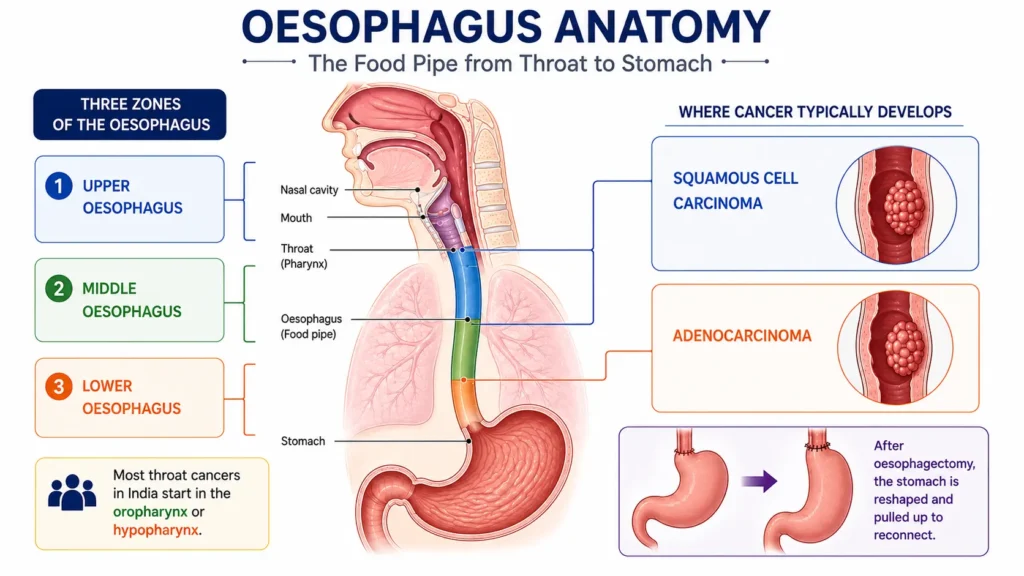
Both types are serious, but both are treatable, especially when caught early.
Early Signs and Symptoms of Oesophageal Cancer
The most important early warning sign of oesophageal cancer is progressive difficulty swallowing, starting with solid foods and eventually affecting liquids, and this must never be ignored or put down to ageing.
Because the food pipe is flexible, it can stretch around a growing tumour for a long time before symptoms appear. By the time swallowing becomes difficult, the tumour is often already significant in size. Watch for:
- Difficulty swallowing (dysphagia) – the most common symptom; starts with solids like bread or meat, then progresses to softer foods and eventually liquids
- Food getting stuck or coming back up after eating
- Unexplained weight loss – often significant; patients lose weight rapidly because eating becomes difficult and painful
- Chest pain or pressure behind the breastbone, not related to the heart
- Persistent heartburn or indigestion that is new or getting worse
- Hoarse voice – when the tumour presses on the nerve that controls the vocal cord
- Persistent cough – particularly when lying down or after eating
- Vomiting or bringing up blood
If swallowing has become harder over the past few weeks or months, please see an oesophageal cancer specialist in Delhi NCR immediately. Do not wait for it to get worse.
How Is Oesophageal Cancer Diagnosed?
Oesophageal cancer is diagnosed through endoscopy and biopsy, a thin camera is passed down the throat into the food pipe to look at the tumour and take a tissue sample to confirm the diagnosis.
Here is what the diagnosis process looks like at Dr. Dabas’s centre:
- Upper GI endoscopy – a flexible camera is passed through the mouth into the food pipe and stomach; the tumour is directly seen and a biopsy is taken; this is the single most important test for oesophageal cancer diagnosis
- Biopsy – the tissue sample confirms whether cancer is present and what type it is
- Endoscopic ultrasound (EUS) – an endoscope with an ultrasound probe assesses how deeply the tumour has grown into the food pipe wall and whether nearby lymph nodes are affected
- CT scan of the chest and abdomen – shows the size and location of the tumour and any spread to lymph nodes or other organs
- PET-CT scan – checks whether cancer has spread to distant parts of the body; essential for oesophageal cancer staging
- Barium swallow X-ray – shows the outline of the food pipe and where it is narrowed by the tumour
- Lung function and cardiac tests – done before surgery to make sure you are fit enough for the operation
- Nutritional assessment – most patients with oesophageal cancer are malnourished by the time of diagnosis; nutrition support is started early
Dr. Dabas explains every result clearly to you and your family before any treatment decision is made.
Reach Out for Expert Care
Stages of Oesophageal Cancer
Oesophageal cancer is staged from Stage I to Stage IV, early stages are confined to the food pipe wall, while advanced stages involve nearby organs or distant spread.
| Stage | What It Means |
| Stage I | Cancer is in the inner lining only; has not grown deep |
| Stage II | Cancer has grown deeper into the food pipe wall or reached nearby lymph nodes |
| Stage III | Cancer has grown through the wall or spread to more lymph nodes |
| Stage IVA | Cancer has spread to distant lymph nodes |
| Stage IVB | Cancer has spread to other organs, liver, lungs, bones |
Stage I and II oesophageal cancer can be treated with curative intent. Stage III is treated aggressively with chemotherapy, radiation, and surgery. Even Stage IV oesophageal cancer treatment can extend life and significantly improve quality of life.
Oesophageal Cancer Treatment Options in Delhi NCR
Oesophageal cancer is treated with surgery, chemotherapy, radiation, or a combination, for most patients, the best outcome comes from chemotherapy or chemoradiation first to shrink the tumour, followed by surgery to remove it.
Dr. Surender Kumar Dabas, one of the best surgical oncologists in Delhi NCR and a specialist in upper gastrointestinal cancer surgery, offers every modern oesophageal cancer treatment option, planned personally for you.
- Surgery – Oesophagectomy
- Surgical removal of the affected part of the food pipe is the only curative treatment for oesophageal cancer
- The stomach is then pulled up and reconnected to the remaining food pipe to restore the ability to eat
- Two main types of oesophagectomy in Delhi NCR:
- Ivor Lewis oesophagectomy – combines an abdominal incision and a chest incision; used for middle and lower food pipe cancers; the most commonly performed type
- McKeown oesophagectomy – uses three incisions (neck, chest, and abdomen); used for upper food pipe cancers
- The goal in both cases is complete removal of the tumour with clear margins
- Minimally Invasive Oesophagectomy in Delhi
- Minimally invasive oesophagectomy uses keyhole (laparoscopic) incisions instead of large open cuts
- Same cancer surgery – smaller cuts, less pain, shorter hospital stay, and faster recovery
- Dr. Dabas performs minimally invasive oesophagectomy in Delhi for eligible patients with excellent outcomes
- Robotic Oesophageal Cancer Surgery in Delhi
- Robotic oesophageal cancer surgery uses the Da Vinci Xi system for greater precision inside the narrow chest cavity
- The robotic arms move with far greater range than a human hand, critical for the delicate reconstruction needed after removing the food pipe
- Benefits: less blood loss, lower risk of complications, faster recovery, and a shorter hospital stay
- Dr. Surender Kumar Dabas is one of the best robotic cancer surgeons in Delhi NCR and offers robotic oesophagectomy for suitable patients
- Endoscopic Treatment for Early Oesophageal Cancer
- For very early-stage oesophageal tumours confined to the inner lining only
- Endoscopic mucosal resection (EMR) or endoscopic submucosal dissection (ESD), the tumour is removed through the endoscope without any surgery
- No hospital stay needed for most patients
- Only suitable for Stage I tumours that have not grown deep
- Neoadjuvant Chemotherapy and Chemoradiation
- Given before surgery to shrink the tumour and make it easier to remove completely
- Neoadjuvant chemoradiotherapy, combined chemotherapy and radiation given for 5 weeks before surgery; this is now the standard approach for Stage II and III oesophageal cancer
- Shrinking the tumour first significantly improves the chance of complete surgical removal
- Most patients have surgery 6 to 8 weeks after completing chemoradiation
- Definitive Chemoradiation (Without Surgery)
- For patients who are not fit enough for surgery or who have upper oesophageal cancer where surgery is very complex
- Chemotherapy and radiation given together as the primary treatment
- Can achieve remission in selected patients, particularly for squamous cell carcinoma of the oesophagus
- Chemotherapy for Oesophageal Cancer
- Used before surgery (neoadjuvant) to shrink the tumour
- Used after surgery (adjuvant) for selected high-risk patients
- Used as palliative treatment for Stage IV oesophageal cancer to slow growth and extend quality of life
- Common regimens: FLOT, FOLFOX, carboplatin with paclitaxel
- Immunotherapy for Oesophageal Cancer
- Nivolumab and pembrolizumab, checkpoint inhibitors approved for advanced oesophageal cancer after chemotherapy
- Also used in combination with chemotherapy as first-line treatment for advanced disease
- Works by helping the immune system recognise and attack cancer cells
- Stent Placement and Nutritional Support
- For patients with severe swallowing difficulty, a stent (small tube) is placed inside the food pipe to keep it open and allow eating while treatment is being planned
- A feeding tube (PEG or nasogastric tube) may be used to maintain nutrition before and after surgery
- Nutritional support is a critical part of oesophageal cancer treatment, patients who are better nourished tolerate surgery and chemotherapy much better
What to Expect After Oesophageal Cancer Surgery
Recovery after oesophagectomy takes time, most patients stay in hospital for 7 to 10 days, start with liquids and gradually progress to solid food, and return to normal eating within 6 to 8 weeks.
Here is what recovery typically looks like:
- Hospital stay – 7 to 10 days; shorter with minimally invasive or robotic surgery
- Eating after surgery – you will start with sips of water, then liquids, then soft foods, then normal food over several weeks
- Eating smaller, more frequent meals – since the stomach is now smaller and higher up, you will need to eat little and often
- Reflux and dumping – some patients experience acid reflux or dumping syndrome (feeling unwell after eating); these are managed with diet adjustments and medication
- Gradual return to activities – most patients are back to light activity within 4 to 6 weeks and return to normal life within 3 months
- Ongoing follow-up – regular endoscopy, CT scans, and blood tests to monitor recovery and check for any recurrence
Why Choose Dr. Surender Kumar Dabas for Oesophageal Cancer Treatment in Delhi NCR?
Dr. Surender Kumar Dabas is one of the best oesophageal cancer surgeons in Delhi NCR, with 22+ years of experience, 5,000+ robotic surgeries, and specialist expertise in minimally invasive and robotic oesophagectomy.
- 22+ years of experience in upper GI and thoracic surgical oncology including oesophageal cancer, stomach cancer, and gastrointestinal tumours
- one of the Best robotic cancer surgeon in Delhi NCR and India – performs robotic oesophagectomy using the Da Vinci Xi system with precision and minimal complications
- 5,000+ robotic surgeries and 30,000+ complex cancer surgeries performed
- Minimally invasive expertise – offers keyhole and robotic oesophagectomy in Delhi NCR for eligible patients; smaller cuts, faster recovery, better outcomes
- Nutrition-first approach – every patient’s nutritional status is assessed and optimised before surgery begins; well-nourished patients recover faster and tolerate treatment better
- Multidisciplinary care – works with medical oncologists, radiation oncologists, gastroenterologists, dietitians, and physiotherapists for a complete, personalised oesophageal cancer treatment plan
- Clear, honest communication – explains every step of the diagnosis, staging, and treatment in simple language; you and your family will always know what is happening and why
- Second opinion welcome – patients who have been told their oesophageal cancer cannot be operated are encouraged to consult Dr. Dabas
- Patients from Delhi, Noida, Gurgaon, Faridabad, and abroad seek oesophageal cancer treatment by Dr. Surender Kumar Dabas
Oesophageal Cancer Treatment Cost in Delhi NCR
The cost of oesophageal cancer treatment in Delhi NCR depends on:
- Stage of cancer and type of surgery, minimally invasive vs. robotic vs. open oesophagectomy
- Whether neoadjuvant chemotherapy or chemoradiation is needed before surgery
- Nutritional support and feeding tube requirements
- Duration of hospital stay and ICU care
- Post-operative chemotherapy or immunotherapy
- Follow-up care and monitoring
Robotic and minimally invasive oesophagectomy may have a higher surgical cost but typically results in a shorter hospital stay and fewer complications, reducing the overall treatment cost. For a clear, personalised oesophageal cancer surgery cost estimate in Delhi, book a consultation with Dr. Surender Kumar Dabas.
If swallowing has been getting harder, or if you or a loved one has been diagnosed with oesophageal cancer, the most important thing you can do right now is speak to a best surgical oncologist.

Dr. Surender Dabas' Medical Content Team
Dr. Surender Dabas' Medical Content Team is committed to providing accurate, reliable, and easy-to-understand information on cancer care. Working closely with oncology experts, the team ensures that every article is medically reviewed, up-to-date, and designed to help patients and their families better understand cancer, treatment options, and recovery.

 WhatsApp