
Robotic Neck Dissection in Delhi NCR
Neck dissection is a surgery to remove lymph nodes from the neck. It is done when cancer has spread to the neck, or when there is a high chance it might spread there.
Think of your lymph nodes as small filters spread across your neck. When cancer starts in the mouth, throat, or thyroid, these nodes are often the first place it travels to.
Neck dissection is done for two reasons:
- To treat cancer that has already reached the neck lymph nodes
- To prevent spread, when the risk of cancer reaching the neck is high, removing those nodes early is the safer choice
It is a very common part of treatment for head and neck cancers, including oral cancer, tongue cancer, throat cancer, thyroid cancer, and salivary gland cancer.
What Is Robotic Neck Dissection?
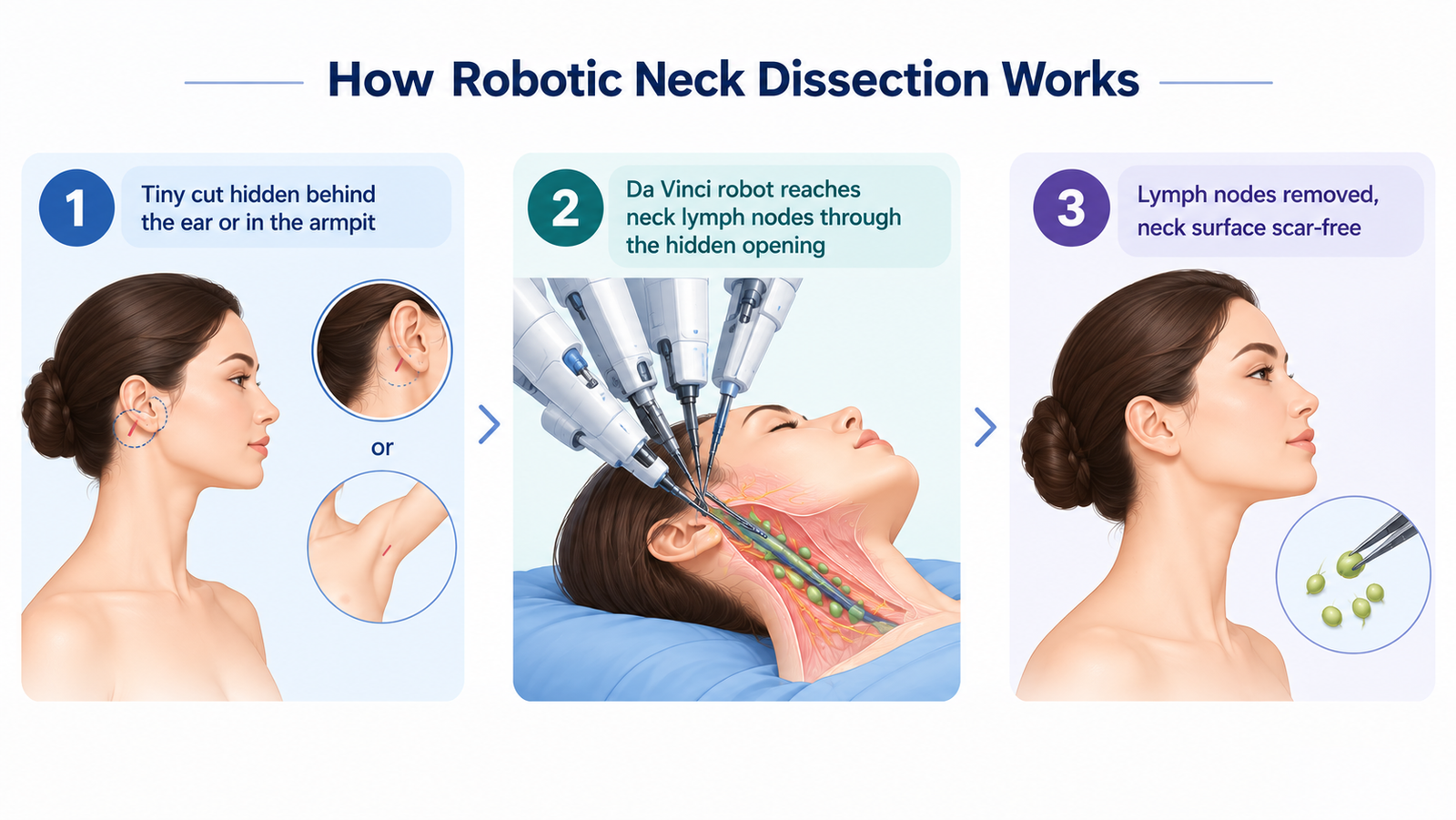
Robotic neck dissection removes neck lymph nodes using the Da Vinci robot through a tiny hidden incision, so there is no visible scar on your neck at all.
In traditional surgery, a long cut is made along the side of the neck, leaving a permanent scar that many patients, especially younger people and women, find very upsetting.
Robotic neck dissection is different:
- The surgery is done through a small cut hidden behind the ear or in the armpit
- The Da Vinci robot reaches the neck lymph nodes through this hidden opening
- The same complete lymph node removal is done, but your neck looks completely untouched
- Dr. Surender Kumar Dabas is one of the best cancer surgeon in Delhi NCR and one of the pioneers of this technique in India.
Who Needs Robotic Neck Dissection?
Robotic neck dissection is a good option for patients who need neck lymph node removal but want to avoid a visible scar, it works well for younger patients, women, and anyone in a profession where appearance matters.
You may be a good candidate if you have:
- Oral cancer – tongue, cheek, lip, or floor of mouth cancer where neck nodes need to be removed
- Throat cancer – tonsil or base of tongue cancer with neck involvement
- Thyroid cancer – where neck lymph nodes need to be cleared
- Salivary gland cancer – parotid or submandibular gland cancer with neck spread
- Skin cancer of the head and neck – with spread to neck lymph nodes
- Any head and neck cancer where your doctor recommends removing neck nodes as a precaution
Dr. Dabas assesses every patient individually, your cancer type, stage, and neck structure all determine whether the robotic approach is right for you.
Reach Out for Expert Care
Types of Neck Dissection
There are three main types of neck dissection, the right one for you depends on how far the cancer has spread and which lymph node groups need to be removed.
- Selective neck dissection – only the lymph node groups most likely to be affected are removed; all important nerves, veins, and muscles are kept intact; the most common type and the one best suited to the robotic approach
- Modified radical neck dissection – most lymph node groups are removed, but important structures like the main nerve to the shoulder are preserved where possible; used when cancer has spread to more areas of the neck
- Radical neck dissection – all major lymph node groups are removed along with the shoulder nerve, main neck vein, and large neck muscle; only used for very advanced neck disease; rarely needed today
Robotic neck dissection works best for selective neck dissection, the approach that removes what is needed while preserving as much normal function as possible.
How Is Robotic Neck Dissection Done?
Robotic neck dissection is performed under general anaesthesia through a tiny hidden cut behind the ear or in the armpit, the Da Vinci robot then removes the neck lymph nodes while leaving your neck completely scar-free.
Here is a simple step-by-step of what happens:
- You go to sleep under general anaesthesia, the whole procedure takes about 2 to 3 hours
- A small hidden cut is made, either just behind your ear in the hairline, or in your armpit; you will not see this on your neck at all
- A small working space is created under the skin so the robotic instruments can reach the neck lymph nodes
- The Da Vinci robot is set up, Dr. Dabas sits at a console and controls the robotic arms with 3D magnified vision inside your neck
- Lymph nodes are carefully removed, the robot’s precision allows Dr. Dabas to clearly see and protect every important nerve and blood vessel while removing all the necessary lymph node groups
- The hidden cut is closed, no drain is usually needed; no scar on your neck
- You wake up and recovery begins, most patients are sitting up and sipping water the same day
Robotic Neck Dissection vs. Traditional Open Surgery
Robotic neck dissection removes the same lymph nodes just as thoroughly as traditional open surgery, but with no neck scar, much less pain, and a significantly faster recovery.
| Open Neck Dissection | Robotic Neck Dissection | |
| Cut on the neck | Yes – 8 to 15 cm visible scar | No – hidden behind ear or armpit |
| Visible scar | Permanent neck scar | No visible neck scar |
| Hospital stay | 3 to 5 days | 1 to 2 days |
| Pain after surgery | Moderate to significant | Minimal |
| Recovery time | 4 to 6 weeks | 2 to 3 weeks |
| Nerve protection | Good | Excellent – 3D robotic precision |
| Cancer result | Complete removal | Complete removal – same result |
The cancer outcome is mostly the same with both approaches. The difference is how the surgery is done, and what your neck looks like afterwards.
Benefits of Robotic Neck Dissection
The biggest benefit of robotic neck dissection is no visible scar on your neck, along with less pain, a shorter hospital stay, and the precision of the Da Vinci robot to protect the nerves and blood vessels in your neck.
Here is what patients tell us they value most:
- No scar on the neck – the most important benefit for most patients; your neck looks completely normal after surgery
- Much less pain – a tiny hidden cut hurts far less than a long neck incision
- Home sooner – most patients go home within 1 to 2 days
- Back to normal life faster – most people return to daily activities within 2 to 3 weeks
- Better nerve protection – the 3D robotic camera gives Dr. Dabas a magnified view that makes it easier to identify and protect the nerves in your neck, reducing the risk of shoulder weakness or numbness
- Less neck stiffness – because the neck skin is not cut directly, most patients experience far less tightness, pulling, and long-term stiffness than after open surgery
- Same cancer treatment – every lymph node group is removed just as thoroughly
- Confidence during recovery – not having a visible scar helps many patients feel more like themselves during and after cancer treatment
Why Choose Dr. Surender Kumar Dabas for Robotic Neck Dissection in Delhi NCR?
Dr. Surender Kumar Dabas is one of the best cancer doctor in Delhi, a pioneer in robotic neck dissection with 22+ years of experience and one of the highest volumes of robotic head and neck cancer surgeries performed in Asia.
- Pioneer in robotic neck dissection in India – among the first surgeons to perform this procedure in the country; has trained other surgeons across India in this technique
- One of the best robotic cancer surgeon in Delhi NCR and India – uses the Da Vinci Xi system, the most advanced robotic surgical platform available
- 22+ years of experience in head and neck cancer surgery, oral, throat, thyroid, and salivary gland cancers
- 5,000+ robotic surgeries and 30,000+ complex cancer surgeries performed
- Exceptional nerve preservation record, protects the shoulder nerve, facial nerve branches, and major neck blood vessels with robotic precision
- Trains other surgeons, has proctored robotic neck dissection at AIIMS, Tata Memorial Hospital Mumbai, and Apollo Delhi; a nationally recognised expert
- Talks to you in plain language, explains exactly what the surgery involves, what to expect, and how recovery works; never leaves you with unanswered questions
- Understands the emotional side, knows that a cancer diagnosis combined with the worry of a visible scar is a lot to carry; takes the time to address both
What Does Recovery Look Like?
Most patients go home within 1 to 2 days after robotic neck dissection and are back to daily life within 2 to 3 weeks, much faster than after traditional open neck surgery.
Here is a simple day-by-day picture of recovery:
- Day of surgery – you wake up, the hidden cut is already closed, no drain on the neck; you are sitting up and sipping water within a few hours
- Day 1 to 2 – mild discomfort managed with simple painkillers; you go home
- Week 1 – some mild swelling near the hidden incision; eating and drinking normally; neck movement is comfortable
- Week 2 to 3 – most patients are back to light work, driving, and daily activities; swelling settles
- Week 4 onwards – near-complete return to normal; the hidden scar is already fading
- Month 2 to 3 – full recovery; the scar behind the ear or in the armpit is barely visible and completely hidden
- Follow-up appointments – regular check-ups with Dr. Dabas to make sure recovery is on track and cancer is under control
Reach Out for Expert Care
What Does Robotic Neck Dissection Cost in Delhi NCR?
The cost of robotic neck dissection in Delhi NCR depends on a few things:
- Which type of neck dissection is needed, selective, modified radical, or combined
- Whether it is done at the same time as the main cancer surgery (oral, throat, or thyroid)
- Whether one side or both sides of the neck are treated
- How long you stay in hospital
- Post-operative follow-up and care
Because the hospital stay is shorter with the robotic approach, the overall cost is often comparable to open surgery when everything is added up. For a clear, honest cost estimate, you may book a consultation with Dr. Surender Kumar Dabas, a leading cancer doctor in Dwarka.
If your doctor has told you that you need neck dissection, and you want to know whether a scar-free robotic option is right for you, speak to one of the best cancer doctor in Dwarka, Dr. Surender Kumar Dabas, today.

Dr. Surender Dabas' Medical Content Team
Dr. Surender Dabas' Medical Content Team is committed to providing accurate, reliable, and easy-to-understand information on cancer care. Working closely with oncology experts, the team ensures that every article is medically reviewed, up-to-date, and designed to help patients and their families better understand cancer, treatment options, and recovery.
 WhatsApp