
Laryngeal (Voice Box) Cancer Treatment in Delhi NCR
Laryngeal cancer is cancer of the voice box, the larynx, and is one of the most common head and neck cancers in India, strongly linked to smoking and alcohol use, with hoarseness of voice being the most important early warning sign.
Your larynx sits in your throat and does three things: it helps you breathe, speak, and swallow safely. When cancer develops here, catching it early makes a huge difference, early laryngeal cancer can often be treated while fully preserving your voice.
Three types based on where in the larynx cancer starts:
- Glottic cancer – starts on the vocal cords; the most common type; causes hoarseness early, which means it is often caught sooner
- Supraglottic cancer – starts above the vocal cords; often diagnosed later because it does not affect the voice immediately
- Subglottic cancer – starts below the vocal cords; the rarest type; often diagnosed late
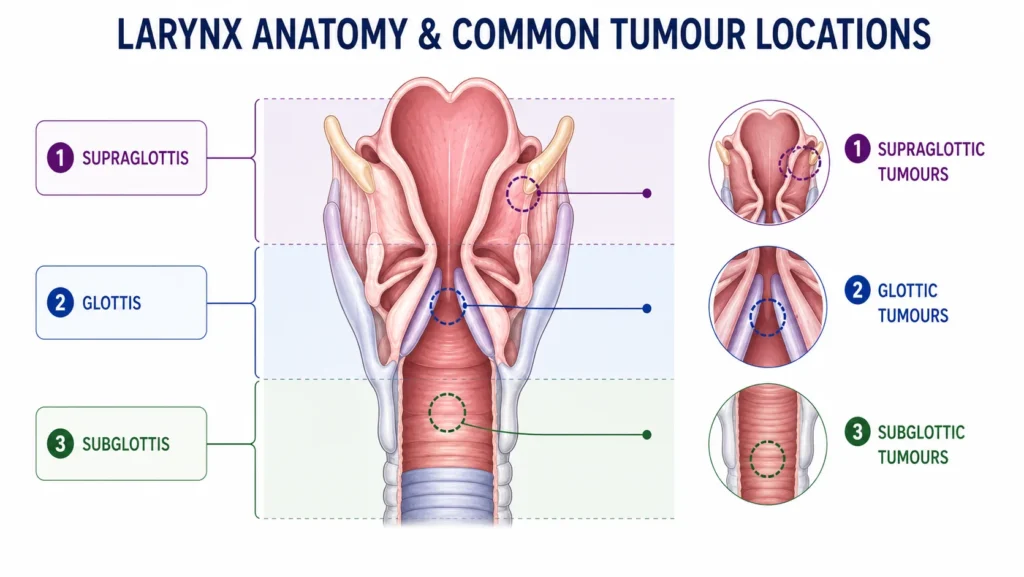
Almost all laryngeal cancers are squamous cell carcinomas, they start in the flat cells lining the inside of the larynx.
Symptoms and Early Signs of Laryngeal Cancer
The most important early sign of laryngeal cancer is hoarseness or a change in your voice that lasts more than 3 weeks, this should never be ignored, especially in smokers.
Many people put off seeing a doctor because these symptoms seem minor. Do not wait:
- Hoarseness or voice changes lasting more than 3 weeks, the single most important warning sign, especially for glottic cancer
- A persistent sore throat that does not get better with antibiotics or rest
- Difficulty swallowing, food or liquids feel like they are getting stuck
- A lump in the neck, may mean cancer has spread to nearby lymph nodes
- Noisy or difficult breathing, a high-pitched sound when breathing (stridor)
- Ear pain on one side without any ear infection, referred pain from the throat
- Unexplained weight loss
- A chronic cough that does not go away
- Feeling like something is stuck in your throat
If you smoke or drink alcohol and have had a hoarse voice for more than 3 weeks, please see a laryngeal cancer specialist in Delhi NCR immediately. Early diagnosis can mean the difference between a simple procedure and major surgery.
How Is Laryngeal Cancer Diagnosed?
Laryngeal cancer is diagnosed through laryngoscopy and biopsy, a thin camera is used to look directly at the voice box, and a small tissue sample is taken to confirm whether cancer is present.
Dr. Surender Kumar Dabas uses a step-by-step approach to laryngeal cancer diagnosis:
- Laryngoscopy – a thin, flexible camera passed through the nose and throat to directly see the larynx and vocal cords; done in the clinic, usually takes a few minutes
- Microlaryngoscopy and biopsy – done under general anaesthesia; gives a closer look at the tumour and takes a tissue sample to confirm the diagnosis
- CT scan of the neck and chest – shows how large the tumour is and whether lymph nodes are involved
- MRI scan – gives detailed images of soft tissue and helps plan surgery
- PET-CT scan – checks whether cancer has spread to distant parts of the body
- Chest X-ray or CT chest – rules out spread to the lungs
Once the diagnosis is confirmed, Dr. Dabas discusses all findings clearly with you and your family before any treatment decisions are made.
Reach Out for Expert Care
Types and Stages of Laryngeal Cancer
Laryngeal cancer is staged from Stage I to Stage IV, early-stage cancer of the voice box is highly curable and can often be treated while preserving your voice.
| Stage | What It Means |
| Stage I | Small tumour confined to one part of the larynx; vocal cord movement is normal |
| Stage II | Tumour has grown within the larynx but has not spread outside |
| Stage III | Tumour has spread within the larynx or to one nearby lymph node |
| Stage IV | Cancer has spread to nearby structures, multiple lymph nodes, or distant organs |
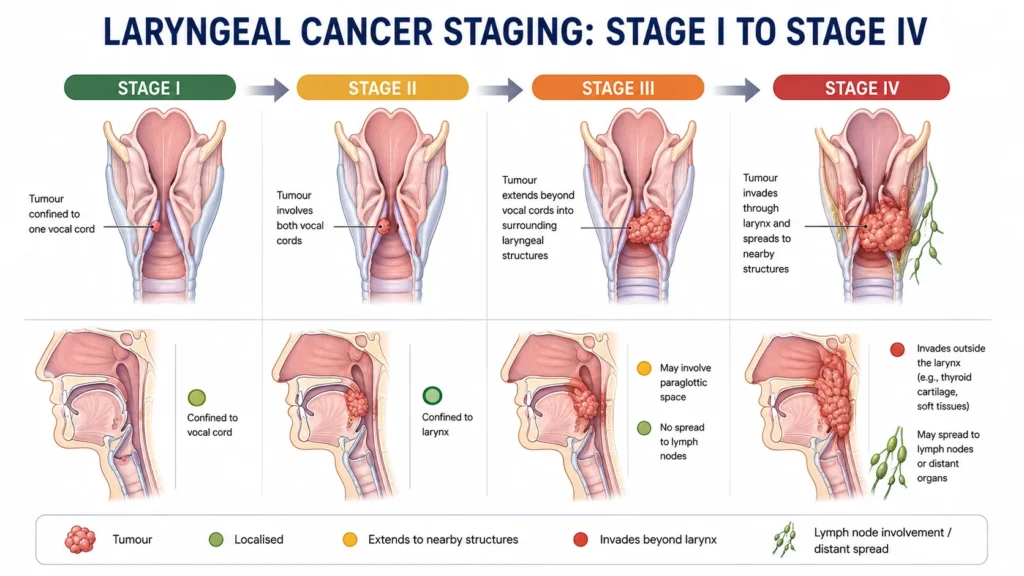
Good news for early diagnosis: Stage I and Stage II glottic cancer (vocal cord cancer) is among the most curable of all head and neck cancers, with survival rates above 85 to 90% with the right treatment.
Laryngeal Cancer Treatment Options in Delhi NCR
Laryngeal cancer is treated with surgery, radiation therapy, or a combination of both, the goal is always to remove or destroy the cancer while preserving your ability to speak, swallow, and breathe as normally as possible.
Dr. Surender Kumar Dabas, one of the best surgical oncologist in Delhi, builds a personalised treatment plan for every patient based on tumour size, location, stage, and your own priorities.
- Transoral Laser Surgery for Laryngeal Cancer
- A laser is used through the mouth to remove the tumour, no cuts on the neck
- Used for early-stage glottic cancer and selected supraglottic tumours
- Most patients go home within 1 to 2 days
- Voice is usually well preserved
- One of the best options for early laryngeal cancer treatment in Delhi NCR
- Partial Laryngectomy in Delhi
- Removes only the part of the larynx affected by cancer
- The remaining larynx is reconstructed so you can still breathe, speak, and swallow
- Used for selected Stage II and III tumours where the whole voice box does not need to be removed
- Preserves voice function in most patients
- Total Laryngectomy in Delhi
- Complete removal of the voice box
- Required for large, advanced tumours that cannot be treated any other way
- After surgery, you breathe through a permanent opening in your neck (stoma), tracheostomy
- Voice rehabilitation options are available:
- Tracheoesophageal voice prosthesis (TEP), the most natural-sounding option; a small valve allows speech using air from the lungs
- Electrolarynx, a handheld device that creates sound
- Oesophageal speech, learned over time with speech therapy
- Dr. Dabas and his team prepare every patient thoroughly for life after total laryngectomy, including speech rehabilitation and emotional support
- Neck Dissection for Laryngeal Cancer
- Removes lymph nodes from the neck when cancer has spread or is at high risk of spreading
- Often performed at the same time as laryngeal surgery
- Selective neck dissection removes only the lymph node groups at risk, preserving nerves and blood vessels where possible
- Radiation Therapy for Laryngeal Cancer
- Very effective for early-stage voice box cancer, can cure Stage I and II glottic cancer while fully preserving the voice
- Used after surgery (adjuvant radiotherapy) for high-risk patients to reduce the chance of recurrence
- IMRT (Intensity-Modulated Radiation Therapy) targets the tumour with precision while protecting the surrounding throat, salivary glands, and spinal cord
- Chemotherapy for Laryngeal Cancer
- Given alongside radiation (chemoradiation) for Stage III and IV laryngeal cancer, helps radiation work better
- Used when the goal is to avoid total laryngectomy and preserve the voice box (organ preservation protocol)
- Cisplatin is the most commonly used drug
- Also used as palliative treatment for very advanced or recurrent disease
- Immunotherapy for Laryngeal Cancer
- Pembrolizumab and nivolumab, checkpoint inhibitors approved for recurrent or metastatic head and neck squamous cell carcinoma including larynx cancer
- Used when cancer returns after standard treatment or in patients who cannot tolerate chemotherapy
- Activates the body’s own immune system to recognise and attack cancer cells
Voice-Preserving Treatment for Laryngeal Cancer
Many patients with early to intermediate-stage laryngeal cancer can be treated without removing the voice box, laser surgery and radiation therapy can cure the cancer while fully preserving the voice.
This is one of the most important things patients want to know. Here is what is possible:
- Stage I and II glottic cancer – laser surgery or radiation therapy alone can cure the cancer with excellent voice outcomes
- Stage III laryngeal cancer – chemoradiation (without surgery) is an established voice-preserving approach for selected patients
- Partial laryngectomy – removes the tumour but keeps enough of the larynx for voice function
- Voice preservation is always discussed as part of the treatment plan, Dr. Dabas explains every option clearly so you can make an informed choice
Why Choose Dr. Surender Kumar Dabas for Laryngeal Cancer Treatment in Delhi NCR?
Dr. Surender Kumar Dabas is one of the best head and neck cancer surgeons in Delhi NCR, with 22+ years of experience, 5,000+ robotic surgeries, and specialist expertise in laryngeal cancer surgery, voice preservation, and post-laryngectomy rehabilitation.
- 22+ years of experience in head and neck surgical oncology, laryngeal, oral, thyroid, and throat cancers
- Pioneer in robotic head and neck cancer surgery, among the highest volume robotic head and neck cancer surgeons in Asia
- 5,000+ robotic surgeries and 30,000+ complex cancer surgeries performed
- Voice-first approach, always explores voice-preserving options before recommending total laryngectomy
- Complete rehabilitation pathway, coordinates speech therapists, swallowing specialists, and voice rehabilitation experts as part of the care team
- Clear, honest communication, explains diagnosis, staging, and every treatment option in simple language; always includes the family in discussions
- Patients travel from across India – Delhi, Noida, Gurgaon, Faridabad, and internationally, for laryngeal cancer treatment by Dr. Surender Kumar Dabas
Laryngeal Cancer Treatment Cost in Delhi NCR
The cost of laryngeal cancer treatment in Delhi NCR depends on:
- Stage and location of the tumour, glottic, supraglottic, or subglottic
- Type of surgery, laser surgery, partial laryngectomy, or total laryngectomy
- Whether neck dissection is needed
- Radiation therapy and chemotherapy requirements
- Voice rehabilitation and post-operative care
- Duration of hospital stay
Laser surgery for early laryngeal cancer is significantly less costly than total laryngectomy with reconstruction. For a clear, personalised laryngeal cancer surgery cost estimate in Delhi, book a consultation with Dr. Surender Kumar Dabas, one of the best robotic cancer surgeons in India.
If you or someone in your family has had a hoarse voice, persistent sore throat, or a lump in the neck for more than 3 weeks, please do not ignore it and consult one of the best laryngeal cancer doctor in Delhi.

Dr. Surender Dabas' Medical Content Team
Dr. Surender Dabas' Medical Content Team is committed to providing accurate, reliable, and easy-to-understand information on cancer care. Working closely with oncology experts, the team ensures that every article is medically reviewed, up-to-date, and designed to help patients and their families better understand cancer, treatment options, and recovery.

 WhatsApp