
Throat Cancer Treatment in Delhi NCR
Throat cancer is cancer that grows in the throat. It is one of the most common head and neck cancers in India and is strongly linked to tobacco, alcohol, and HPV infection.
Your throat connects your mouth to your windpipe and food pipe. Cancer can grow in different parts of it, and where it starts affects what symptoms you get and how it is treated.
The main types are:
- Oropharyngeal cancer – grows in the middle of the throat, tonsils, soft palate, and base of the tongue; increasingly common in non-smokers due to HPV infection
- Hypopharyngeal cancer – grows in the lower throat just above the food pipe; often found late because early symptoms are subtle
- Nasopharyngeal cancer – grows in the upper throat behind the nose
- Laryngeal cancer – cancer of the voice box
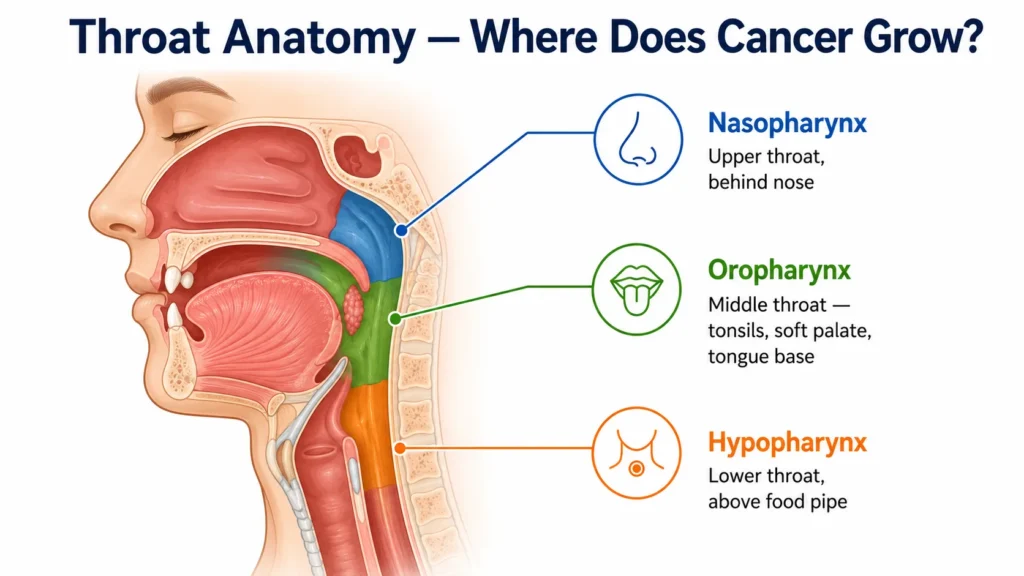
Most throat cancers are squamous cell carcinomas, starting in the thin flat cells that line the inside of the throat.
What Causes Throat Cancer?
Throat cancer is most commonly caused by tobacco use, alcohol, and HPV infection, in India, smoking and tobacco chewing are the biggest risk factors.
Things that increase your risk:
- Tobacco in any form – cigarettes, bidi, gutka, khaini, hookah; the biggest throat cancer cause in India
- Alcohol – drinking heavily alongside tobacco multiplies the risk many times over
- HPV infection – a virus spread through close contact; increasingly responsible for throat cancer in younger patients who have never smoked
- Betel nut chewing – risky even without tobacco
- Poor diet – low intake of fruits and vegetables over many years
- Acid reflux (GERD) – repeated irritation of the throat lining
- Low immunity – people on immunosuppressants or living with HIV are at higher risk
What Are the Symptoms of Throat Cancer?
The most important early warning signs of throat cancer are a sore throat that will not heal, difficulty swallowing, and a lump in the neck, if any of these last more than 3 weeks, see a specialist immediately.
These symptoms are often mistaken for a common cold or tonsil infection. Please do not ignore them:
- A sore throat that does not get better even after antibiotics, lasting more than 3 weeks
- Difficulty swallowing, food or liquid feels stuck or painful going down
- A lump in the neck, often the first thing patients notice, even before throat pain
- Hoarseness, voice sounds rough or different from usual
- Ear pain on one side with no ear problem, the pain is referred from the throat
- Unexplained weight loss, losing weight without trying
- A nagging cough or coughing up blood
- Feeling like something is permanently stuck in your throat
- Noisy or laboured breathing
A simple rule: If any of these symptoms have lasted more than 3 weeks, please see a throat cancer doctor in Delhi NCR today. The earlier the diagnosis, the more treatment choices you have.
Reach Out for Expert Care
How Is Throat Cancer Diagnosed?
Throat cancer is diagnosed by looking directly at the throat with a camera and taking a small tissue sample (biopsy), this is the only reliable way to confirm whether cancer is present.
Here is what to expect:
- Flexible camera examination (nasopharyngoscopy) – a thin, flexible camera passed through the nose to look at the throat; takes just a few minutes in the clinic
- Panendoscopy under anaesthesia – a closer look at the entire throat, voice box, and upper food pipe; a biopsy is taken at the same time to confirm the diagnosis
- CT scan of the neck and chest – shows the size of the tumour and whether lymph nodes are affected
- MRI scan – gives detailed images of the throat and surrounding tissue
- PET-CT scan – checks whether cancer has spread elsewhere in the body
- HPV test – done on the biopsy tissue for oropharyngeal tumours; HPV-positive cancers respond better to treatment
- Dental check – done before radiation to protect your teeth and gums during treatment
Dr. Dabas explains every result to you and your family in simple language before any treatment begins.
Stages of Throat Cancer
Throat cancer is staged from Stage I to Stage IV, early stages are highly curable, and even advanced throat cancer can be treated effectively with the right combination of surgery, radiation, and chemotherapy.
| Stage | What It Means |
| Stage I | Small tumour, only in one part of the throat, no spread |
| Stage II | Tumour has grown a little but has not spread to lymph nodes |
| Stage III | Tumour is larger or has reached one nearby lymph node |
| Stage IVA | Spread to nearby structures or multiple lymph nodes, still treatable with curative intent |
| Stage IVB | Involves major blood vessels, harder to operate on |
| Stage IVC | Has spread to distant organs like the lungs or liver |
One important thing to know: HPV-positive throat cancer responds very well to treatment, even at advanced stages. Many younger patients with HPV-related oropharyngeal cancer achieve excellent long-term outcomes.
Treatment Options for Throat Cancer in Delhi NCR
Throat cancer is treated with surgery, radiation, chemotherapy, or a combination, the aim is always to remove the cancer while protecting your ability to speak, swallow, and breathe as normally as possible.
Dr. Surender Kumar Dabas, one of the best robotic cancer surgeons in Delhi NCR, offers every modern throat cancer treatment option, matched to your stage and your life.
- Robotic Throat Cancer Surgery (TORS)
- The Da Vinci robot is used to remove the tumour through the mouth, no cuts on the neck
- Used for tonsil cancer and base of tongue cancer
- No visible scars, less pain, home usually within 2 to 3 days
- Swallowing and speech recover faster than with open surgery
- Dr. Surender Dabas is among the best robotic cancer surgeons in India for this procedure
- Open Throat Surgery
- Used for larger tumours that cannot be reached through the mouth
- The affected part of the throat is removed and rebuilt
- Microvascular free flap reconstruction, healthy tissue from the arm or thigh is used to rebuild the throat so you can swallow again
- Neck dissection is usually done at the same time
- Neck Dissection
- Removes lymph nodes from the neck where cancer has spread or may spread
- Done carefully to protect nerves that control shoulder movement and sensation
- Usually done alongside throat surgery in one operation
- Radiation Therapy
- Can cure early-stage throat cancer on its own, without surgery
- IMRT, a precise form of radiation that targets the tumour while protecting your saliva glands, jaw, and spinal cord
- Given after surgery to reduce the risk of cancer coming back
- HPV-positive oropharyngeal cancer responds especially well to radiation
- Chemotherapy
- Given alongside radiation (chemoradiation) for Stage III and IVA throat cancer
- Cisplatin is the most commonly used drug, it makes radiation more powerful
- Can also be given before surgery to shrink a large tumour
- Used as palliative treatment to manage advanced disease and extend quality of life
- Immunotherapy
- Pembrolizumab and nivolumab, drugs that wake up your immune system to fight the cancer
- Approved for recurrent or advanced head and neck cancer including throat cancer
- Particularly effective in HPV-positive and high PD-L1 expressing tumours
- Targeted Therapy
- Cetuximab, used with radiation for patients who cannot tolerate chemotherapy
- Targets a specific protein (EGFR) on cancer cells that helps them grow
Why Choose Dr. Surender Kumar Dabas for Throat Cancer Treatment in Delhi NCR?
Dr. Surender Kumar Dabas is one of the best surgical oncologists in Delhi NCR, with 22+ years of experience, 5,000+ robotic surgeries, and specialist expertise in robotic throat cancer surgery, reconstruction, and voice and swallowing preservation.
- 22+ years treating complex head and neck cancers including throat, oral, laryngeal, and thyroid cancers
- Best robotic cancer surgeon in Delhi, India, uses the Da Vinci Xi system for TORS and complex throat procedures
- Pioneer in robotic head and neck surgery, among the highest volume robotic surgeons for head and neck cancer in Asia
- 5,000+ robotic surgeries and 30,000+ complex cancer surgeries
- Rebuilds what surgery removes, expert in microvascular free flap reconstruction to restore swallowing and speech after major throat surgery
- HPV-aware treatment, all oropharyngeal cancer patients get HPV testing; results directly guide how aggressively we treat
- You are never alone, Dr. Dabas and his team of medical oncologists, radiation specialists, speech therapists, and nutritionists support you at every step
- Speaks to you simply, no confusing medical jargon; you and your family will always understand what is happening and why
What Does Throat Cancer Treatment Cost in Delhi NCR?
The cost of throat cancer treatment in Delhi NCR depends on:
- Where the cancer is – oropharynx, hypopharynx, or nasopharynx
- Type of surgery – robotic TORS or open surgery with reconstruction
- Whether neck dissection is needed
- Radiation and chemotherapy plan
- Length of hospital stay and rehabilitation
Robotic TORS means a shorter hospital stay and faster recovery, which often reduces the overall cost compared to open surgery. For a clear, honest cost estimate based on your specific situation, book a consultation with Dr. Surender Kumar Dabas, one of the best doctors for cancer surgery in Delhi.
A hoarse voice, a sore throat, or a lump in the neck that has not gone away in 3 weeks is your body telling you something. Please listen to it.

Dr. Surender Dabas' Medical Content Team
Dr. Surender Dabas' Medical Content Team is committed to providing accurate, reliable, and easy-to-understand information on cancer care. Working closely with oncology experts, the team ensures that every article is medically reviewed, up-to-date, and designed to help patients and their families better understand cancer, treatment options, and recovery.

 WhatsApp