
Bladder Cancer Treatment in Delhi NCR
Bladder cancer is the abnormal growth of malignant cells in the bladder, the organ that stores urine, and is one of the most common urological cancers in India, with blood in urine being the most frequent early warning sign.
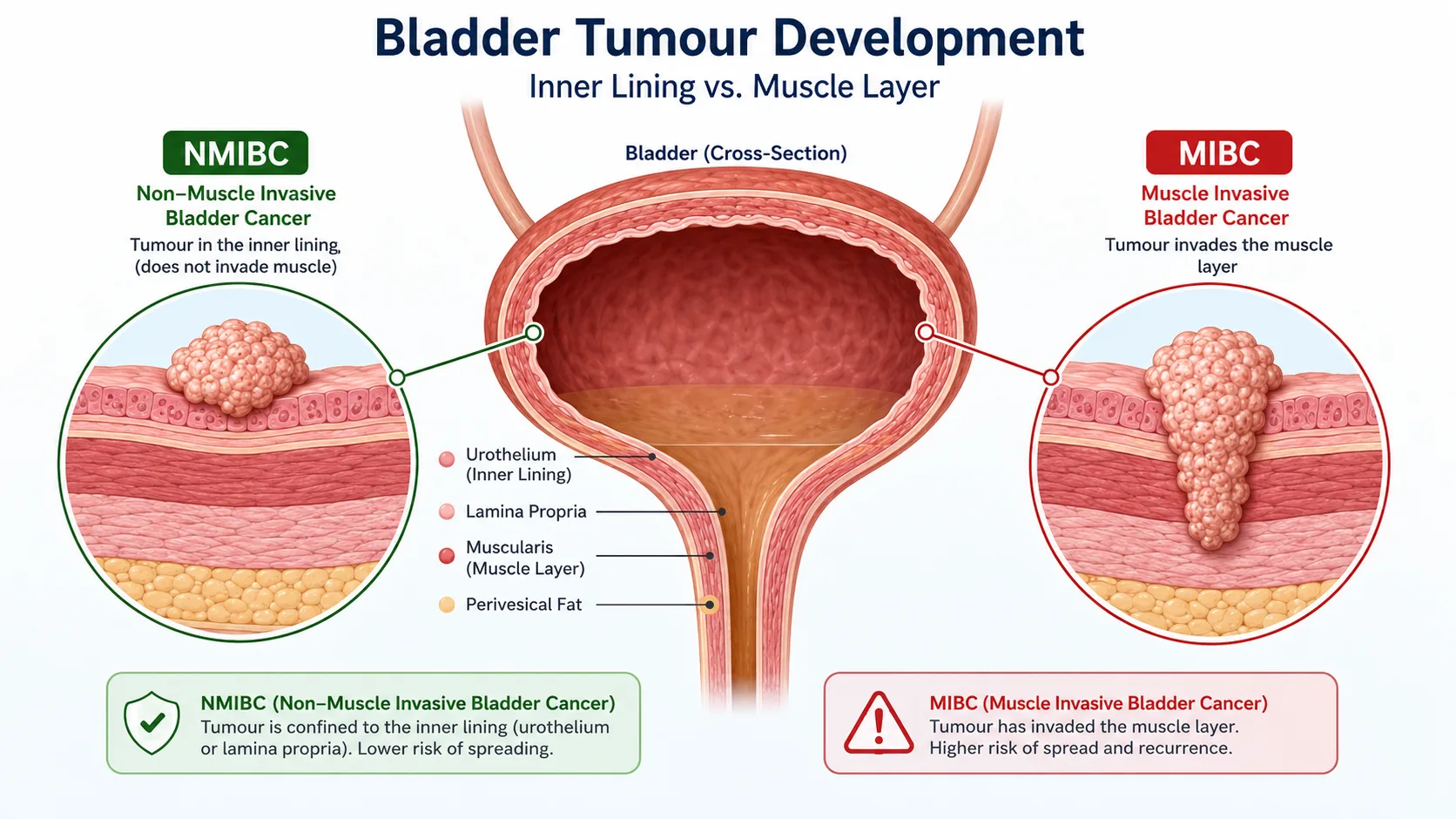
The bladder is a hollow, flexible organ in the lower abdomen. Bladder cancer begins when cells in the inner lining of the bladder grow abnormally and form a tumour. It is more common in men than women and is strongly linked to smoking and occupational chemical exposure.
- The most common type is urothelial carcinoma (transitional cell carcinoma), accounting for over 90% of bladder cancers
- Other types include squamous cell carcinoma and adenocarcinoma of the bladder
- Bladder cancer can be non-muscle invasive (early) or muscle invasive (advanced)
- Early detection leads to significantly better outcomes and bladder preservation in many cases
What Causes Bladder Cancer?
Bladder cancer is most commonly caused by smoking and long-term exposure to industrial chemicals, these are the two biggest risk factors identified in Indian and global patients.
Common bladder cancer risk factors include:
- Smoking – the single largest bladder cancer cause; smokers are 2 to 3 times more likely to develop bladder cancer
- Occupational chemical exposure – workers in rubber, leather, textile, dye, and paint industries face higher risk
- Chronic bladder infections – recurrent UTIs and long-term catheter use increase risk
- Age – more common in people above 60 years
- Gender – men are 3 to 4 times more likely to develop bladder cancer than women
- Previous cancer treatment – prior pelvic radiation or cyclophosphamide chemotherapy increases risk
- Family history – a first-degree relative with bladder cancer raises individual risk
- Arsenic in drinking water – linked to higher bladder cancer incidence in certain regions
Symptoms of Bladder Cancer
The most common bladder cancer symptom is blood in the urine, which may appear pink, red, or cola-coloured and is often painless, making it easy to dismiss or overlook.
Many patients mistake early bladder cancer symptoms for a urinary tract infection. Do not ignore the following:
- Blood in urine (haematuria) – may come and go; never normal and always needs evaluation
- Frequent urge to urinate, even when the bladder is not full
- Pain or burning during urination
- Difficulty passing urine or weak urine stream
- Lower back pain or pain on one side
- Pelvic pain
- Unexplained weight loss and fatigue (in advanced cases)
- Swelling in the legs (when cancer has spread to lymph nodes)
Bladder cancer symptoms in women are often mistaken for UTIs or menstrual issues, which can delay diagnosis. Any blood in urine, regardless of gender, warrants immediate investigation.
Reach Out for Expert Care
How Is Bladder Cancer Diagnosed?
Bladder cancer is diagnosed through cystoscopy, a camera test inside the bladder, supported by urine tests and imaging scans, making it one of the few cancers where direct visual examination is possible.
Dr. Surender Kumar Dabas follows a thorough bladder cancer diagnosis pathway:
- Urine cytology – checks for cancerous cells shed into urine
- Ultrasound – initial imaging to detect bladder wall thickening or masses
- Cystoscopy – gold standard; a thin camera is inserted into the bladder to directly visualise tumours
- CT urogram – detailed imaging of the bladder, ureters, and kidneys
- MRI pelvis – assesses depth of tumour invasion into the bladder muscle
- PET scan – evaluates spread to lymph nodes or distant organs
- TURBT (Transurethral Resection of Bladder Tumour) – both diagnostic and therapeutic; removes the tumour and sends it for biopsy to confirm stage and grade
Stages of Bladder Cancer
Bladder cancer is staged from Stage 0 to Stage IV, early stages are confined to the bladder lining, while advanced stages involve the bladder muscle, nearby organs, or distant sites.
| Stage | Description |
| Stage 0 | Cancer cells on the inner surface of the bladder only |
| Stage I | Cancer has grown into the connective tissue but not the muscle |
| Stage II | Cancer has invaded the bladder muscle |
| Stage III | Cancer has spread to nearby fat, prostate, uterus, or lymph nodes |
| Stage IV | Cancer has spread to distant organs such as lungs, liver, or bones |
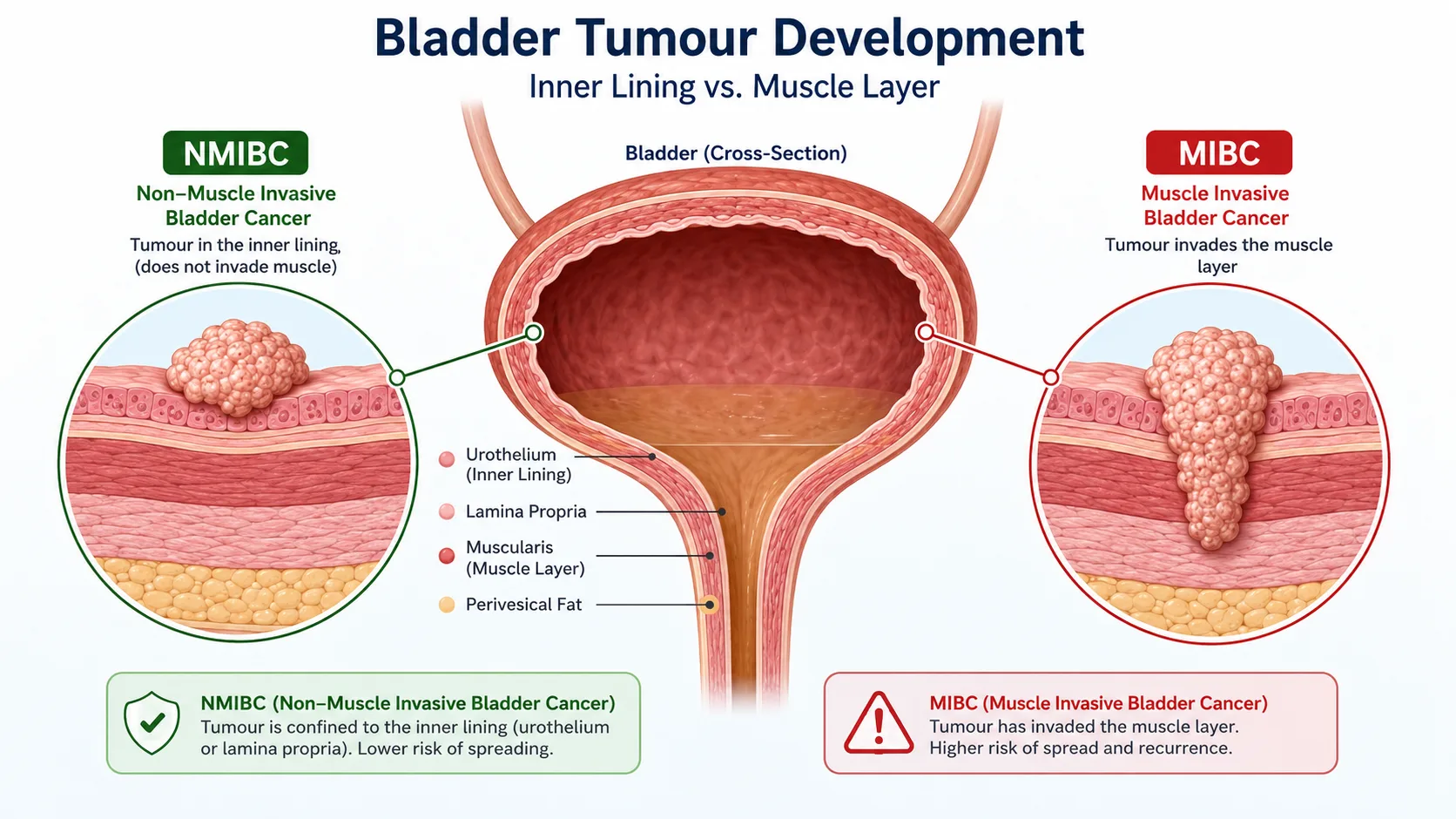
Stages 0 and I are non-muscle invasive bladder cancer (NMIBC) and are highly treatable. Stages II and III are muscle invasive bladder cancer (MIBC) and require more aggressive treatment.
Bladder Cancer Treatment Options in Delhi NCR
Bladder cancer treatment depends on the stage, non-muscle invasive cancer is treated with TURBT and intravesical therapy, while muscle invasive cancer requires radical cystectomy, often combined with chemotherapy.
Dr. Surender Kumar Dabas, one of the best cancer doctor in Delhi, offers a full range of treatments personalised to each patient’s stage, grade, and overall health.
- TURBT – Transurethral Resection of Bladder Tumour
- First-line treatment for non-muscle invasive bladder cancer
- Tumour is removed endoscopically through the urethra, no external cuts required
- Also serves as the definitive diagnosis and staging tool
- Most patients go home within 24 to 48 hours
- Intravesical Therapy (BCG or Chemotherapy into the Bladder)
- Given after TURBT to reduce the risk of recurrence
- BCG immunotherapy, the most effective intravesical treatment for high-risk non-muscle invasive bladder cancer
- Intravesical chemotherapy (mitomycin C), used for low to intermediate risk cases
- Robotic Radical Cystectomy
- Complete removal of the bladder for muscle invasive bladder cancer
- Performed using the Da Vinci Xi robotic system for greater precision and faster recovery
- In men: bladder, prostate, and seminal vesicles are removed
- In women: bladder, uterus, ovaries, and part of the vagina may be removed
- Followed by urinary diversion, creating a new way for urine to leave the body
- Urinary Diversion Options After Cystectomy
- Neobladder, a new bladder created from the intestine, allowing near-normal urination
- Ileal conduit, urine drains through a small stoma into an external pouch
- Dr. Dabas discusses both options in detail so patients can make an informed choice
- Bladder-Preserving Treatment (Trimodality Therapy)
- For selected patients with muscle invasive bladder cancer who are not surgical candidates
- Combines TURBT, chemotherapy, and radiation to preserve the bladder
- Requires careful patient selection and close follow-up
- Chemotherapy for Bladder Cancer
- Neoadjuvant chemotherapy, given before radical cystectomy to shrink the tumour
- Adjuvant chemotherapy, given after surgery to reduce recurrence risk
- Standard regimen: gemcitabine with cisplatin (GC)
- Immunotherapy for Bladder Cancer
- Checkpoint inhibitors (pembrolizumab, atezolizumab) used for advanced or metastatic bladder cancer
- Also used for BCG-unresponsive non-muscle invasive bladder cancer in selected cases
Why Choose Dr. Surender Kumar Dabas for Bladder Cancer Treatment in Delhi NCR?
Dr. Surender Kumar Dabas is one of the best robotic cancer surgeons in Delhi NCR with 22+ years of experience, 5,000+ robotic surgeries, and specialist expertise in robotic cystectomy and urological cancer surgery.
- 22+ years of experience in surgical oncology including complex bladder cancer surgery in Delhi NCR
- 5,000+ robotic surgeries, among the highest robotic surgery volumes for a cancer surgeon in India
- Robotic cancer doctor in Delhi NCR, performs robotic radical cystectomy using the Da Vinci Xi system with precision and minimal blood loss
- Bladder preservation focus, always evaluates whether trimodality or bladder-sparing approaches are suitable before recommending cystectomy
- Urinary reconstruction expertise, experienced in neobladder creation and ileal conduit, offering patients full surgical options for life after cystectomy
- Clear communication, explains bladder cancer staging, surgery, and urinary diversion options in simple language so patients and families feel confident at every step
- Shorter hospital stays and faster recovery, robotic cystectomy patients typically recover significantly faster than those undergoing open surgery
- Patients from across India consult Dr. Dabas for complex bladder cancer treatment in Delhi NCR, including robotic cystectomy and neobladder reconstruction
Cost of Bladder Cancer Treatment in Delhi NCR
The cost of bladder cancer treatment in Delhi NCR depends on several factors:
- Stage and grade of bladder cancer (non-muscle invasive vs. muscle invasive)
- Type of surgery, TURBT, robotic cystectomy, or bladder-sparing treatment
- Choice of urinary diversion, neobladder or ileal conduit
- Need for chemotherapy or immunotherapy
- Hospital stay duration and post-operative care
For a transparent, personalised cost estimate based on your reports, book a consultation with Dr. Surender Kumar Dabas, one of the best bladder cancer doctor in Delhi.
If you or a family member has been diagnosed with bladder cancer or is experiencing bladder cancer symptoms such as blood in urine, early evaluation is the most important step.

Dr. Surender Dabas' Medical Content Team
Dr. Surender Dabas' Medical Content Team is committed to providing accurate, reliable, and easy-to-understand information on cancer care. Working closely with oncology experts, the team ensures that every article is medically reviewed, up-to-date, and designed to help patients and their families better understand cancer, treatment options, and recovery.

 WhatsApp