
Gastric (Stomach) Cancer Treatment in Delhi NCR
Gastric cancer, also called stomach cancer, is the uncontrolled growth of malignant cells in the stomach lining, and is one of the most common gastrointestinal cancers in India, often diagnosed late because early symptoms are mild and easy to overlook.
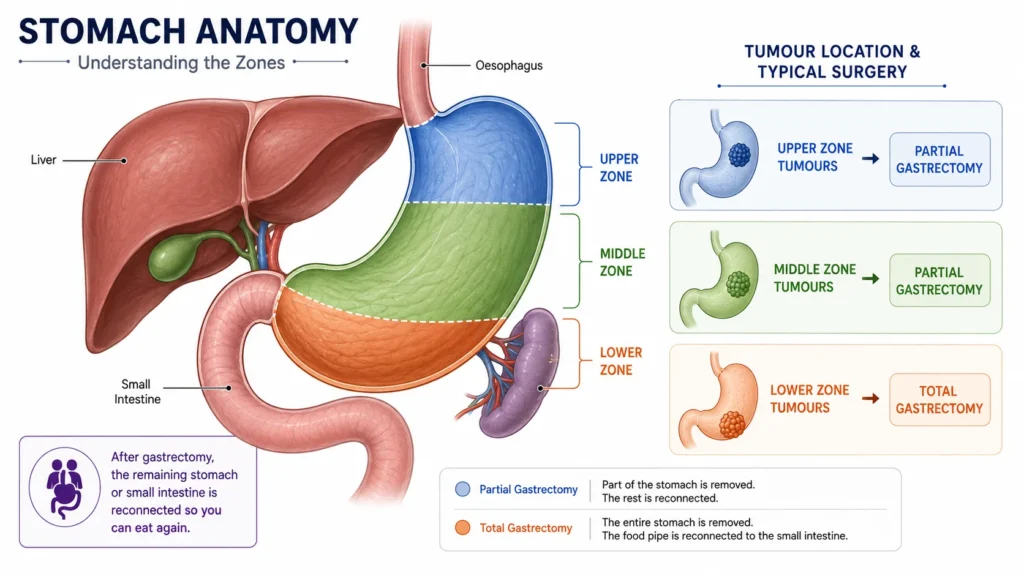
Your stomach sits in the upper left part of your abdomen. It breaks down food, mixes it with digestive juices, and passes it into the small intestine. When gastric cancer develops in the stomach lining, it can grow quietly for months before causing noticeable symptoms, which is why early evaluation matters.
Common types of stomach cancer:
- Gastric adenocarcinoma – accounts for more than 90% of all stomach cancers; starts in the glandular cells lining the stomach; the type most people mean when they say gastric cancer
- Gastrointestinal stromal tumour (GIST) – starts in the connective tissue of the stomach wall; treated differently from adenocarcinoma
- Gastric lymphoma – cancer of the lymphatic tissue in the stomach; treated primarily with chemotherapy
- Gastric carcinoid tumours – rare; develop from hormone-producing cells in the stomach
What Causes Gastric Cancer?
Gastric cancer is most commonly linked to H. pylori bacterial infection, a diet high in salty and processed foods, and smoking, in India, late diagnosis rather than high incidence is the bigger challenge.
Key gastric cancer risk factors to know:
- H. pylori infection – a bacterial infection of the stomach lining; the single most important gastric cancer cause globally; causes chronic inflammation that over time can trigger cancerous changes
- Diet – regular consumption of very salty, smoked, pickled, or processed foods is linked to higher risk
- Tobacco and smoking smokers have twice the risk of developing stomach cancer compared to non-smokers
- Family history – a close relative with gastric cancer increases your risk
- Chronic gastritis and stomach ulcers – long-standing stomach inflammation increases cancer risk
- Previous stomach surgery – certain stomach operations done years ago can raise long-term risk
- Obesity – linked to gastric cancer of the upper stomach and gastro-oesophageal junction
- Age and gender – more common in men and in people above 60 years
Symptoms of Gastric Cancer
The most common early symptoms of gastric cancer are persistent indigestion, upper abdominal discomfort, and loss of appetite, because these overlap with common stomach problems, many patients are diagnosed late.
Please do not put these symptoms down to “just acidity”, especially if they are new, persistent, or getting worse:
- Persistent indigestion or heartburn that does not respond to antacids
- Upper abdominal pain or discomfort – a dull ache in the centre or upper left of the abdomen
- Loss of appetite – particularly a new or worsening dislike of meat
- Feeling full very quickly even after eating small amounts (early satiety)
- Unexplained weight loss – often the most alarming symptom
- Nausea and vomiting – sometimes with blood in the vomit
- Dark or tarry stools – a sign of bleeding from the tumour
- Anaemia – feeling tired and breathless due to slow blood loss from the tumour
- Swelling or fluid in the abdomen (in advanced cases)
- A palpable lump in the upper abdomen
If any of these symptoms have been present for more than 4 weeks, especially in someone above 45 or with a family history of stomach cancer, please see a gastric cancer specialist in Delhi NCR for an endoscopy.
Reach Out for Expert Care
How Is Gastric Cancer Diagnosed?
Gastric cancer is diagnosed through upper GI endoscopy and biopsy, a camera is passed through the mouth into the stomach to directly view the tumour and take a tissue sample to confirm the diagnosis.
Dr. Surender Kumar Dabas uses a thorough step-by-step gastric cancer diagnosis process:
- Upper GI endoscopy – the most important test; a flexible camera is passed through the mouth into the stomach; the tumour is seen directly and a biopsy is taken
- Biopsy – the tissue sample confirms whether gastric cancer is present, what type it is, and its grade
- CT scan of the chest, abdomen, and pelvis – evaluates tumour size, depth, lymph node involvement, and spread to other organs like the liver
- PET-CT scan – checks for cancer spread to distant parts of the body; essential for accurate gastric cancer staging
- Endoscopic ultrasound (EUS) – assesses how deeply the tumour has grown into the stomach wall; critical for surgical planning
- Staging laparoscopy – a keyhole camera examination of the abdominal cavity done before surgery to check for any small peritoneal deposits not seen on scans
- HER2 testing – done on the biopsy tissue; HER2-positive gastric cancer responds to targeted therapy with trastuzumab
- Nutritional assessment – many gastric cancer patients are undernourished; nutritional support is started early to prepare for treatment
Stages of Gastric Cancer
Gastric cancer is staged from Stage I to Stage IV, early-stage stomach cancer is highly curable with surgery, while advanced stages require a combination of chemotherapy and surgery for the best outcomes.
| Stage | What It Means |
| Stage I | Cancer is in the inner layers of the stomach wall only |
| Stage II | Cancer has grown deeper or spread to a few nearby lymph nodes |
| Stage III | Cancer has grown through the stomach wall or spread to more lymph nodes |
| Stage IVA | Cancer has spread to nearby organs or the abdominal lining (peritoneum) |
| Stage IVB | Cancer has spread to distant organs — liver, lungs, or bones |
Stage I and II gastric cancer is highly curable with surgery. Stage III is treated with a combination of chemotherapy and surgery. Even Stage IV stomach cancer treatment can extend life and improve quality of life significantly with modern chemotherapy and targeted therapy.
Gastric Cancer Treatment Options in Delhi NCR
Gastric cancer is treated with surgery, chemotherapy, targeted therapy, and in some cases radiation, for most patients, the best outcomes come from chemotherapy before and after surgery combined with complete surgical removal of the tumour.
Dr. Surender Kumar Dabas, one of the best surgical oncologists in Delhi, offers every modern gastric cancer treatment option, personalised to your stage, tumour type, and health.
- Surgery – Gastrectomy
- Surgical removal of the stomach (partial or total) is the cornerstone of gastric cancer treatment for localised disease
- Subtotal (partial) gastrectomy – removes the part of the stomach containing the tumour along with nearby lymph nodes; the remaining stomach is reconnected to the small intestine; used for tumours in the lower stomach
- Total gastrectomy – complete removal of the stomach; the oesophagus is connected directly to the small intestine; used for tumours in the upper or middle stomach, or widespread disease
- D2 lymph node dissection – an extended removal of lymph nodes around the stomach; standard practice in high-volume gastric cancer surgery; significantly improves cure rates
- Performed with a reconstruction that allows you to eat again – smaller meals, more frequently
- Robotic Gastric Cancer Surgery in Delhi
- Robotic gastrectomy uses the Da Vinci Xi system, 3D vision and robotic arm precision inside the abdomen
- The same complete cancer surgery, with smaller cuts, less blood loss, less pain, and faster recovery than open surgery
- Patients are typically mobile sooner, eat sooner, and go home sooner after robotic gastric cancer surgery in Delhi
- Dr. Surender Kumar Dabas is one of the best robotic cancer surgeons in Delhi and performs robotic gastrectomy for eligible patients
- Minimally Invasive (Laparoscopic) Gastrectomy
- Keyhole surgery using small incisions and a laparoscopic camera
- Offers the same oncological outcomes as open surgery with significantly faster recovery
- Suitable for early-stage and selected advanced gastric tumour cases
- Neoadjuvant Chemotherapy (Before Surgery)
- Chemotherapy given before surgery to shrink the tumour and kill microscopic cancer cells
- Makes surgery safer and more effective, increases the chance of complete tumour removal
- Standard regimen: FLOT (docetaxel, oxaliplatin, leucovorin, fluorouracil), shown to significantly improve survival in advanced gastric cancer
- 3 to 4 cycles are given before surgery, followed by surgery, then more chemotherapy after
- Adjuvant Chemotherapy (After Surgery)
- Given after surgery to kill any remaining cancer cells and reduce recurrence risk
- Part of the standard treatment pathway for Stage II and III gastric cancer
- Continued for a total of 8 cycles when combined with pre-surgery chemotherapy (FLOT protocol)
- Targeted Therapy for Gastric Cancer
- Trastuzumab (Herceptin) – used for HER2-positive gastric cancer alongside chemotherapy; significantly improves outcomes in this subgroup
- Ramucirumab – targets tumour blood vessel growth; used in second-line treatment for advanced disease
- HER2 and PD-L1 testing on the biopsy determines which targeted or immunotherapy drugs will work best
- Immunotherapy for Gastric Cancer
- Nivolumab and pembrolizumab – checkpoint inhibitors approved for advanced stomach cancer
- Used alongside chemotherapy as first-line treatment for advanced PD-L1 positive or MSI-high gastric cancer
- Works by helping your immune system recognise and attack cancer cells
- HIPEC for Gastric Cancer with Peritoneal Spread
- For selected patients with gastric cancer that has spread to the abdominal lining (peritoneum)
- Cytoreductive surgery with HIPEC – all visible cancer is removed surgically, then heated chemotherapy is circulated inside the abdomen to destroy remaining microscopic cells
- Offers the best possible outcome for carefully selected patients with peritoneal disease
- Requires specialist surgical expertise available at Dr. Dabas’s centre
- Palliative Treatment
- For advanced or Stage IV gastric cancer where cure is not the goal
- Chemotherapy, immunotherapy, and targeted therapy extend survival and maintain quality of life
- Stent placement can relieve blockage and restore the ability to eat
- Nutritional support and symptom management are core parts of care
Why Choose Dr. Surender Kumar Dabas for Gastric Cancer Treatment in Delhi NCR?
Dr. Surender Kumar Dabas is one of the best gastric cancer surgeons in Delhi NCR, with 22+ years of experience, 5,000+ robotic surgeries, and specialist expertise in robotic gastrectomy, D2 lymph node dissection, and HIPEC for stomach cancer.
- 22+ years of experience in GI surgical oncology including stomach cancer, oesophageal cancer, and complex gastrointestinal tumours
- Best robotic cancer surgeon in Delhi, India, performs robotic gastrectomy using the Da Vinci Xi system with precision and minimal complications
- 5,000+ robotic surgeries and 30,000+ complex cancer surgeries performed
- D2 lymph node dissection expertise – standard in every gastric cancer resection; maximises the chance of complete cure
- HIPEC capability – performs cytoreductive surgery with HIPEC for selected gastric cancer patients with peritoneal spread
- Nutrition-first approach – every patient’s nutritional status is assessed and corrected before surgery; this directly improves recovery and treatment tolerance
- Multidisciplinary care – works with medical oncologists, gastroenterologists, dietitians, and radiologists to build a complete personalised gastric cancer treatment plan
- Second opinion welcome – patients told their stomach cancer cannot be operated are encouraged to consult Dr. Dabas; resectability requires specialist GI surgical assessment
- Clear communication – explains every step in simple language; families are always included in discussions
Gastric Cancer Treatment Cost in Delhi NCR
The cost of gastric cancer treatment in Delhi NCR depends on:
- Stage of cancer and type of surgery needed – partial vs. total gastrectomy
- Surgical approach – robotic, laparoscopic, or open surgery
- Whether HIPEC is part of the procedure
- Neoadjuvant and adjuvant chemotherapy cycles
- HER2-targeted therapy or immunotherapy requirements
- Duration of hospital stay and nutritional support
Robotic gastrectomy may have a higher upfront cost but typically means fewer complications, shorter hospital stay, and faster recovery, reducing overall treatment costs. For a personalised gastric cancer surgery cost estimate in Delhi, book a consultation with Dr. Surender Kumar Dabas.
If you or a loved one has been experiencing persistent stomach pain, difficulty eating, or unexplained weight loss, do not wait.

Dr. Surender Dabas' Medical Content Team
Dr. Surender Dabas' Medical Content Team is committed to providing accurate, reliable, and easy-to-understand information on cancer care. Working closely with oncology experts, the team ensures that every article is medically reviewed, up-to-date, and designed to help patients and their families better understand cancer, treatment options, and recovery.


 WhatsApp