
Robotic Gastrectomy in Delhi NCR
Gastrectomy is a surgery to remove part or all of the stomach, it is the main treatment for stomach cancer and gives the best chance of cure when the cancer is caught at an early or intermediate stage.
Your stomach sits in the upper left part of your abdomen. When stomach cancer (gastric cancer) develops, surgery to remove the affected part of the stomach, along with surrounding lymph nodes, is the most important step in treatment.
Two main types of gastrectomy:
- Partial (subtotal) gastrectomy – removes the lower part of the stomach where the tumour is; the remaining upper stomach is reconnected to the small intestine; used for tumours in the lower stomach
- Total gastrectomy – removes the entire stomach; the food pipe is connected directly to the small intestine; used for tumours in the upper or middle stomach, or when cancer is more widespread
After gastrectomy, you can still eat, you will just need to adjust to smaller, more frequent meals as your body adapts.
What Is Robotic Gastrectomy?
Robotic gastrectomy is a minimally invasive stomach cancer surgery performed using the Da Vinci robotic system, it removes the same amount of stomach and lymph nodes as open surgery, but through tiny keyhole cuts with less pain and faster recovery.
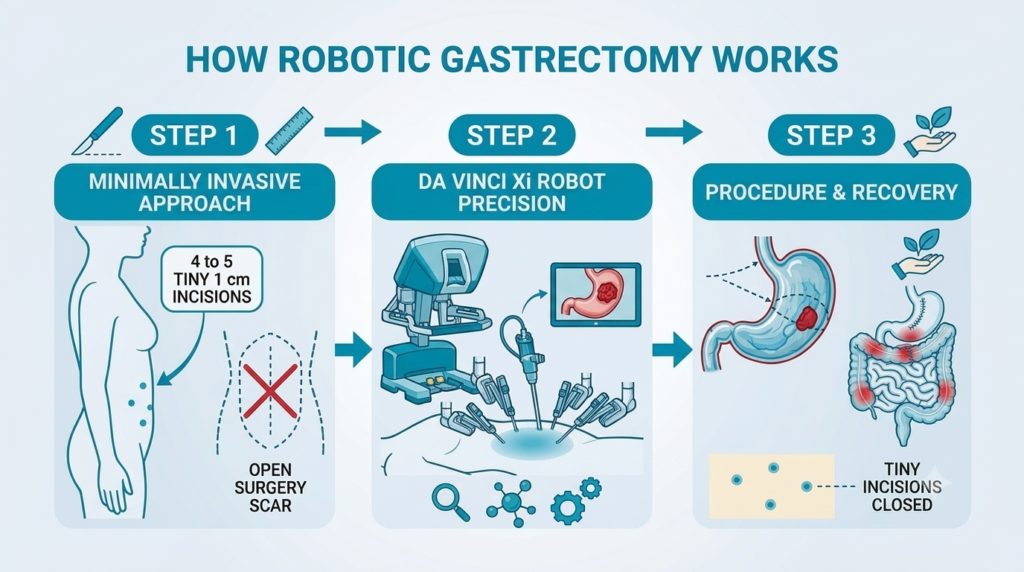
Instead of one large cut across the abdomen, robotic gastrectomy uses 4 to 5 small cuts, each about 1 cm in size. The Da Vinci Xi robot’s arms and 3D camera go through these tiny openings, giving Dr. Dabas an exceptionally clear, magnified view inside the abdomen and the precision to perform a complete cancer operation with minimal disruption to your body.
Dr. Surender Kumar Dabas is one of the best robotic cancer surgeons in Delhi NCR and performs robotic gastrectomy for eligible patients with gastric cancer.
Who Needs Robotic Gastrectomy?
Robotic gastrectomy is recommended for patients with stomach cancer who are suitable for surgery, it is particularly beneficial for those who want a faster recovery, less pain, and a shorter hospital stay compared to traditional open surgery.
You may be a suitable candidate for robotic gastrectomy in Delhi NCR if you have:
- Early-stage gastric cancer (Stage I or Stage II) – the ideal candidates; complete cure is achievable
- Stage III stomach cancer – after neoadjuvant chemotherapy to shrink the tumour first; then robotic surgery for removal
- GIST (Gastrointestinal Stromal Tumour) of the stomach – robotic removal gives excellent outcomes
- Patients who want minimal scarring and faster return to daily life
- Patients who have completed pre-surgery chemotherapy (FLOT protocol) and are now ready for surgery
- Patients who are otherwise medically fit for surgery
Dr. Surender Dabas, one of the best cancer doctor in Delhi, evaluates every patient individually, your cancer stage, tumour location, and overall health determine whether robotic gastrectomy is the right approach for you.
Reach Out for Expert Care
How Is Robotic Gastrectomy Performed?
Robotic gastrectomy is performed under general anaesthesia through 4 to 5 tiny cuts in the abdomen. The Da Vinci robot removes the stomach (partial or total) and lymph nodes with precision while you remain completely asleep and comfortable.
Here is a simple step-by-step of what happens:
- You go to sleep under general anaesthesia, the procedure takes approximately 3 to 5 hours depending on whether it is partial or total gastrectomy
- Four to five tiny cuts (each about 1 cm) are made in the abdomen, no large incision
- The Da Vinci Xi robot is set up – Dr. Surender Dabas sits at a console nearby and controls the robotic arms with 3D magnified vision inside your abdomen
- The stomach and lymph nodes are removed, the robotic arms move with far greater precision than human hands inside the confined space of the abdomen; the tumour, surrounding stomach tissue, and nearby lymph node groups (D2 dissection) are all carefully removed
- Reconstruction is done, the remaining stomach or small intestine is reconnected so food can pass through again; this is called anastomosis
- The small cuts are closed, you have four to five tiny scars instead of one large one
- You wake up and recovery begins, most patients are sipping water and sitting up the same day
Robotic Gastrectomy vs. Open Gastrectomy
Robotic gastrectomy achieves the same complete cancer removal as open surgery, but with significantly smaller cuts, less blood loss, less pain, and a much faster recovery.
| Open Gastrectomy | Robotic Gastrectomy | |
| Cut size | 15 to 25 cm incision | 4 to 5 cuts of 1 cm each |
| Blood loss | Higher | Significantly lower |
| Pain after surgery | Significant | Minimal |
| Hospital stay | 10 to 14 days | 5 to 7 days |
| Recovery time | 8 to 12 weeks | 4 to 6 weeks |
| Lymph node removal | Complete (D2) | Complete (D2) |
| Cancer outcome | Excellent | Excellent |
| Scar | Large visible scar | Four to five tiny scars |
The cancer surgery is the same, what changes is how your body is treated in the process.
Benefits of Robotic Gastrectomy
The main benefits of robotic gastrectomy are smaller cuts, significantly less pain, a shorter hospital stay, and faster return to normal life, all while achieving the same thorough cancer removal as open surgery.
Here is what patients tell us they appreciate most:
- Much less pain after surgery – tiny cuts cause far less discomfort than a large abdominal incision; most patients need only mild painkillers after the first day
- Shorter hospital stay – most patients go home in 5 to 7 days instead of 10 to 14 days after open surgery
- Back to normal life sooner – most patients return to light activities within 4 to 6 weeks instead of 8 to 12 weeks
- Significantly less blood loss – robotic precision means less bleeding during surgery and a lower chance of needing a blood transfusion
- Smaller scars – four to five tiny marks instead of one large scar across the abdomen
- Lower risk of complications – less wound infection, hernia, and post-operative chest problems because the body is disturbed far less
- Faster return to eating – patients start sipping water sooner and progress to soft foods more quickly
- Same thorough cancer operation – complete D2 lymph node dissection is performed in every case; the cancer result is identical to open surgery
- Better for tolerating chemotherapy – patients who recover faster from surgery can start post-operative chemotherapy on time, which improves overall outcomes
What Is D2 Lymph Node Dissection?
D2 lymph node dissection is the removal of an extended group of lymph nodes around the stomach during gastrectomy, it is the international gold standard for stomach cancer surgery and significantly improves the chance of cure.
This is one of the most important things to understand about stomach cancer surgery:
- Stomach cancer spreads first to the lymph nodes surrounding the stomach
- Simply removing the stomach without a thorough D2 lymph node clearance leaves behind nodes that may contain cancer cells
- D2 dissection removes all the lymph node groups around the stomach, along the major blood vessels, and in the surrounding fat
- Dr. Surender Kumar Dabas performs D2 lymph node dissection as a standard part of every robotic gastrectomy, this is what separates a specialist cancer operation from a basic surgical procedure
- The robotic system’s 3D precision makes D2 dissection safer and more thorough than it is with open or standard laparoscopic surgery
Why Choose Dr. Surender Kumar Dabas for Robotic Gastrectomy in Delhi NCR?
Dr. Surender Kumar Dabas is one of the best cancer surgeons in Delhi, India, with 22+ years of experience, 5,000+ robotic surgeries, and specialist expertise in robotic gastrectomy and D2 lymph node dissection for stomach cancer.
- Robotic cancer surgeon in Delhi, performs robotic gastrectomy using the Da Vinci Xi system with precision, safety, and minimal complications
- 5,000+ robotic surgeries and 30,000+ complex cancer surgeries performed
- D2 dissection expertise, complete lymph node clearance is performed in every case; never compromised
- Nutrition-first approach, every patient’s nutritional status is assessed and corrected before surgery; well-nourished patients recover faster and tolerate post-operative chemotherapy better
- Full treatment coordination, works with medical oncologists to time pre- and post-surgery chemotherapy (FLOT protocol) for the best possible outcome
- Multidisciplinary care, gastroenterologists, dietitians, and physiotherapists all support your recovery alongside the surgical team
- Talks to you simply, explains the surgery, what to eat afterwards, and what recovery looks like in plain language; your family is always included
- Second opinion welcome, patients told their stomach cancer cannot be operated are encouraged to consult Dr. Dabas; robotic surgery is suitable for many patients initially assessed as not operable
Recovery After Robotic Gastrectomy
Most patients go home within 5 to 7 days after robotic gastrectomy and return to light daily activities within 4 to 6 weeks, significantly faster than recovery after traditional open stomach surgery.
Here is what your recovery journey typically looks like:
- Day of surgery – you wake up with four to five small dressings; a nurse helps you sit up; you start sipping water within a few hours
- Day 1 to 2 – up and walking short distances; pain is well controlled with mild medication; drip and tubes are gradually removed
- Day 3 to 4 – progressing from water to clear liquids to soft foods; feeling noticeably more comfortable
- Day 5 to 7 – going home; eating soft foods; managing comfortably without hospital-level pain relief
- Week 2 to 3 – back to gentle daily activities; diet gradually expanding to include more foods
- Week 4 to 6 – most patients return to light work; diet close to normal but in smaller, more frequent portions
- Long term – eating 5 to 6 small meals a day rather than 3 large ones; most patients adapt well and enjoy a good quality of life
A dietitian from Dr. Dabas’s team will guide your diet at every stage of recovery.
Robotic Gastrectomy Cost in Delhi NCR
The cost of robotic gastrectomy in Delhi NCR depends on:
- Type of surgery – partial vs. total robotic gastrectomy
- Whether pre-surgery chemotherapy (FLOT) was completed
- Duration of hospital stay and ICU requirements
- Post-operative chemotherapy plan
- Nutritional support needs during recovery
Robotic gastrectomy typically means a shorter hospital stay and fewer complications than open surgery, which often balances out the overall cost of treatment. For a clear, personalised robotic gastrectomy cost in Delhi NCR, you may book a consultation with Dr. Surender Kumar Dabas.
If you or a loved one has been diagnosed with stomach cancer and want to know if robotic gastrectomy is the right option, you may speak to Dr. Surender Kumar Dabas today.
Reach Out for Expert Care
Frequently Asked Questions
Q1. Is robotic gastrectomy as effective as open surgery for stomach cancer?
Ans: Yes. Robotic gastrectomy follows the same cancer surgery principles, including D2 lymph node dissection, as open surgery. It may offer benefits such as smaller incisions, less pain, shorter hospital stay, and faster recovery.
Q2. Can I eat normally after robotic gastrectomy?
Ans: Most patients can return to a broad range of foods after robotic gastrectomy, but smaller, more frequent meals are usually recommended. After partial gastrectomy, eating often becomes easier within a few weeks, while total gastrectomy requires longer-term dietary adjustments.
Q3. How long will I stay in the hospital after robotic gastrectomy?
Ans: Most patients undergoing robotic gastrectomy in Delhi NCR may stay in the hospital for around 5 to 7 days, depending on recovery and individual health. Hospital stay can vary from patient to patient.
Q4. What is FLOT chemotherapy, and do I need it before robotic gastrectomy?
Ans: FLOT chemotherapy combines docetaxel, oxaliplatin, leucovorin, and fluorouracil and may be recommended before and after surgery for selected patients with Stage II or III stomach cancer. Your cancer team will determine whether it is appropriate for your gastric cancer.
Q5. Who is the best doctor for robotic gastrectomy in Delhi NCR?
Ans: Dr. Surender Kumar Dabas is an experienced robotic cancer surgeon in Delhi NCR, with 22+ years of experience and 5,000+ robotic surgeries. He specializes in robotic gastrectomy, D2 lymph node dissection, and complex cancer surgery at Manipal Hospital Dwarka and Manipal Jivisha Cancer Centre, Sonipat.
Q6. What does robotic gastrectomy cost in Delhi NCR?
Ans: The cost of robotic gastrectomy in Delhi NCR varies based on the type of surgery, hospital stay, and treatment plan. A consultation with Dr. Surender Kumar Dabas can provide a personalized cost estimate based on your diagnosis.

Dr. Surender Dabas' Medical Content Team
Dr. Surender Dabas' Medical Content Team is committed to providing accurate, reliable, and easy-to-understand information on cancer care. Working closely with oncology experts, the team ensures that every article is medically reviewed, up-to-date, and designed to help patients and their families better understand cancer, treatment options, and recovery.
 WhatsApp