
Robotic Lymph Node Dissection in Delhi NCR
Lymph node dissection is a surgery to remove lymph nodes from the body. It is done to treat cancer that has spread to the lymph nodes or to check whether cancer has started to spread.
Think of your lymph nodes as small checkpoints spread throughout your body. They are part of your immune system and the first place most cancers travel to when they start spreading. When your doctor recommends lymph node dissection, it means either cancer has already reached those nodes, or the risk of it spreading there is high enough that removing them is the safest choice.
Lymph node dissection is an important part of cancer treatment for:
- Oral cancer and throat cancer – neck lymph nodes are the first site of spread
- Stomach cancer – D2 lymph node dissection around the stomach is the gold standard
- Colon and rectal cancer – lymph nodes along the bowel are removed with the tumour
- Gynaecological cancers – uterine, cervical, and ovarian cancer; pelvic lymph nodes are assessed
- Thyroid cancer – central and lateral neck nodes are removed depending on the tumour
- Breast cancer – axillary (armpit) lymph node dissection for selected cases
- Melanoma and skin cancers – regional lymph node removal for cancer spread
What Is Robotic Lymph Node Dissection?
Robotic lymph node dissection uses the Da Vinci robotic system to remove lymph nodes through tiny keyhole cuts, achieving the same thorough removal as open surgery with significantly less pain, less blood loss, and faster recovery.
Traditional lymph node surgery often requires large incisions, in the neck, abdomen, chest, or groin, depending on where the nodes are. This means significant pain, a long hospital stay, and a slow recovery.
Robotic lymph node dissection is different:
- Surgery is performed through 3 to 5 tiny cuts of about 1 cm each
- The Da Vinci Xi robot’s 3D camera gives Dr. Dabas a magnified, crystal-clear view of the lymph nodes and surrounding structures
- The robotic arms move with far greater precision than human hands, critical when operating near nerves, blood vessels, and delicate tissues
- Dr. Surender Kumar Dabas is one of the best robotic cancer surgeons in Delhi NCR and performs robotic lymph node dissection across multiple cancer types
Where Can Robotic Lymph Node Dissection Be Performed?
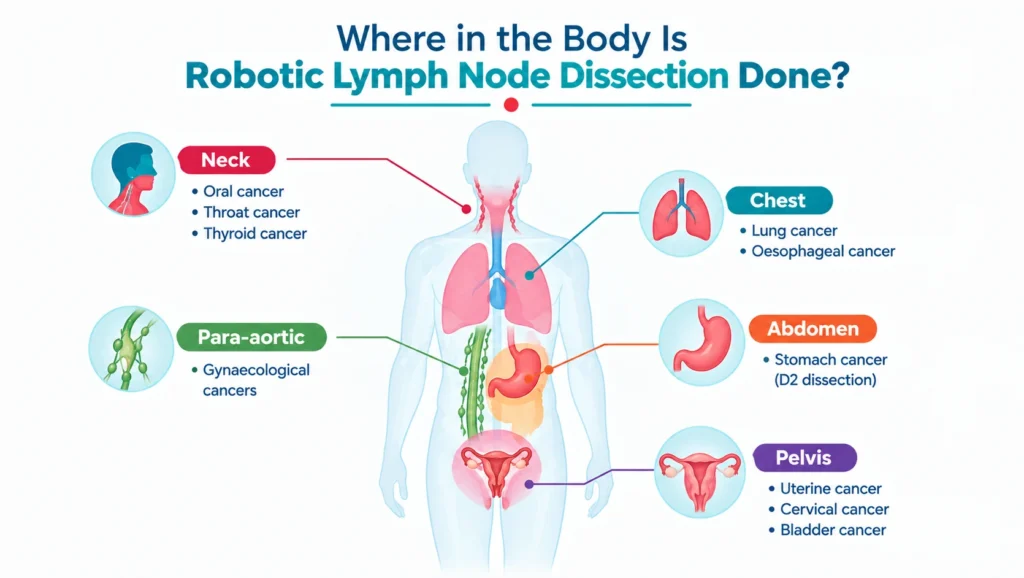
Robotic lymph node dissection can be performed in the neck, chest, abdomen, pelvis, and groin, the robotic approach is particularly valuable in areas where precision near major nerves and blood vessels is critical.
Common areas where Dr. Surender Dabas performs robotic lymph node dissection:
- Neck (cervical lymph node dissection) – for oral cancer, throat cancer, thyroid cancer, and salivary gland cancers; selective or modified radical neck dissection performed through a hidden incision with no visible neck scar
- Abdomen (D2 gastric lymph node dissection) – for stomach cancer; removes the extended group of nodes around the stomach along major blood vessels; the international gold standard for gastric cancer surgery
- Pelvis (pelvic lymph node dissection) – for uterine cancer, cervical cancer, bladder cancer, and prostate cancer; sentinel lymph node biopsy or full pelvic dissection performed robotically
- Chest (mediastinal lymph node dissection) – for lung cancer, oesophageal cancer, and thymus cancer; nodes between the lungs removed with robotic precision
- Para-aortic lymph node dissection – for gynaecological cancers that may have spread to nodes along the major abdominal blood vessel (aorta)
Reach Out for Expert Care
Who Needs Robotic Lymph Node Dissection?
Robotic lymph node dissection is recommended for cancer patients who need lymph node removal as part of their treatment, it is particularly beneficial when the nodes are near important nerves or blood vessels, where robotic precision makes the biggest difference.
You may need robotic lymph node dissection in Delhi NCR if:
- Your cancer has visibly spread to nearby lymph nodes on your scans
- Your cancer type carries a high risk of spreading to lymph nodes even when scans look clear
- Your surgeon needs to check the lymph nodes for accurate staging before deciding on further treatment
- You need sentinel lymph node biopsy, a targeted technique that checks only the first nodes cancer would travel to
- You are having robotic surgery for your primary cancer and lymph node removal will be done at the same time
- You want the most precise, minimally invasive approach available
Dr. Surender Dabas reviews every patient’s scans and reports individually before recommending the extent and approach of lymph node dissection.
How Is Robotic Lymph Node Dissection Performed?
Robotic lymph node dissection is performed under general anaesthesia through tiny cuts. The Da Vinci robot removes the lymph nodes with 3D precision while protecting the nerves and blood vessels surrounding them.
Here is what happens step by step:
- You go to sleep under general anaesthesia, the procedure takes 1 to 4 hours depending on the location and extent of dissection
- Three to five tiny cuts (about 1 cm each) are made near the area being treated, neck, abdomen, chest, or pelvis
- The Da Vinci Xi robot is set up, Dr. Dabas sits at a console and controls the robotic arms with a 3D magnified view inside the body
- Lymph nodes are carefully identified, the 3D camera clearly shows each lymph node group, the blood vessels supplying them, and the nerves running alongside them
- Lymph nodes are removed one group at a time, each group is carefully dissected and removed; the robotic precision means surrounding nerves and blood vessels are protected throughout
- Everything is checked, the area is inspected for any bleeding before closing
- Tiny cuts are closed, you wake up with small dressings and no large scar
- Recovery begins the same day, most patients are sitting up and comfortable within a few hours
Robotic vs. Open Lymph Node Dissection
Robotic lymph node dissection removes the same lymph nodes just as thoroughly as open surgery, but with smaller cuts, significantly less pain, better nerve preservation, and a much faster recovery.
| Open Lymph Node Dissection | Robotic Lymph Node Dissection | |
| Cut size | Large incision (5 to 20 cm) | 3 to 5 cuts of 1 cm each |
| Blood loss | Higher | Significantly lower |
| Pain after surgery | Significant | Minimal |
| Hospital stay | 3 to 7 days | 1 to 3 days |
| Recovery time | 4 to 8 weeks | 2 to 4 weeks |
| Nerve preservation | Good | Excellent (3D robotic precision) |
| Lymph node removal | Complete | Complete |
| Scar | Visible scar | Tiny or hidden scars |
The cancer outcome, how thoroughly the lymph nodes are removed, is exactly the same. The difference is in how your body is treated and how quickly you recover.
Benefits of Robotic Lymph Node Dissection
The key benefits of robotic lymph node dissection are much less pain, a shorter hospital stay of 1 to 3 days, significantly better nerve preservation, and a faster return to normal life, with the same complete lymph node removal as open surgery.
Here is what patients tell us matters most to them:
- Much less pain – tiny cuts cause far less discomfort than large surgical incisions
- Home in 1 to 3 days – instead of 3 to 7 days after open surgery
- Back to normal life in 2 to 4 weeks – instead of 4 to 8 weeks
- Better nerve protection – the 3D magnified robotic view clearly identifies every nerve; risk of nerve damage causing numbness, weakness, or functional loss is significantly reduced
- Less lymphoedema risk – when sentinel lymph node biopsy is used instead of full dissection; only the at-risk nodes are removed; leg, arm, or face swelling is far less likely
- Smaller or hidden scars – particularly important for neck dissection where a visible scar can be distressing
- Lower risk of complications – less bleeding, less infection, and less damage to surrounding structures
- Faster start to chemotherapy or radiation – patients who recover quickly can begin further treatment on schedule
- Same thorough cancer clearance – every lymph node group required for staging and treatment is removed completely
What Is Sentinel Lymph Node Biopsy?
Sentinel lymph node biopsy is a targeted technique used instead of full lymph node dissection in selected cases, only the first lymph nodes cancer would travel to are removed and tested, which significantly reduces side effects.
This is one of the most important advances in cancer surgery in recent years:
- A special dye or radioactive tracer is injected near the tumour before or during surgery
- The dye travels to the first one or two lymph nodes the cancer would drain into, these are the sentinel nodes
- Only these nodes are removed and sent for analysis
- If they are clear, no further nodes need to be removed
- If cancer is found in them, a full lymph node dissection is performed
- This approach dramatically reduces the risk of lymphoedema (fluid build-up causing swelling in the arm, leg, or face)
- Dr. Dabas uses sentinel lymph node biopsy routinely for uterine cancer, breast cancer, and selected oral cancer and melanoma cases
Why Choose Dr. Surender Kumar Dabas for Robotic Lymph Node Dissection in Delhi NCR?
Dr. Surender Kumar Dabas is among the best robotic cancer doctor in Delhi NCR and India, with 22+ years of experience, 5,000+ robotic surgeries, and specialist expertise in robotic lymph node dissection across multiple cancer types including head and neck, GI, gynaecological, and thoracic cancers.
- Among the most renowned robotic cancer surgeon in Delhi NCR and India, performs robotic lymph node dissection using the Da Vinci Xi system across the neck, chest, abdomen, and pelvis
- Leading cancer surgeon in Dwarka, consults at Manipal Hospital, Sector 6, Dwarka; fully equipped with the Da Vinci Xi robotic system
- Experienced cancer doctor in Delhi NCR, having 22+ years of experience across head and neck, GI, gynaecological, thoracic, and urological cancers
- 5,000+ robotic surgeries and 30,000+ complex cancer surgeries performed
- Nerve preservation expertise, exceptional track record of protecting critical nerves during neck, pelvic, and abdominal lymph node dissection
- Sentinel lymph node biopsy expertise, reduces surgical side effects while maintaining accurate cancer staging
- Pioneer in robotic head and neck surgery, among the highest volume robotic head and neck cancer surgeons in Asia; neck lymph node dissection through hidden incisions is a particular area of expertise
- D2 gastric lymph node dissection, performed as standard in every robotic gastrectomy for stomach cancer; the international gold standard
- Multidisciplinary cancer care, works with medical oncologists, radiation oncologists, and pathologists; lymph node results guide the entire treatment plan
- Talks to you simply, explains why lymph node removal matters, what the surgery involves, and what recovery looks like in plain language
Reach Out for Expert Care
What Does Recovery Look Like?
Most patients go home within 1 to 3 days after robotic lymph node dissection and return to normal daily activities within 2 to 4 weeks, significantly faster than recovery after traditional open lymph node surgery.
Recovery varies slightly depending on which area of the body was treated:
- Neck dissection – home in 1 to 2 days; back to light activities in 2 to 3 weeks; neck movement returns quickly
- Abdominal or pelvic dissection – home in 2 to 3 days; light activities in 2 to 3 weeks; full recovery in 4 to 6 weeks
- Day of surgery – you wake up with tiny dressings; sitting up and sipping water within a few hours
- Day 1 – up and walking; pain managed comfortably with mild tablets
- Day 2 to 3 – going home; eating normally; managing comfortably without hospital-level medication
- Week 1 to 2 – gentle daily activities; some mild tiredness and swelling that gradually settles
- Week 3 to 4 – most patients are back to work and daily routines
- Follow-up – regular check-ups with Dr. Surender Dabas to confirm recovery and review the lymph node results, which guide the next steps in treatment
Robotic Lymph Node Dissection Cost in Delhi NCR
The cost of robotic lymph node dissection in Delhi NCR starts from approximately ₹2,50,000, depending on multiple factors like::
- Which part of the body is being treated, neck, abdomen, pelvis, or chest
- Extent of dissection, sentinel biopsy only vs. full regional dissection
- Whether it is performed alongside primary cancer surgery
- Duration of hospital stay
- Post-operative chemotherapy or radiation requirements
The shorter hospital stay of 1 to 3 days compared to 3 to 7 days for open surgery often balances the overall cost. For a personalised cost estimate for robotic lymph node dissection in Delhi NCR, you may book a consultation with Dr. Surender Kumar Dabas.
Book a Consultation
If your doctor has recommended lymph node dissection as part of your cancer treatment and you want to explore the robotic option, speak to Dr. Surender Kumar Dabas today.
Frequently Asked Questions
Q1: Is robotic lymph node dissection as thorough as open surgery?
Ans: Yes, completely. Robotic lymph node dissection removes every required lymph node group with the same thoroughness as open surgery. The cancer staging and treatment outcomes are identical. The difference is smaller cuts, less pain, better nerve protection, and a much faster recovery.
Q2: What is the difference between lymph node dissection and sentinel lymph node biopsy?
Ans: Lymph node dissection removes an entire group or region of lymph nodes. Sentinel lymph node biopsy removes only the first one or two nodes cancer would travel to, using a special dye to identify them. If the sentinel nodes are clear, no further nodes need to be removed.
Q3: Will I get lymphoedema after robotic lymph node dissection?
Ans: The risk of lymphoedema, swelling caused by fluid build-up, depends on how many nodes are removed. Sentinel lymph node biopsy significantly reduces this risk by removing far fewer nodes. When full dissection is needed, the robotic approach causes less trauma to surrounding tissue, which also reduces lymphoedema risk compared to open surgery. Dr. Surender Dabas will discuss your individual risk before surgery.
Q4: How long will I stay in hospital?
Ans: Most patients go home in 1 to 3 days after robotic lymph node dissection in Delhi NCR. Neck dissection patients often go home in 1 to 2 days. Abdominal or pelvic dissection patients typically stay 2 to 3 days. You will be up and walking the day after surgery in most cases.
Q5: Can robotic lymph node dissection be done at the same time as my main cancer surgery?
Ans: Yes, in most cases, robotic lymph node dissection is performed as part of the same operation as your primary cancer surgery. For example, neck dissection is done at the same time as oral or throat cancer surgery; pelvic lymph node dissection is done during robotic hysterectomy; and D2 dissection is performed during robotic gastrectomy. This means one anaesthetic, one recovery, and a single hospital stay.

Dr. Surender Dabas' Medical Content Team
Dr. Surender Dabas' Medical Content Team is committed to providing accurate, reliable, and easy-to-understand information on cancer care. Working closely with oncology experts, the team ensures that every article is medically reviewed, up-to-date, and designed to help patients and their families better understand cancer, treatment options, and recovery.
 WhatsApp