
Thyroid Cancer Surgery – What You Need to Know Before You Decide
If you or someone you love has just been told “it’s thyroid cancer, you’ll need surgery,” your mind is probably racing with questions. Is surgery the only option? What’s the difference between the old method and the newer robotic technique? Will there be a visible scar? How long before life gets back to normal?
This blog answers the questions patients and families ask most often about thyroid cancer surgery, comparing traditional and robotic approaches, so you can walk into your consultation feeling informed rather than anxious.
When is surgery actually needed for thyroid cancer?
Surgery is recommended for most confirmed thyroid cancers, though the extent of surgery depends on tumour size, spread and type. Very small, low-risk nodules may sometimes be monitored instead of operated on immediately.
Not every thyroid nodule needs an operation. Many lumps in the thyroid are harmless and simply monitored with regular scans. However, once a biopsy confirms cancer, surgery becomes the primary treatment in the vast majority of cases, particularly for papillary, follicular and medullary thyroid cancers.
The extent of surgery, whether removing half the thyroid (lobectomy) or the entire gland (total thyroidectomy), depends on factors like tumour size, whether it has spread to lymph nodes, and the specific type of cancer involved. This is why an accurate diagnosis and detailed imaging matter so much before any decision is made.
Traditional thyroidectomy vs. robotic thyroidectomy
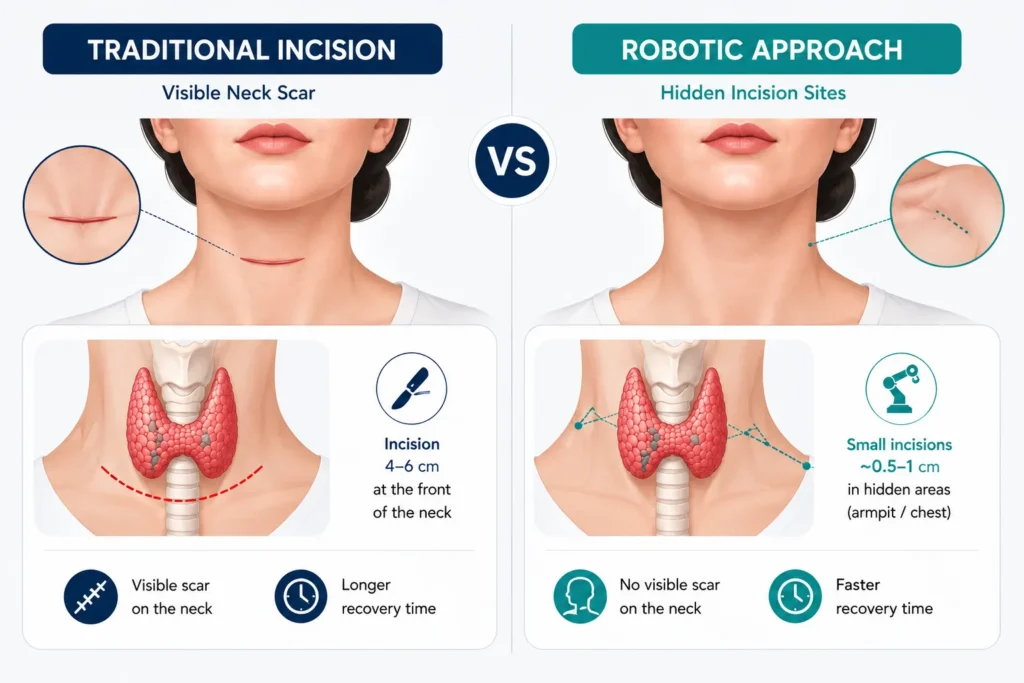
Traditional thyroidectomy uses a neck incision, while robotic thyroidectomy for thyroid cancer uses tiny instruments through hidden incisions, offering similar cancer control with better cosmetic and recovery outcomes.
For decades, traditional thyroidectomy has meant a horizontal incision at the front of the neck, generally around 5 to 8 centimetres long. It’s a well-established, safe technique that has treated thousands of patients successfully.
Robotic surgery for thyroid cancer takes a different route. Using a robotic surgical system, the surgeon operates through small incisions placed in less visible areas, such as under the armpit or behind the ear, depending on the technique used. Fine, wristed instruments allow precise movement inside tight spaces around the thyroid, close to delicate structures like the vocal cord nerves and parathyroid glands.
Both approaches aim for complete cancer removal. The real differences lie in precision, visibility for the surgeon, and what the patient sees afterwards. This is why more patients are now specifically seeking a best robotic cancer surgeon in India rather than settling for the conventional route by default.
The scar question – why robotic matters for thyroid
Robotic thyroidectomy avoids a visible neck scar by accessing the thyroid through hidden incision sites, an important factor for younger patients and those concerned about visible scarring.
For many patients, especially younger women, the neck scar is a genuine worry, not a vanity concern but a daily reminder of illness every time they look in the mirror. A visible scar can affect confidence at work, in social settings, and simply in how someone feels about themselves during recovery.
This is where thyroid cancer robotic surgery offers a meaningful advantage. Because incisions are placed away from the neck itself, patients are often left with no visible scarring in the area people notice first. For someone consulting the best thyroid cancer doctor in Delhi or best thyroid cancer doctor in Dwarka, this scar-free approach is frequently one of the deciding factors in choosing robotic over traditional surgery.
A message from Dr Surender Kumar Dabas
“Every thyroid cancer patient I meet has the same underlying fear: will I look and feel like myself again? My approach has always been to combine oncological safety with the least disruption to a patient’s daily life and confidence. Robotic surgery has allowed me to offer that balance to many of my patients, without ever compromising on cancer clearance.”
Stage 1 thyroid cancer: is surgery always the answer?
For stage 1 thyroid cancer, surgery, typically lobectomy or total thyroidectomy, remains the standard treatment, offering excellent long-term outcomes when performed by an experienced surgical oncologist.
Stage 1 thyroid cancer surgery tends to carry a reassuring prognosis. At this stage, the cancer is usually confined to the thyroid gland, sometimes with limited spread to nearby lymph nodes, and hasn’t reached distant organs.
Surgery remains the standard recommendation even at stage 1, because it offers the most reliable route to long-term remission. Depending on tumour characteristics, a surgeon may recommend removing just the affected lobe rather than the entire gland, which can help preserve some natural thyroid function and reduce the need for lifelong hormone replacement in select cases.
Patients often ask whether “watchful waiting” is an option at this stage. For select very low-risk, very small tumours, some centres do offer active surveillance, but this decision should only be made after a thorough discussion with a best surgical oncologist in Delhi or best surgical oncologist in India who can weigh the specific risk factors involved.
Recovery timeline: week by week
Recovery from thyroid cancer surgery generally takes one to two weeks for basic activities and up to four to six weeks for full normal routine, with robotic surgery often allowing a faster return to daily life.
Patients frequently ask how long to recover from thyroid cancer surgery, and the honest answer is that it varies, but here’s a general guide:
- Days 1 to 2: Hospital stay, mild throat discomfort, some neck stiffness or swelling around the incision sites.
- Days 3 to 7: Most patients return home and manage with light activity, soft foods, and rest. Voice may feel slightly hoarse.
- Week 2: Many people resume desk-based work, though heavy lifting and strenuous exercise are still restricted.
- Weeks 3 to 4: Energy levels improve steadily; incisions continue healing well.
- Weeks 4 to 6: Most patients are back to their full normal routine, with follow-up scans and thyroid hormone level checks scheduled.
Robotic surgery patients often report a smoother early recovery, with less visible bruising and reduced self-consciousness during the healing phase, since there’s no prominent neck incision to manage or conceal.
Dr. Surender Dabas’s approach to thyroid cancer surgery
Dr Surender Kumar Dabas is widely regarded as one of the best robotic cancer surgeon in Delhi NCR, one of the best cancer doctor in Delhi, one of the best cancer Doctor in Dwarka, with a surgical career spanning over 30,000 cancer surgeries and 5,000+ robotic procedures, including some of the highest volumes of robotic head and neck surgeries in Asia. His approach to thyroid cancer combines rigorous oncological standards with a genuine focus on how surgery affects a patient’s everyday life afterwards.
Operating at Manipal Comprehensive Cancer Centre, Delhi NCR, and Manipal Jivisha Cancer Centre, Sonipat, Dr Dabas is often sought out as the best robotic cancer surgeon in Dwarka and across the wider NCR region for patients specifically wanting a scar-conscious, precision-led approach to thyroid cancer treatment.
If you’ve recently been diagnosed and are weighing your options, a consultation is the best next step. Understanding your specific tumour, stage and the surgical approach best suited to you can bring real clarity during an otherwise overwhelming time.
Book a consultation with Dr Surender Kumar Dabas today to discuss the right thyroid cancer surgery approach for you.

 WhatsApp