
Robotic Radical Prostatectomy in Delhi NCR
Robotic radical prostatectomy is a keyhole operation to remove the prostate gland in men with prostate cancer, with the surgeon controlling robotic instruments from a console. For many men with localised disease, it is a well-established option, but it is not the only one, and not every man with prostate cancer needs surgery. This page explains who may be suitable, how the operation is done, what recovery looks like, and which risks to weigh up. Dr Surender Kumar Dabas, a robotic cancer surgeon in Delhi, offers robotic prostate cancer surgery in Delhi NCR for suitable patients, with consultations at Manipal Hospitals, Dwarka.
What Is Robotic Radical Prostatectomy?
Robotic radical prostatectomy, also called robot-assisted radical prostatectomy, is a minimally invasive operation that removes the whole prostate gland and the seminal vesicles to treat prostate cancer, using robotic instruments controlled by the surgeon.
How the technology works and how it differs from open surgery.
-
The surgeon sits at a console and controls a magnified 3D camera and wrist-controlled instruments. The robot does not operate on its own.
-
Instruments enter through several small incisions in the abdomen. The prostate, the seminal vesicles, and, when needed, nearby lymph nodes are removed.
-
In open surgery, the surgeon works by hand through one larger incision. Both approaches aim for complete cancer removal.
-
Dr. Surender Dabas uses the Da Vinci Xi platform in his practice of robotic cancer surgery in Delhi NCR. Availability of a given procedure at each location is confirmed at consultation.
Who May Need Robotic Radical Prostatectomy?
Robotic radical prostatectomy is usually considered for men whose cancer appears confined to the prostate, or selected men with locally advanced disease, who are fit for surgery and expected to live more than 10 years.
Suitability depends on several factors that your surgeon will review with you.
-
Risk group: Stage, Grade Group and PSA level guide the plan. For low-risk cancer, guidelines prefer active surveillance. For favourable intermediate-risk cancer, surveillance, radiotherapy and surgery are all discussed. For unfavourable intermediate-risk or high-risk cancer, surgery or radiotherapy with hormone therapy are both options.
-
Locally advanced disease: European guidelines describe surgery as a reasonable first step in selected men if the tumour is not fixed and does not invade the urethral sphincter, often within a combined treatment plan.
-
Staging scans: MRI of the prostate, and for higher-risk cancer, a PSMA PET scan or bone scan with CT, help plan treatment.
-
Overall health: Fitness for anaesthesia, other medical conditions, and personal priorities matter as much as the scan results.
-
Not every man needs surgery. Read more on prostate cancer treatment in Delhi NCR.
Reach Out for Expert Care
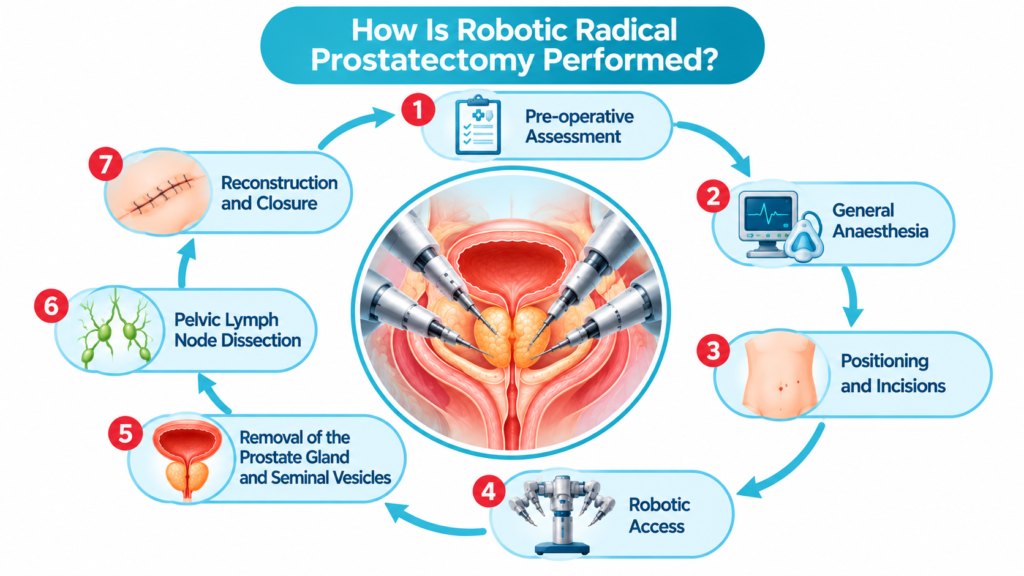
How Is Robotic Radical Prostatectomy Performed?
The operation is done under general anaesthesia through small abdominal incisions. The prostate and seminal vesicles are removed, lymph nodes are sampled when indicated, and the bladder is rejoined to the urethra.
The main steps are:
-
Pre-operative assessment: blood tests, PSA, MRI and staging scans, and an anaesthetic check.
-
General anaesthesia: you are asleep throughout.
-
Positioning and incisions: a few small cuts are made in the abdomen.
-
Robotic access: the camera and instruments are inserted and docked to the robot.
-
Removal of the prostate gland and seminal vesicles, taking care around the bladder, rectum and urethra.
-
Pelvic lymph node dissection, only when your risk assessment suggests it is worthwhile. When done, an extended dissection is recommended.
-
Reconstruction and closure: the bladder is joined to the urethra over a catheter, and the incisions are closed.
Nerve-Sparing Technique
Nerve-sparing surgery aims to preserve the nerves beside the prostate that support erections. Guidelines advise it where it is oncologically safe. Whether it is possible depends on tumour location and extent, biopsy grade, MRI findings, and your existing erectile function. It can be done on one side only, or partly.
Benefits of Robotic Radical Prostatectomy
Compared with open surgery, robotic radical prostatectomy usually means smaller incisions, less blood loss, less early pain and a shorter hospital stay. Cancer control and long-term urinary and sexual function appear similar.
The evidence behind this is worth knowing.
-
In a randomised trial, robotic surgery was linked to blood loss of about 443 mL versus 1,338 mL, and a stay of about 1.5 versus 3.2 days, compared with open surgery.
-
At 24 months, the same trial found similar urinary and sexual function. Its authors concluded that the benefits are largely related to the minimally invasive approach.
-
A magnified 3D view and wristed instruments help the surgeon work in the narrow pelvis.
-
Surgeon experience matters alongside technology. Robotic surgery is not claimed to be superior to open or laparoscopic surgery for long-term cancer control.
-
For a wider overview, read robotic surgery for cancer treatment: benefits, risks and recovery.
Robotic vs Open Radical Prostatectomy
Both operations remove the same organs for the same reason. Robotic surgery offers a minimally invasive route with less blood loss, but trials have not shown a clear long-term advantage in cancer control or function.
A balanced side-by-side comparison:
| Feature | Robotic radical prostatectomy | Open radical prostatectomy |
| Surgical approach | Surgeon operates robotic instruments from a console | Surgeon operates by hand |
| Incisions | Several small keyhole incisions | One larger incision |
| Visualisation | Magnified 3D high-definition view | Direct view |
| Instrument movement | Wristed, tremor-filtered instruments | Hand-held instruments |
| Blood loss | Usually lower | Usually higher |
| Hospital recovery | Often shorter stay | Often longer stay |
The right choice depends on your anatomy, cancer features, and the surgeon’s experience. See also robotic vs open cancer surgery.
Recovery After Robotic Radical Prostatectomy
Most men go home within one to three days with a urinary catheter, which is usually removed after one to two weeks. Return to usual activities takes about six weeks, while urinary control and erections recover more slowly.
Recovery varies between patients. A typical pattern:
-
Hospital recovery: you are encouraged to walk early. Discharge is usually within one to three days.
-
Urinary catheter: it stays in while the bladder joins to the urethra heals, then is removed at a follow-up visit.
-
Wound care: keep the small incisions clean and dry, and report fever, redness, discharge or catheter problems.
-
Daily activities: avoid heavy lifting for several weeks, as advised by your surgeon.
-
Urinary continence: some leakage is common at first and usually improves over weeks to months. Pelvic floor exercises, ideally started before surgery, help.
-
Erectile function: it can take months to a few years to improve, and depends on nerve-sparing and your function before surgery.
-
Follow-up: regular PSA tests check that the cancer was removed. An undetectable PSA is the aim, and any rise needs prompt review.
Risks of Robotic Radical Prostatectomy
Like any major operation, robotic radical prostatectomy carries risks. The most common are urinary incontinence and erectile dysfunction, along with bleeding, infection, blood clots and anaesthetic reactions.
Most men recover well, but your own risk depends on your health, your cancer and the surgery performed.
-
Urinary incontinence: usually improves, though a small number of men have long-term leakage.
-
Erectile dysfunction: common after surgery, especially if nerves cannot be spared.
-
Bleeding, infection and blood clots in the legs or lungs.
-
Anaesthesia-related complications, which your anaesthetist will discuss.
-
Bladder neck contracture or urethral narrowing, which can cause a weak stream and may need a further procedure.
-
Lymphocele (a fluid collection) after lymph node dissection.
-
Other effects: dry orgasm and infertility, and, rarely, injury to nearby organs such as the bowel.
-
Discuss your individual risks with your treating surgeon before deciding.
About Dr. Surender Kumar Dabas
Dr. Surender Kumar Dabas is a cancer doctor in Delhi, associated with comprehensive cancer care at Manipal Hospitals Dwarka and Manipal Jivisha Cancer Centre, Sonipat.
-
Qualifications: MBBS, MS (General Surgery), DNB (Surgical Oncology).
-
Professional designation: Chairman, Manipal Comprehensive Cancer Centre and Onco Robotic Surgeries, North West Cluster.
-
Delhi Medical Council Registration Number: 34114.
Related care: see his approach to urological cancer care in Delhi NCR.
Reach Out for Expert Care
Frequently Asked Questions
Q1. What is the success rate of robotic radical prostatectomy?
Ans. There is no single figure. Success depends on your cancer’s stage and grade, and is judged by complete removal and an undetectable PSA afterwards. Outcomes cannot be guaranteed.
Q2. Is robotic prostate surgery better than open surgery?
Ans. It usually means less blood loss and a shorter stay. Trials show similar cancer control and long-term urinary and sexual function, so surgeon experience matters.
Q3. How long does robotic radical prostatectomy take?
Ans. It typically takes a few hours. Duration varies with anatomy, nerve-sparing and whether lymph nodes are removed.
Q4. How many days does a patient stay in hospital?
Ans. Most men stay one to three days, depending on recovery.
Q5. How long does it take to recover after robotic prostate surgery?
Ans. Most men return to usual activities in about six weeks. Catheter removal is usually after one to two weeks.
Q6. Can urinary incontinence occur after prostate removal?
Ans. Yes. Leakage is common early and usually improves over weeks to months. Pelvic floor exercises help.
Q7. Can erectile function return after robotic prostatectomy?
Ans. It can, particularly after nerve-sparing surgery, but recovery takes months to years and is not guaranteed. Treatments are available.
Q8. How do I find an experienced robotic prostate cancer surgeon in Delhi NCR?
Ans. Ask about training, annual case numbers, and nerve-sparing approach. Dr. Dabas is an experienced cancer surgeon in Delhi NCR who consults at Dwarka.
Medical disclaimer: This page is for general education and does not replace advice from your doctor. Treatment depends on your diagnosis and clinical assessment.
Medical Sources & References
-
European Association of Urology (EAU), EANM, ESTRO, ESUR, ISUP, SIOG: Guidelines on Prostate Cancer, 2026 update (Part I, European Urology, 2026).
-
American Urological Association (AUA) and ASTRO: Clinically Localized Prostate Cancer Guideline (2022, amended 2026).
-
National Comprehensive Cancer Network (NCCN): Guidelines Insights, Prostate Cancer, Version 5.2026 (J Natl Compr Canc Netw, 2026).
-
Yaxley JW et al.: robot-assisted laparoscopic vs open radical retropubic prostatectomy, early outcomes (The Lancet, 2016).
-
Coughlin GD et al.: the same trial, 24-month outcomes (The Lancet Oncology, 2018).
-
American Cancer Society: Surgery for Prostate Cancer.
-
Cancer Council Australia: Prostate cancer, what to expect after surgery.

Dr. Surender Dabas' Medical Content Team
Dr. Surender Dabas' Medical Content Team is committed to providing accurate, reliable, and easy-to-understand information on cancer care. Working closely with oncology experts, the team ensures that every article is medically reviewed, up-to-date, and designed to help patients and their families better understand cancer, treatment options, and recovery.
 WhatsApp