
Robotic Hysterectomy in Delhi NCR
Hysterectomy is a surgery to remove the uterus (womb). It is the main treatment for uterine cancer and is also used for cervical cancer, ovarian cancer, and other gynaecological conditions.
The uterus is the organ in a woman’s pelvis where a baby grows. When cancer develops in or around it, removing the uterus surgically is usually the most important step towards cure.
Depending on what needs to be removed, hysterectomy can include:
- The uterus and cervix – called a total hysterectomy
- The uterus, cervix, both ovaries, and both fallopian tubes – the most common approach when surgery is done for cancer
- Radical hysterectomy – the uterus, cervix, top of the vagina, and the tissue around the uterus are also removed; used for cervical cancer and selected uterine cancers
After hysterectomy, you will no longer have periods and cannot become pregnant. For most women with gynaecological cancer, this surgery is the most important step towards getting better.
What Is Robotic Hysterectomy?
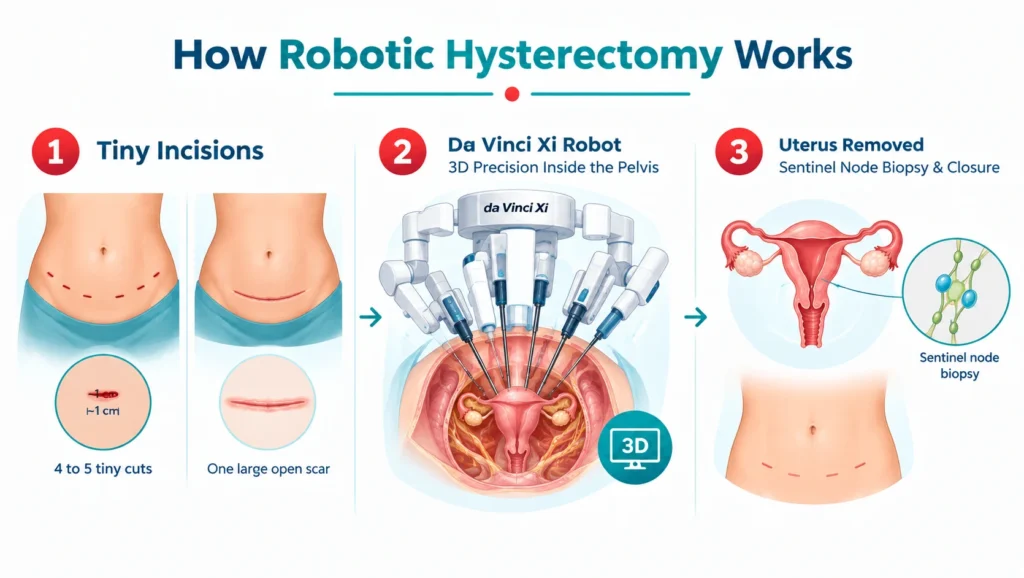
Robotic hysterectomy is a minimally invasive surgery that removes the uterus using the Da Vinci robotic system through tiny keyhole cuts, giving patients the same complete cancer surgery with much less pain, less blood loss, and a faster recovery than open surgery.
Instead of one large cut across the lower abdomen, robotic hysterectomy uses 4 to 5 tiny cuts each about 1 cm in size. The Da Vinci Xi robot’s arms and 3D camera go through these small openings, giving Dr. Dabas a magnified, crystal-clear view inside the pelvis to perform a thorough cancer operation while disturbing as little of the surrounding tissue as possible.
Dr. Surender Kumar Dabas is one of the best robotic cancer surgeons in Delhi NCR and performs robotic hysterectomy for women with uterine cancer, cervical cancer, and ovarian cancer.
Who Needs Robotic Hysterectomy?
Robotic hysterectomy is recommended for women with gynaecological cancers who need surgical removal of the uterus, it is most commonly used for uterine cancer, early cervical cancer, and selected ovarian cancer cases.
You do not have to decide anything today, but here are the situations where Dr. Dabas typically recommends the robotic approach:
- Uterine cancer (endometrial cancer) – the most common reason; robotic hysterectomy is now the preferred approach for most uterine cancer cases worldwide
- Cervical cancer (Stage I and selected Stage II) – the uterus, cervix, upper vagina, and surrounding tissue are removed with robotic precision
- Ovarian cancer (early-stage) – the uterus, both ovaries, and fallopian tubes are removed as part of staging and treatment
- Fibroids, endometriosis, or prolapse – for women who also need hysterectomy for non-cancerous reasons
- Women who want less pain, smaller scars, and a faster return to daily life
- Women who are overweight or obese – robotic surgery actually works better in this group than open surgery
Dr. Surender Dabas reviews every patient’s case individually, your diagnosis, stage, and health determine whether robotic hysterectomy is right for you.
How Is Robotic Hysterectomy Performed?
Robotic hysterectomy is performed under general anaesthesia through 4 to 5 tiny cuts, the Da Vinci robot removes the uterus and any other required structures with precision while you remain completely asleep.
Here is a simple step-by-step of what happens:
- You go to sleep under general anaesthesia, the whole procedure takes about 2 to 3 hours
- Four to five tiny cuts (each about 1 cm) are made in the lower abdomen, no large incision
- A small amount of gas gently expands the abdomen to give the robot space to work
- Dr. Dabas sits at a console nearby and controls the robotic arms, with a 3D magnified view inside your pelvis, far clearer than the human eye can see
- The uterus is carefully separated from the bladder, bowel, and the tubes that carry urine from the kidneys, the robot’s 3D camera clearly shows every structure so nothing is accidentally damaged
- Lymph nodes are checked using a special dye technique called sentinel lymph node biopsy, done at the same time to see if cancer has spread
- The uterus is removed through one of the small cuts or through the vagina
- The tiny cuts are closed, you wake up with four to five small dressings and no large scar
- Recovery begins the same day, most patients are sitting up and sipping water within a few hours
Reach Out for Expert Care
Robotic Hysterectomy vs. Open Hysterectomy
Robotic hysterectomy achieves the same complete cancer surgery as open hysterectomy, but with smaller cuts, much less pain, less blood loss, and a significantly faster recovery.
| Open Hysterectomy | Robotic Hysterectomy | |
| Cut size | 10 to 15 cm incision | 4 to 5 cuts of 1 cm each |
| Blood loss | Higher | Significantly lower |
| Pain after surgery | Significant | Minimal |
| Hospital stay | 5 to 7 days | 2 to 3 days |
| Recovery time | 6 to 8 weeks | 3 to 4 weeks |
| Cancer clearance | Complete | Complete, same result |
| Scar | Large lower abdominal scar | Four to five tiny scars |
The cancer surgery is exactly the same, what changes is how your body heals afterwards.
Benefits of Robotic Hysterectomy
The key benefits of robotic hysterectomy are much less pain after surgery, going home in 2 to 3 days, and returning to normal life in 3 to 4 weeks, all with the same complete cancer removal as open surgery.
Here is what patients tell us they value most:
- Much less pain – tiny cuts hurt far less than a large abdominal incision; most patients need only mild painkillers after the first day
- Home in 2 to 3 days – instead of 5 to 7 days after open surgery
- Back to normal life in 3 to 4 weeks – instead of 6 to 8 weeks
- Much less blood loss – lower chance of needing a blood transfusion
- Smaller scars – four to five tiny marks instead of one large lower abdominal scar
- Lower risk of complications – less wound infection and less chance of bladder or bowel injury
- Works well for overweight women – robotic surgery is safer for heavier patients than open surgery
- Faster start to any further treatment – patients who recover quickly can begin radiation or chemotherapy on time
- Same thorough cancer operation – lymph node assessment is done as standard; the cancer result is identical to open surgery
What Is Sentinel Lymph Node Biopsy?
Sentinel lymph node biopsy is a technique used during robotic hysterectomy to check if cancer has spread to the lymph nodes, only the most important nodes are removed, which means fewer side effects than removing all pelvic lymph nodes.
Here is how it works in simple terms:
- A special dye is injected into the uterus before or during surgery
- The dye travels to the first few lymph nodes that cancer would drain into, these are the sentinel nodes
- Only these nodes are removed and tested
- If they are clear, no more nodes need to be removed
- If cancer is found, a more thorough node removal is done
- This means less leg swelling (lymphoedema) and fewer long-term side effects for most women
- Dr. Dabas performs sentinel lymph node biopsy as a standard part of robotic hysterectomy for uterine cancer
Why Choose Dr. Surender Kumar Dabas for Robotic Hysterectomy in Delhi NCR?
Dr. Surender Kumar Dabas is one of the best robotic cancer surgeons in Delhi NCR and India, with 22+ years of experience, 5,000+ robotic surgeries, and specialist expertise in robotic hysterectomy and gynaecological cancer surgery.
- One of the Best robotic cancer surgeon in Delhi NCR and India, performs robotic hysterectomy using the Da Vinci Xi system; most patients go home in 2 to 3 days
- One of the top cancer doctor in Delhi NCR with 22+ years in gynaecological, GI, urological, and head and neck cancer surgery
- 5,000+ robotic surgeries and 30,000+ complex cancer surgeries performed
- Sentinel lymph node biopsy expertise, reduces surgical side effects while ensuring accurate cancer staging
- Genetic testing offered, if you have a family history of cancer, Dr. Dabas can arrange testing that may protect you and your family members in the future
- Talks to you simply, explains what removing the uterus means for your body, what recovery looks like, and what comes next, in plain, honest language before you decide anything
- Sensitive and unhurried, understands that gynaecological cancer surgery is deeply personal; every patient gets the time and privacy they need
- Multidisciplinary care, works with medical oncologists, radiation oncologists, and genetic counsellors for a complete personalised plan
What Does Recovery Look Like?
Most patients go home within 2 to 3 days after robotic hysterectomy and are back to normal daily activities within 3 to 4 weeks, much faster than the 6 to 8 weeks needed after open surgery.
Here is a simple day-by-day picture:
- Day of surgery – you wake up feeling comfortable; sitting up and sipping water within a few hours; four to five small dressings on the abdomen
- Day 1 – up and walking; eating soft foods; pain well managed with mild tablets
- Day 2 to 3 – going home; comfortable without hospital-level pain relief
- Week 1 to 2 – gentle activities at home; some tiredness is normal; no heavy lifting
- Week 3 to 4 – back to light work, driving, and daily routines; energy returning to normal
- Week 6 – follow-up with Dr. Dabas; most patients are fully recovered and any further treatment can begin if needed
Robotic Hysterectomy Cost in Delhi NCR
The cost of robotic hysterectomy in Delhi NCR depends on:
- Type of hysterectomy – total, radical, or extended
- Whether sentinel lymph node biopsy or full lymph node dissection is needed
- Cancer type – uterine, cervical, or ovarian cancer
- Length of hospital stay
- Post-operative radiation or chemotherapy needs
The shorter 2 to 3 day hospital stay (vs. 5 to 7 days for open surgery) significantly reduces the overall cost of treatment. For a clear, honest robotic hysterectomy cost estimate in Delhi NCR, book a consultation with Dr. Surender Kumar Dabas.
If you have been diagnosed with uterine cancer, cervical cancer, or ovarian cancer and want to know if robotic hysterectomy is right for you, please do not wait.
Reach Out for Expert Care
Frequently Asked Questions
Q1. Is robotic hysterectomy as effective as open surgery for cancer?
Ans1. Yes, completely. The cancer is removed just as thoroughly. The only difference is smaller cuts, less pain, and a faster recovery. The chance of the cancer coming back is exactly the same as with open surgery.
Q2. Will I go through menopause after robotic hysterectomy?
Ans2. If both ovaries are removed, which is standard for most gynaecological cancers, you will go into menopause straight after surgery. This can cause hot flushes, mood changes, and sleep disturbance. Most women adjust well with time and the right support from their care team.
Q3. How long will I stay in hospital?
Ans3. Most patients go home in 2 to 3 days. You will be sitting up on the day of surgery, eating soft foods by day one, and walking comfortably by day two.
Q4. Can robotic hysterectomy be done if I am overweight?
Ans4. Yes, and it actually works better for overweight women than open surgery. There is no large abdominal cut, so the risk of wound complications and infection is significantly lower. Dr. Dabas performs robotic hysterectomy safely across all body types.
Q5. What is sentinel lymph node biopsy and will I need it?
Ans5. It is a simple technique where a dye is used to identify the first lymph nodes the cancer would travel to; only those are removed and tested. It gives accurate information about whether cancer has spread, with far fewer side effects than removing all pelvic nodes. Most women having robotic hysterectomy for uterine cancer at Dr. Dabas’s centre have this done as standard.
Q6. What does robotic hysterectomy cost in Delhi NCR?
Ans6. Cost of robotic hysterectomy in Delhi NCR depends on the type of surgery and post-operative treatment needed. The shorter hospital stay of 2 to 3 days usually balances out the cost compared to open surgery.

Dr. Surender Dabas' Medical Content Team
Dr. Surender Dabas' Medical Content Team is committed to providing accurate, reliable, and easy-to-understand information on cancer care. Working closely with oncology experts, the team ensures that every article is medically reviewed, up-to-date, and designed to help patients and their families better understand cancer, treatment options, and recovery.
 WhatsApp