
Robotic Radical Hysterectomy in Delhi NCR
Robotic radical hysterectomy is a keyhole operation in which a surgeon uses robotic instruments to remove the uterus, cervix and surrounding tissues in selected women with cervical cancer. It deserves a more careful explanation than most robotic operations. For early-stage cervical cancer, major guidelines currently recommend open radical hysterectomy as the standard approach, and a robotic approach is considered only after the evidence has been discussed. Robotic hysterectomy has a wider, well-accepted role in uterine (endometrial) cancer. This page explains the difference, so you can ask informed questions. Dr Surender Kumar Dabas is a robotic cancer surgeon in Delhi whose practice includes gynaecological cancers.
What Is Robotic Radical Hysterectomy?
Radical hysterectomy is a cancer operation that removes the uterus, cervix, the supporting tissue beside the cervix (parametrium) and the upper vagina, usually with a check of the pelvic lymph nodes. In the robotic version, the surgeon performs these steps through small incisions using robotic instruments.
The main points are:
-
It is more extensive than a simple hysterectomy, which removes the uterus and cervix only.
-
The ovaries and tubes can sometimes be left in place in women who have not reached menopause, depending on the cancer assessment.
-
The surgeon sits at a console and controls a magnified 3D camera and wristed instruments. The robot does not operate on its own.
-
It is one option within robotic cancer surgery in Delhi NCR, never the default for every patient.
When Is Robotic Radical Hysterectomy Recommended?
Radical hysterectomy is recommended for selected women with early-stage cervical cancer. For these women, guidelines currently favour an open approach, and a robotic approach is discussed only in selected cases after the evidence is explained.
Suitability depends on the following:
-
Stage and tumour size: a small tumour confined to the cervix, assessed by examination, MRI and, where needed, PET-CT.
-
Tumour features: depth of invasion, lymphovascular involvement and cell type decide how extensive surgery should be. Some very small, low-risk tumours may need less than a radical hysterectomy, as the SHAPE trial suggested.
-
Locally advanced disease: when cancer has spread beyond the cervix, chemoradiation is usually the main treatment instead.
-
Fitness and fertility wishes: your general health, age and plans for pregnancy all shape the choice.
-
Not every cervical cancer needs this operation. Read more on cervical cancer treatment in Delhi NCR.
Reach Out for Expert Care
Robotic Surgery for Cervical Cancer vs Uterine Cancer
Cervical cancer and uterine cancer are different diseases. Radical hysterectomy is for selected cervical cancers, while uterine cancer is usually treated with a hysterectomy that also removes both tubes and ovaries, for which robotic surgery is an accepted approach.
How they differ:
-
Cervical cancer starts in the cervix and is usually linked to HPV. Early-stage disease may be treated with radical hysterectomy and pelvic lymph node assessment. Open surgery is the guideline standard, and robotic evidence is still developing.
-
Uterine (endometrial) cancer starts in the womb lining and often shows early as abnormal bleeding. The usual surgery is total hysterectomy with removal of both tubes and ovaries. Sentinel lymph node assessment is preferred over full node removal in suitable cases, and minimally invasive surgery, including robotic, is an accepted approach for early disease.
-
Radical hysterectomy is not routinely needed for uterine cancer.
-
Treatment depends on stage, cell type and, for uterine cancer, molecular features. See uterine cancer treatment in Delhi NCR, and any bleeding after menopause needs prompt review.
How Is Robotic Radical Hysterectomy Performed?
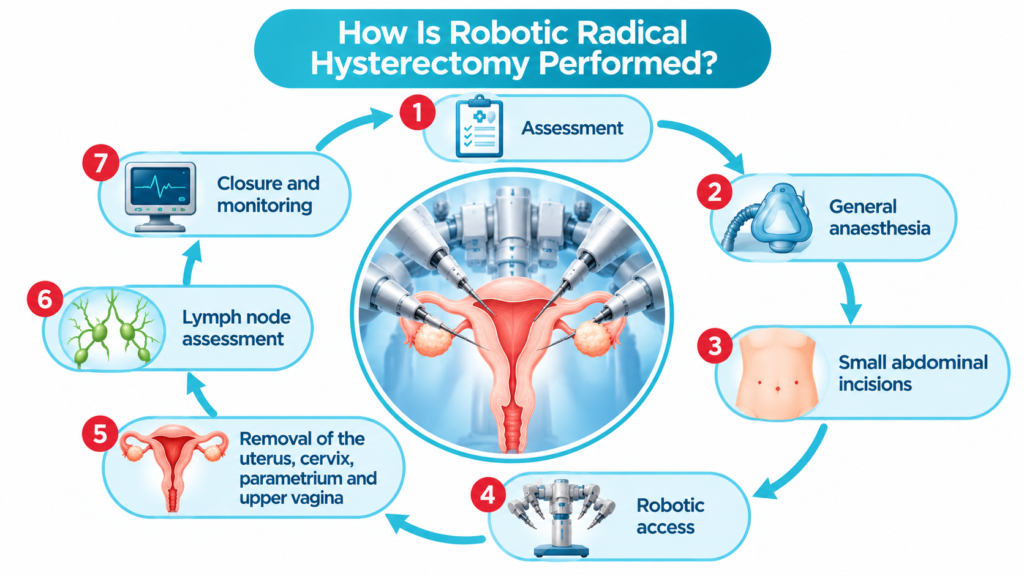
The operation is done under general anaesthesia through small abdominal incisions, and usually takes a few hours. Robotic instruments remove the uterus, cervix, surrounding tissue and upper vagina, and lymph nodes are assessed.
The steps are:
-
Assessment: pelvic MRI, other scans, pathology review and an anaesthetic check.
-
General anaesthesia: you are asleep throughout.
-
Small abdominal incisions: several keyhole cuts are made.
-
Robotic access: the camera and instruments are placed and docked to the robot.
-
Removal of the uterus, cervix, parametrium and upper vagina, with techniques that avoid handling the tumour.
-
Lymph node assessment: sentinel node mapping or pelvic node removal, depending on risk.
-
Closure and monitoring: incisions are closed, and you are monitored on the ward.
Potential Benefits of Robotic-Assisted Hysterectomy
Robotic-assisted hysterectomy usually brings smaller incisions, a 3D view, wristed instruments, less blood loss and a shorter hospital stay. These benefits do not mean better cancer control than open surgery.
The evidence supports the following:
-
Smaller incisions and less early pain than open surgery.
-
Enhanced 3D magnified visualisation and articulated instruments in the narrow pelvis.
-
Often a stay of a few days, compared with five to seven days after open radical hysterectomy.
-
Limitations: robotic surgery is not shown to be superior to open surgery, and in early cervical cancer minimally invasive surgery was linked to worse survival in a major trial.
-
For a wider comparison, read robotic vs open cancer surgery.
Robotic vs Open Radical Hysterectomy
For early-stage cervical cancer, open radical hysterectomy is currently the guideline-recommended standard.
A balanced comparison:
| Feature | Robotic radical hysterectomy | Open radical hysterectomy |
| Surgical approach | Robotic instruments controlled by the surgeon | Surgeon operates by hand |
| Incisions | Several small keyhole incisions | One larger abdominal incision |
| Visualisation | Magnified 3D view | Direct view |
| Instrument movement | Wristed, tremor-filtered | Hand-held |
| Blood loss | Usually lower | Usually higher |
| Recovery | Often shorter stay and faster return to activity | Often longer stay |
| Clinical suitability | Considered case by case; accepted for uterine cancer | Guideline standard for early-stage cervical cancer |
Recovery After Robotic Radical Hysterectomy
After minimally invasive radical hysterectomy, most women stay in hospital for a few days and return to normal activities within a few weeks, with full recovery taking up to about three months. Recovery varies with the extent of surgery and your health.
A typical pattern:
-
Immediate monitoring: early walking and measures to prevent blood clots.
-
Pain management: usually with tablets, and generally less than after open surgery.
-
Wound care: keep the small incisions clean and dry, and report fever or discharge.
-
Catheter and bladder: some women have temporary difficulty passing urine, and a catheter may be needed for two to three weeks.
-
Vaginal discharge: a reddish-brown discharge can last up to six weeks. Heavy or bright red bleeding needs urgent review.
-
Activity: avoid heavy lifting and intercourse until your surgeon clears you.
-
Follow-up: regular examinations after surgery, with further treatment advised if pathology shows higher-risk features.
Risks of Robotic Radical Hysterectomy
Like any major operation, radical hysterectomy carries risks. Most women recover without long-term problems, and your surgeon will explain your own risks.
The main risks are:
-
Bleeding, infection and blood clots.
-
Injury to nearby organs: the bladder, ureters, bowel or blood vessels, which is uncommon.
-
Bladder and bowel changes, including difficulty emptying the bladder.
-
Lymphoedema (leg swelling) where lymph nodes are removed.
-
Anaesthesia-related complications.
-
Menopausal effects if the ovaries are removed or affected.
-
Sexual health changes, including vaginal shortening or dryness.
Reach Out for Expert Care
About Dr. Surender Kumar Dabas
Dr. Surender Kumar Dabas is a cancer doctor in Delhi, associated with comprehensive cancer care at Manipal Hospitals Dwarka and Manipal Jivisha Cancer Centre, Sonipat.
-
Qualifications: MBBS, MS (General Surgery), DNB (Surgical Oncology).
-
Professional designation: Chairman, Manipal Comprehensive Cancer Centre and Onco Robotic Surgeries, North West Cluster.
-
Delhi Medical Council Registration Number: 34114.
Choosing a cancer surgery specialist in Dwarka: a consultation reviews your scans and pathology and the evidence for each surgical approach.
Know the warning signs first with gynaecological cancer warning signs.
Frequently Asked Questions
Q1. What is robotic radical hysterectomy?
Ans. It is a cancer operation that removes the uterus, cervix, surrounding tissue and upper vagina using surgeon-controlled robotic instruments through small incisions.
Q2. Is robotic hysterectomy used for cervical cancer?
It can be discussed in selected cases, but open radical hysterectomy is currently the guideline standard for early-stage cervical cancer because of the LACC trial.
Q3. Is robotic surgery suitable for uterine cancer?
Ans. Often yes. Robotic or other minimally invasive hysterectomy is an accepted approach for early uterine cancer, depending on your stage and health.
Q4. What is the difference between simple and radical hysterectomy?
Ans. Simple hysterectomy removes the uterus and cervix. Radical hysterectomy also removes the surrounding tissue and upper vagina, and is used for selected cervical cancers.
Q5. How long does recovery take after robotic hysterectomy?
Ans. Most women resume normal activities within a few weeks, and full recovery can take up to about three months.
Q6. What are the risks of robotic radical hysterectomy?
Ans. Risks include bleeding, infection, clots, bladder problems, lymphoedema, menopausal effects and sexual changes. Your surgeon will discuss your own risks.
Q7. Is robotic radical hysterectomy suitable for every cervical cancer patient?
Ans. No. Suitability depends on stage, tumour features and health, and advanced disease is usually treated with chemoradiation.
Q8. How do I find a robotic cancer surgeon in Delhi NCR?
Ans. Ask about training, experience with your specific cancer and the evidence for each approach. Dr Dabas is an experienced cancer surgeon in Delhi NCR who consults at Dwarka.
Medical disclaimer: This page is for general education and does not replace advice from your doctor. Treatment depends on your diagnosis and clinical assessment.
Medical Sources & References
-
ESGO, ESTRO, ESP: Guidelines for the management of patients with cervical cancer, Update 2023 (Int J Gynecol Cancer, 2023).
-
ESGO, ESTRO, ESP: Guidelines for the management of patients with endometrial carcinoma, Update 2025 (Lancet Oncology, 2025).
-
NCCN: Guidelines for Cervical Cancer, open abdominal approach recommendation (as summarised in a 2026 peer-reviewed review).
-
Ramirez PT et al.: LACC trial, minimally invasive vs abdominal radical hysterectomy (New England Journal of Medicine, 2018).
-
Plante M et al.: SHAPE trial, simple vs radical hysterectomy in low-risk cervical cancer (New England Journal of Medicine, 2024).
-
ROCC/GOG-3043: protocol of the robotic vs open trial (Int J Gynecol Cancer, 2025).
-
Cancer Research UK and Macmillan Cancer Support: patient information on surgery for cervical cancer.

Dr. Surender Dabas' Medical Content Team
Dr. Surender Dabas' Medical Content Team is committed to providing accurate, reliable, and easy-to-understand information on cancer care. Working closely with oncology experts, the team ensures that every article is medically reviewed, up-to-date, and designed to help patients and their families better understand cancer, treatment options, and recovery.

 WhatsApp