
Robotic Oophorectomy and Debulking Surgery in Delhi NCR
Ovarian surgery covers a wide range of operations. It can mean removing one ovary through small cuts, or a long operation for advanced cancer. If you have been told you need an ovarian tumour removed, it helps to know exactly which operation is being discussed and why.
This page explains robotic oophorectomy and debulking surgery in Delhi NCR: what each operation involves, when a robotic approach may suit you, and what recovery looks like. Robotic surgery works well for some patients, but not for all. Your scans, tumour type and cancer stage decide the route.
What Is Oophorectomy?
An oophorectomy is a surgery to remove one or both ovaries, and it may be done for a benign tumour, ovarian cancer, or to lower cancer risk in some high-risk women.
There are two main types:
-
Unilateral oophorectomy: one ovary is removed. The other ovary stays, so hormones and, in some women, fertility can continue.
-
Bilateral oophorectomy: both ovaries are removed. Before menopause, this causes surgical menopause.
A salpingo-oophorectomy removes the ovary together with its fallopian tube. A bilateral salpingo-oophorectomy removes both ovaries and both tubes. This is the usual operation when ovarian cancer or fallopian tube cancer is suspected, because many of these cancers begin in the tube.
These procedures may be recommended for:
-
A mass that looks suspicious on scans or blood tests
-
Confirmed early-stage ovarian cancer
-
Fallopian tube cancer
-
Women at very high genetic risk, such as BRCA mutation carriers
-
Benign tumours that cannot be treated by removing the cyst alone
Not every ovarian tumour needs both ovaries removed. Many benign ovarian tumours can be treated by removing only the cyst or the affected ovary. Age, hormone health and plans for children all shape the decision.
What Is Ovarian Cancer Debulking Surgery?
Debulking surgery, also called cytoreductive surgery, removes as much visible cancer as can be done safely, and it is mainly used for advanced ovarian cancer.
The aim is to leave no visible disease behind. The amount of cancer left after surgery is one of the strongest factors in how well treatment works.
What is removed depends on where the cancer has spread. It may include:
-
Both ovaries and fallopian tubes
-
The uterus
-
The omentum (a fatty apron in the abdomen)
-
Affected peritoneal tissue (the abdominal lining)
-
Lymph nodes
-
Portions of other involved organs, such as the bowel
Most patients do not need all of these. Surgery is planned around your disease, not a fixed list.
Primary debulking is surgery first, followed by chemotherapy. Interval debulking means chemotherapy first (usually three cycles), then surgery, then the remaining chemotherapy. Interval surgery is often chosen when the disease is widespread or when a patient is not yet fit for a major operation. ASCO guidance suggests interval surgery after four or fewer cycles when the cancer has responded or stayed stable.
Reach Out for Expert Care
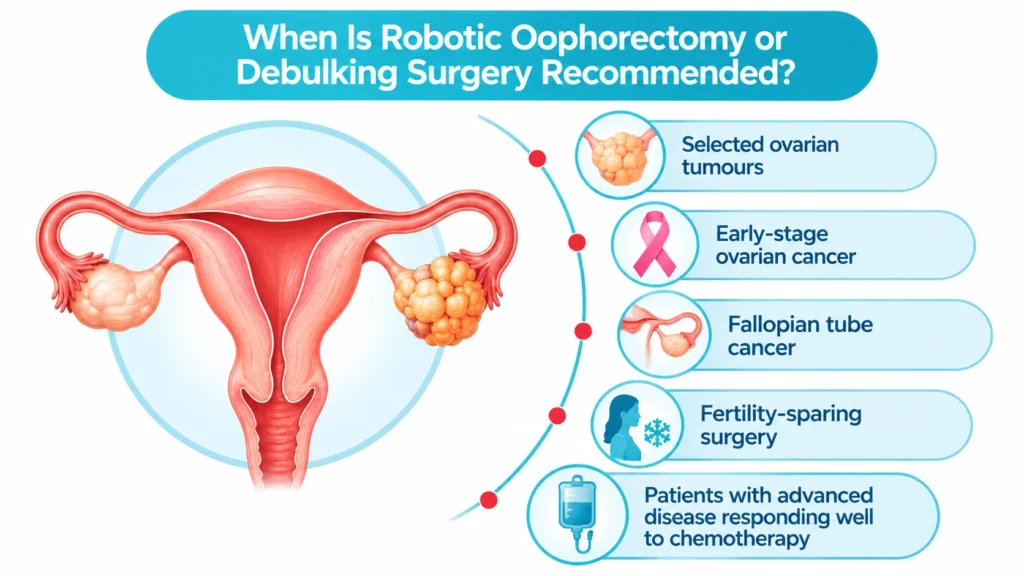
When Is Robotic Oophorectomy or Debulking Surgery Recommended?
Robotic oophorectomy may be recommended for selected ovarian tumours, early-stage ovarian or fallopian tube cancer, and some patients after chemotherapy, depending on tumour spread, stage and general fitness.
A robotic approach may be considered in these situations:
-
Selected ovarian tumours that can be removed safely through small cuts
-
Early-stage ovarian cancer that appears confined to the ovary
-
Fallopian tube cancer found at an early stage
-
Fertility-sparing surgery in carefully chosen young patients
-
Some patients with advanced disease who respond very well to chemotherapy
Your surgeon will also look at:
-
Stage and spread on CT, MRI or PET-CT
-
Tumour type (histology) and CA-125 levels
-
Your age, weight, fitness and previous surgeries
Here is the honest picture. When cancer is widespread, open surgery is often needed to reach all affected areas. Studies suggest minimally invasive interval debulking can achieve similar results in carefully selected patients, but trials are still ongoing. Surgeons often start with a keyhole look inside to judge whether the disease can be removed robotically. If it cannot, the operation continues as open surgery. This is a safety decision, not a failure of the robotic approach.
Dr. Surender Dabas uses the Da Vinci Xi system for selected ovarian cases, including early-stage and fertility-preserving surgery. You can read more on ovarian cancer treatment in Delhi NCR explains the wider treatment plan.
How Does Robotic Ovarian Surgery Work?
In robotic ovarian surgery, the surgeon controls the Da Vinci Xi system from a console and operates through a few small cuts, using a magnified 3D view.
The robot never acts on its own. Every movement follows the surgeon’s hands.
-
You are under general anaesthesia.
-
Small cuts are made in the abdomen.
-
The ovary and tube are removed, usually inside a protective bag.
-
The tissue goes to the lab, sometimes during the operation itself.
-
The plan may change if the findings are wider than scans suggested.
For suitable patients, the benefits can include smaller cuts, less blood loss, less pain and a quicker return to routine life. For a better comparison, read robotic vs laparoscopic vs open cancer surgery. You can also read understanding and treating ovarian cancer with robotic surgery.
HIPEC for Ovarian Cancer: Where It Fits
HIPEC (hyperthermic intraperitoneal chemotherapy) is heated chemotherapy circulated inside the abdomen at the end of surgery, and it is considered only for selected patients with advanced ovarian cancer.
After the visible cancer is removed, a warmed chemotherapy solution is circulated through the abdomen, usually for about 90 minutes. This puts the drug directly on the abdominal lining. Standard intravenous chemotherapy travels through the bloodstream instead.
What the evidence says:
-
The strongest data is for interval surgery after chemotherapy in stage III disease. The OVHIPEC-1 trial reported longer survival with HIPEC in this group.
-
NCCN and ASCO guidance say HIPEC can be considered in this setting. Guidelines are not uniform, and some bodies treat it as investigational.
-
Benefit in other settings, including stage IV disease, is less clear.
HIPEC is not suitable for every patient. It needs good general fitness and healthy kidney function, and it adds surgical risk. It is offered through a multidisciplinary team, case by case. Dr. Surender Dabas includes cytoreductive surgery with HIPEC among the options he discusses for selected ovarian cancer patients.
Risks, Recovery and Follow-Up
Recovery after ovarian cancer surgery depends on the operation: keyhole oophorectomy usually means a shorter stay, while debulking is a major operation with a longer recovery.
Possible risks include:
-
Bleeding or infection
-
Injury to the bowel, bladder or ureter
-
Blood clots
-
Anaesthetic risks
-
Surgical menopause if both ovaries are removed before natural menopause
-
Leg swelling if lymph nodes are removed
Your surgeon will explain the risks that apply to you before surgery.
After surgery:
-
The pathology report confirms the tumour type and stage.
-
Chemotherapy may follow, especially after debulking.
-
BRCA testing and maintenance therapy such as PARP inhibitors may be discussed.
-
Regular follow-up with scans and CA-125 checks helps catch any return early.
About Dr. Surender Kumar Dabas
Dr. Surender Kumar Dabas is a cancer doctor in Delhi, associated with comprehensive cancer care at Manipal Hospitals Dwarka and Manipal Jivisha Cancer Centre, Sonipat.
-
Qualifications: MBBS, MS (General Surgery), DNB (Surgical Oncology).
-
Professional designation: Chairman, Manipal Comprehensive Cancer Centre and Onco Robotic Surgeries, North West Cluster.
-
Delhi Medical Council Registration Number: 34114.
Explore his gynaecological cancer treatment services, or visit the homepage to learn more.
Frequently Asked Questions
Q1. Is robotic surgery suitable for ovarian cancer?
Ans. Robotic surgery can suit selected patients, mainly those with early-stage disease or a strong response to chemotherapy. Widespread cancer often needs open surgery. Your scans and a specialist review decide.
Q2. What is the difference between oophorectomy and debulking surgery?
Ans. Oophorectomy removes one or both ovaries. Debulking removes as much visible cancer as safely possible and may involve several organs.
Q3. Do both ovaries always need to be removed?
Ans. No. Benign tumours and some early cancers may allow one ovary, or part of it, to be preserved. Tumour type, stage, age and fertility wishes guide the decision.
Q4. Is debulking done before or after chemotherapy?
Ans. Either. Primary debulking comes first. Interval debulking follows a few cycles of chemotherapy, often when disease is extensive.
Q5. Can fertility be preserved?
Ans. In carefully selected young patients with early-stage disease, fertility-sparing surgery may be possible. This needs a detailed discussion before surgery.
Q6. Where can I consult a cancer surgeon in Dwarka?
Ans. Dr. Surender Dabas consults at Manipal Hospital, Sector 6, Dwarka. Call +91 8796173403 or book online. Bring your biopsy, scan and blood test reports.

Dr. Surender Dabas' Medical Content Team
Dr. Surender Dabas' Medical Content Team is committed to providing accurate, reliable, and easy-to-understand information on cancer care. Working closely with oncology experts, the team ensures that every article is medically reviewed, up-to-date, and designed to help patients and their families better understand cancer, treatment options, and recovery.
 WhatsApp